
Reviewed · BROOKLYN TOURS
Brooklyn’s Oasis: Audio Guide to Prospect Park
Prospect Park reveals its best side slowly: grand monuments give way to waterfalls, wooded paths, a lake, and broad lawns. This self-guided audio tour leads you from the John Fitzgerald Kennedy Memorial at Grand Army Plaza to the Picnic House, using stories and directions to connect the park’s designed beauty with its history.
I like the offline maps and audio, which let you keep your phone in your pocket instead of stopping at every turn. I also like the unusual mix of sights: one minute you are beside a Civil War arch, and soon you are listening to running water in the Ravine. The trade-off is simple: this is a fairly long walk, with some stairs, and you may need another half-mile to leave the park after the final stop.
Key points to know before you go
- A 90 to 105 minute route: The stated time covers walking between stops, not extra time for photos, rest, or exploring.
- Starts at Grand Army Plaza: Meet at the John Fitzgerald Kennedy Memorial, near the park’s main ceremonial entrance.
- Ends at the Picnic House: The final stop is at 95 Prospect Park West, near the Long Meadow.
- Waterfalls are part of the route: You pass Prospect Park Waterfall and Fallkill Falls, two of the walk’s most peaceful scenes.
- Use it offline: Download the audio, map, and location data before setting out.
- Bring practical gear: Comfortable shoes, water, snacks, and headphones will make the walk much easier.
A self-guided way into Prospect Park
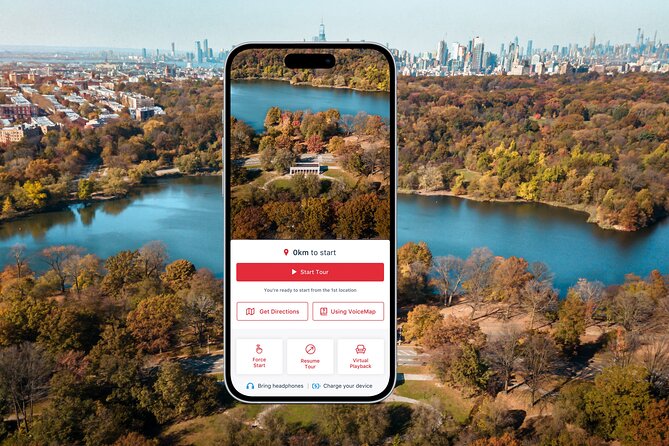
This is not a live tour with a guide walking beside you. It is a GPS-based audio walk from VoiceMap, designed to play as you move through Prospect Park. Once you arrive at the starting point, the route begins with directions and audio prompts that help you stay on course.
That format suits Prospect Park well. The park is large, and its paths can feel confusing if you are visiting for the first time. An audio route gives you structure without forcing you to keep pace with a group. You can pause for photographs, stop for a snack, or replay a section if you miss something.
The tour is offered in English. Your phone and headphones are not included, so bring both. The audio, map, and geodata can be used offline, a useful feature if you do not want to rely on a steady mobile connection.
The advertised walking time is about one hour and 30 minutes to one hour and 45 minutes. That is the time spent moving between the listed sights. If you linger at the waterfalls, sit by the lake, or enjoy the Long Meadow, plan on more time.
More Audio Tours in Brooklyn:
- Brooklyn Bridge Self-guided Bike Tour App – Audio + Written
★ 3.0 · 3 reviews - Skyline Night Bus Audio Narrated Tour Experience
★ 4.5 · 138 reviews
Beginning at the Kennedy Memorial and Grand Army Plaza
The starting point is the John Fitzgerald Kennedy Memorial at Grand Army Plaza. It is a quiet place to begin, especially because the surrounding area can feel busy and urban. The memorial provides a pause before you enter the wide green space of Prospect Park.
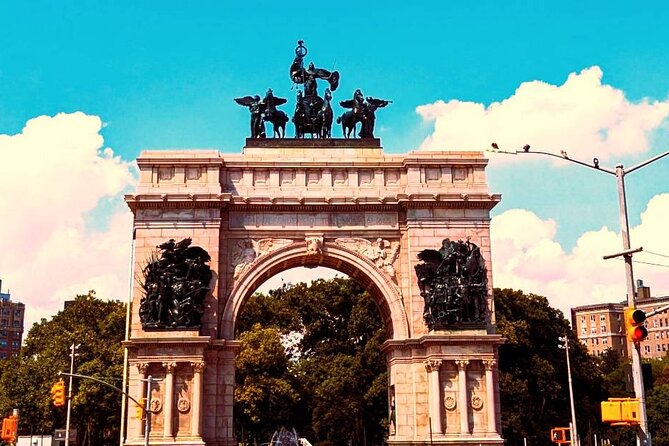
From there, the route takes you into Grand Army Plaza, the formal gateway designed by Frederick Law Olmsted and Calvert Vaux. The plaza is more than a traffic circle or meeting point. It sets the tone for the park with fountains, sculptures, and the large Soldiers’ and Sailors’ Memorial Arch.
The audio is most useful here because it gives the setting some context before you move into the park. You are not simply passing a grand arch on the way to a lawn. You are seeing how the park’s designers created a ceremonial entrance, linking Brooklyn’s city streets with a carefully planned natural setting.
Bailey Fountain and the Soldiers’ and Sailors’ Arch

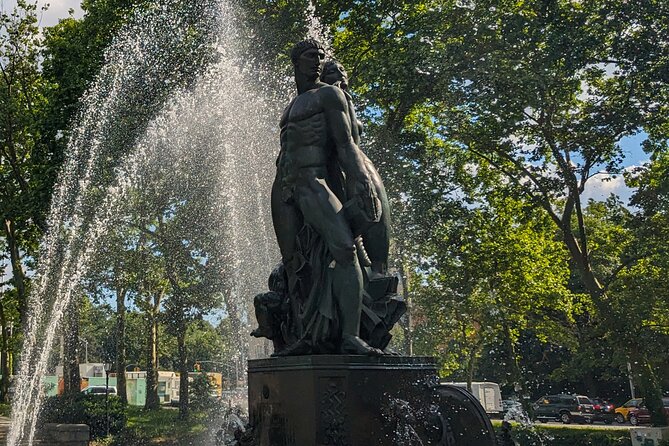
Bailey Fountain is one of the first major sights on the route. Its classical sculpture and water features give Grand Army Plaza a formal, decorative character. If the fountain is operating, it also adds movement and sound to what can otherwise feel like a very monumental space.
The Soldiers’ and Sailors’ Memorial Arch is the plaza’s dominant structure. Its scale is hard to miss, even in a modern city setting. The arch honors Abraham Lincoln and the Union soldiers of the Civil War, making it a place where civic memory and everyday Brooklyn life meet.
I like this opening because it gives you a clear contrast. You begin with stone, statues, and public ceremony, then move toward trees, water, and quieter paths. You will want to pause for photographs here, but remember that the clock does not stop unless you pause the audio.
The Ravine and Prospect Park Waterfall
The route then heads into one of Prospect Park’s most natural-feeling areas, the Ravine. Here, the park’s design becomes less obvious. Trees, slopes, water, and winding paths create a strong change from the formal geometry of Grand Army Plaza.
The Prospect Park Waterfall is a highlight. It is not untouched wilderness, but that is part of the point. The park’s water system was planned and restored as part of the larger design, allowing a waterfall to appear within Brooklyn’s city limits.
This stop gives the audio tour one of its best contrasts between nature and engineering. You can listen to the water while learning how the park’s waterways were shaped. The waterfall is also a good reason to slow down. A quick look will not do the setting justice, especially if you enjoy quiet photographs or the sound of moving water.
Some stairs are involved on the walk, so this section may require more care than a flat stroll around the plaza. The route information does not promise a fully step-free path. If stairs are difficult for you, consider that before booking.
More Self-Guided Tours in Brooklyn:
- Brooklyn Heights and DUMBO Self-Guided Walking Tour
★ 4.0 · 10 reviews - Brooklyn, NY Street Art Puzzle Quest: Self-Guided Tour
★ 4.0 · 5 reviews - Self-Guided Tour of the Museum at Eldridge Street
★ 4.3 · 13 reviews - Cathedral of St. John the Divine: Self-Guided Tour
★ 4.5 · 13 reviews
The Lullwater Boathouse and Fallkill Falls
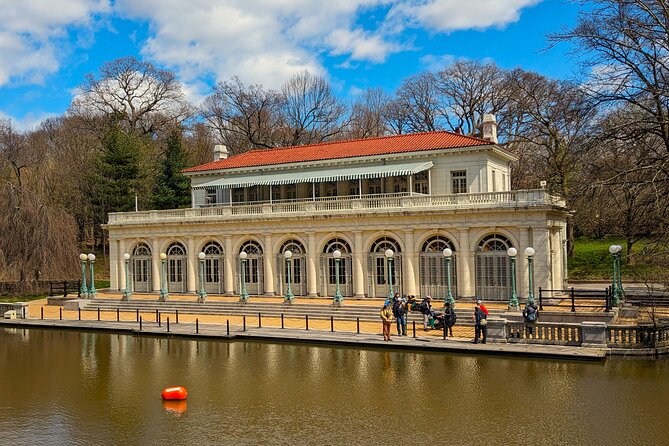
The Beaux Arts-style Boathouse overlooks the Lullwater and brings another change in mood. Its architecture is more elegant than rustic, but it fits the park’s carefully made scenery. The building and water together create one of the route’s strongest photo stops.
The Boathouse also helps show how Prospect Park is meant to be experienced. The park is not simply a patch of grass left open between neighborhoods. Buildings, water, paths, views, and monuments were arranged to create a series of scenes as you walk.
Fallkill Falls comes next, tucked into a more wooded part of the park. It is smaller and quieter than the main Prospect Park Waterfall, but that can make it more appealing. You get a calmer pause, with rushing water replacing the noise of the streets.
The two waterfalls are worth treating as separate stops. The first introduces the Ravine’s water system. Fallkill Falls feels more like a quiet discovery along the route. You may want to pause the tour at both places rather than letting the narration play while you hurry past.
The historic Pump House and Prospect Park’s water system
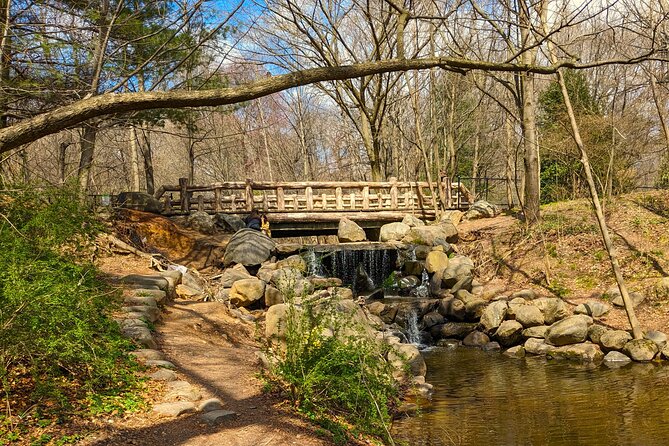
The small historic Pump House is easy to overlook if you do not know what you are seeing. Its original role was to supply water to the park’s waterways. Today it remains as a compact reminder that the park’s natural-looking scenes rely on early engineering.
This is one of the more useful stops for understanding Prospect Park. The waterfalls, lake, and streams are not random features. They are part of a managed system that helps create the park’s sense of changing scenery.
The Pump House may not have the visual drama of the arch or the falls, but it adds depth to the walk. I appreciate stops like this because they explain how a city park works, not just what it looks like. The audio is especially helpful here, since the building itself may not explain its former purpose at a glance.
Concert Grove Pavilion, music, and the lake
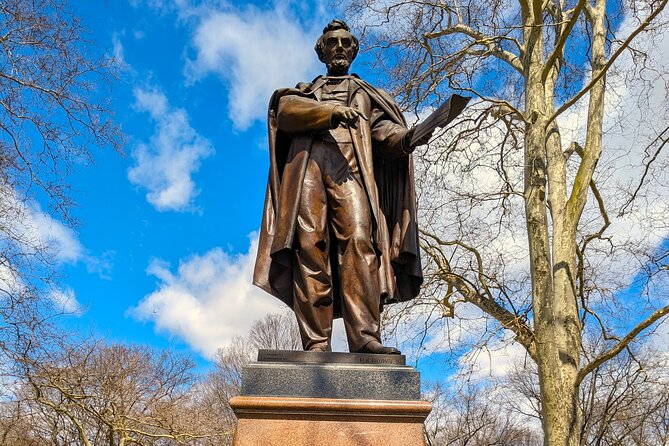
The Concert Grove Pavilion shifts the focus from engineering to culture. Its decorative design and peaceful setting make it a natural place to stop and listen. The audio experience connects the pavilion with classical composers such as Mozart and Beethoven, adding a musical layer to the route.
That feature helps the walk feel more varied. You are not hearing one long block of architectural facts. Instead, the route moves between public monuments, designed scenery, waterworks, and music.
The nearby island in Prospect Park Lake offers another change of pace. Surrounded by water, it gives the park a sense of separation from the streets around it. The esplanade, or broad walkway beside the lake, adds a formal edge to the scene and helps you appreciate the lake as one of Prospect Park’s main gathering areas.
This is a good part of the route for taking your time. The walking estimate does not include extended stops, and the lake area rewards a slower pace. If you are visiting on a tight schedule, keep moving. If you have room in your day, this is one of the places where a short audio walk can turn into a longer park visit.
Finishing at Long Meadow and the Picnic House

The final stop is the Picnic House, at the edge of Long Meadow. This is a fitting ending because the route finishes with open space after passing through water, woods, monuments, and formal buildings.
Long Meadow is Prospect Park’s largest green area, and the Picnic House gives you broad views across it. You can use the final stop as a place to sit, rest, or plan the next part of your day.
Pay attention to the stated ending point. The tour ends near 95 Prospect Park West, but you may still have about half a mile to walk before reaching an exit from the park. That matters if you have a dinner reservation, a train to catch, or someone in your group who is already tired.
What the $9.99 price gets you
At $9.99 per person, this is priced as a low-cost way to add structure and explanation to a visit that you could otherwise make for free. Prospect Park itself has no tour admission charge, so the value comes from the route planning, narration, directions, and offline access.
I see the strongest value in the lifetime use. You can use the tour before the booking date, after it, and again on a later visit. You can also play it virtually from anywhere, which makes it possible to listen like an audiobook even when you are not walking the route.
That flexibility makes the price easier to justify than a one-time audio download. You can split the walk into sections, replay parts, or use the route again with a friend. The catch is that the cost does not include a phone or headphones, and the experience depends on your own device working properly.
This is also not the right choice if you want a person to answer questions on the spot. You receive directions and recorded commentary, but no live guide. For independent visitors, that freedom is a benefit. For anyone who prefers group leadership and conversation, it may feel limited.
Timing, transport, and what to bring
The attraction is open every day, all day, for the stated operating period. You can therefore choose a time that fits your plans rather than joining a fixed departure. The starting point is near public transportation, and confirmation is provided when you book.
Give yourself more than the advertised 90 to 105 minutes. That estimate covers the walking time between attractions, not the time you will spend looking at the arch, photographing the fountain, resting by the lake, or exploring the park.
For a more comfortable walk, bring:
- Comfortable walking shoes
- Water
- Snacks
- Your smartphone
- Headphones
- A fully charged battery
The practical advice is not fancy, but it matters. One person who used the route found Apple Maps helpful alongside the audio for staying on track. That is a sensible backup, especially if you prefer to see your position on a second map.
Service animals are allowed, and most people can participate. Still, the stairs and distance deserve attention. The route is best for someone comfortable walking for more than 90 minutes and managing a self-guided route on a phone.
Who should book this Prospect Park walk
I would recommend it to a first-time Prospect Park visitor who wants more than a casual stroll but does not want to join a scheduled group. The route gives you a clear start and finish, explains the park’s major sights, and includes places you might miss if you simply followed the broadest paths.
It also suits history fans, architecture fans, photographers, and anyone who enjoys designed urban parks. The variety is the main strength: memorials, fountains, waterfalls, a historic water building, a Boathouse, music, a lake, and Long Meadow all appear within one walk.
Families may appreciate the freedom to pause, though the length and stairs could be tiring for young children. It can also work well for couples or solo visitors who prefer to move at their own pace.
I would be less likely to choose it if I wanted a short, easy walk with no navigation. I would also think twice if stairs are a serious problem or if I had a fixed appointment soon after the final stop.
Should you book Brooklyn’s Oasis?
Book this tour if you want a low-cost introduction to Prospect Park with clear directions, offline access, and a strong mix of nature and history. The waterfalls and lake give the route real visual appeal, while the audio helps explain why these scenes exist in the middle of Brooklyn.
Skip it if you want a live guide, a very short walk, or a completely flat route. For everyone else, $9.99 is a fair price for a reusable audio walk, especially if you bring water, wear good shoes, and allow extra time after reaching the Picnic House.
FAQ
How long does the Prospect Park audio tour take?
The walking portion takes approximately one hour and 30 minutes to one hour and 45 minutes. This does not include optional time spent stopping at attractions.
Where does the tour start?
It starts at the John Fitzgerald Kennedy Memorial at Grand Army Plaza in Brooklyn, New York.
Where does the tour end?
It ends near The Picnic House at 95 Prospect Park West, beside Long Meadow.
Is the tour guided by a person?
No. It is a self-guided GPS audio tour provided by VoiceMap, so you explore independently using your smartphone and headphones.
Is the audio tour available offline?
Yes. Offline access includes the audio, maps, and geodata.
What language is offered?
The tour is offered in English.
Are a smartphone and headphones included?
No. You need to bring your own smartphone and headphones.
Can I cancel for a full refund?
Yes. You can cancel at least 24 hours before the experience start time for a full refund. Cancellations or changes made within 24 hours are not refunded or accepted.
Recently added in Brooklyn
- Underground Brooklyn Walking Brewery Tour★ 4.5 · 31 reviews
- Top Shelf Distillery Tour★ 5.0 · 3 reviews
- Street Art Tour in New York City with Local Expert Guide★ 4.0 · 5 reviews
- Best of New York Food Tour: 5 dishes plus famous sightseeing!★ 5.0 · 61 reviews
- [Taro’s Origami Studio] 30-Minute Origami Experience – Brooklyn, New York★ 5.0 · 4 reviews
- Outdoor Escape Room in Brooklyn – Prospect Heights★ 5.0 · 5 reviews
- Vintage + Secondhand Shopping Walking Tour through Brooklyn, NYC★ 5.0 · 3 reviews
- Around the World in a Day: Brooklyn’s Q Train Tour★ 5.0 · 3 reviews
Brooklyn Tours, compared.

NYC Bus Tour of Brooklyn, Bronx, Queens: Art, Food & Sports
Read our review →
NYC Highlights Tour: Bronx, Brooklyn, Harlem, Queens & Coney
Read our review →
Contrasts Tour of Harlem, The Bronx, Queens & Brooklyn
Read our review →
Brooklyn Nets NBA Game Ticket at Barclays Center
Read our review →

Contrasts of Bronx, Queens, Brooklyn, & Manhattan Tour
Read our review →
Brooklyn Bridge & DUMBO Neighborhood Tour – from Manhattan to Brooklyn
Read our review →Browse the lists this tour appears in