
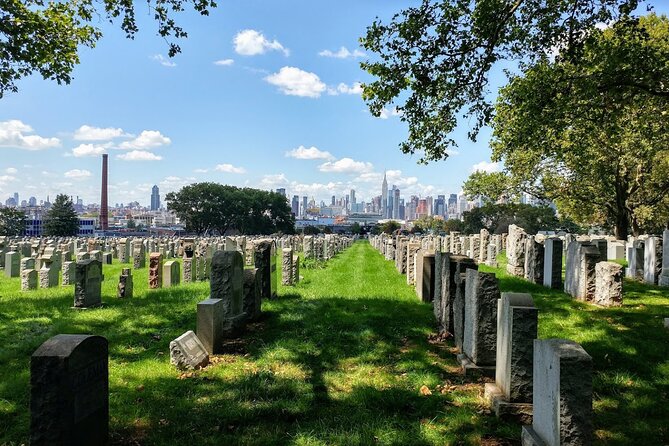
Reviewed · LOWER MANHATTAN TOURS
Twilight Tour: Death in New York (Lower Manhattan)
Lower Manhattan is full of stories about money, power, and revolution. This tour shifts the focus to burial grounds, epidemics, executions, saints, and funerals, turning familiar sights such as the Statue of Liberty viewpoint and Wall Street Bull into places with stranger, more human stories. Guide Krombie brings a lively style, with humor alongside solid historical detail.
I like the small group of no more than 15 people, which makes it easier to hear and ask questions. I also like the route itself: nine stops, short walks, and a clear south-to-north path through the Financial District. The main consideration is tone. This is not a ghost tour packed with paranormal tales. It is factual, social, and occasionally quirky, with death as a way to understand New York.
Key points to know before you go
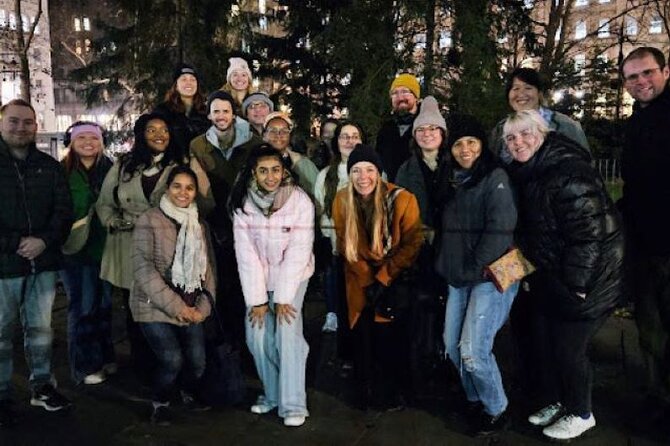
- A different view of famous sights: The Statue of Liberty viewpoint, Wall Street Bull, and City Hall Park all gain darker, less familiar stories.
- Krombie leads with wit: She is the author of Death in New York and combines humor with historical and cultural context.
- Nine stops in 1 hour and 45 minutes: The pace is steady, with roughly 10 to 15 minutes at each location.
- Small-group format: The maximum of 15 people gives the walk a more personal feel than a large city tour.
- More history than horror: Expect epidemics, cemeteries, saints, prisoners, and funerals, not a parade of ghosts.
- Good evening timing: The 7:00 pm start suits the subject and lets you see Lower Manhattan after the workday rush.
Why death makes Lower Manhattan more interesting
This tour works because death is not treated as a side topic. It becomes a doorway into four centuries of New York life. You hear how different communities buried their dead, how epidemics changed city rules, how religion shaped funerals, and how war, immigration, crime, and public health left marks on the streets.
That gives the walk more substance than a simple list of old buildings. At each stop, you connect a visible place with a question about how people lived and died there. A church becomes part of a story about burial rights. A public square raises questions about poverty, hospitals, and the treatment of bodies. A harbor view points toward Indigenous history, executions, and prisoners of war.
The tone matters. Krombie is described as approachable, funny, and just creepy enough to keep your imagination working. The humor helps with a subject that could otherwise feel heavy, but the stories remain rooted in historical, social, and cultural facts.
You should come expecting a walking history talk rather than a theatrical performance. If you want haunted houses, ghost sightings, or paranormal claims, this probably is not the right choice. If you enjoy the overlooked details behind famous places, it offers a fresh way to see Lower Manhattan.
More Lower Manhattan Tours:
- Guided Bike Tour of Lower Manhattan and Brooklyn Bridge
★ 4.5 · 113 reviews - Wall Street, Financial District Walking Tour Lower Manhattan, NYC
★ 5.0 · 108 reviews - Lower Manhattan Secrets And History Walking Tour
★ 5.0 · 96 reviews
Starting at the harbor with pirates and prisoners
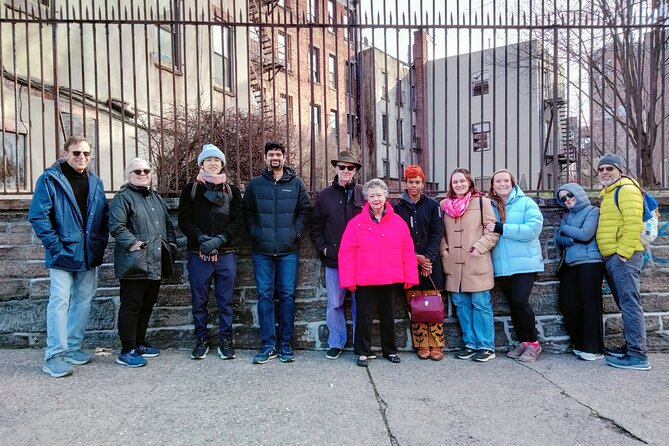
The meeting point is Whitehall Terminal on Whitehall Street, near the southern tip of Manhattan. The first stop offers views toward Staten Island, the Statue of Liberty, and Governors Island. These are familiar sights, but the subject matter quickly moves away from postcard New York.
Here you hear about Lenape history, ancient burial sites, the last recorded pirate execution in New York, and Civil War prisoners. That is a lot to cover in about 15 minutes, but the mix gives the opening a wide frame. New York’s story begins long before its modern streets and includes Indigenous communities, colonial-era crime, military conflict, and the dead left behind by the city’s growth.
The harbor setting also helps you think about New York as a place of arrival and departure. The water connected the city to trade, war, migration, imprisonment, and execution. You get a strong opening view, though the exposed waterfront can bring street noise and the usual city distractions.
Admission to this and every listed stop is included in the walking experience, so you are paying for interpretation rather than entry tickets.
The Seton Shrine and the Catholic way of death
At the Seton Shrine, the subject turns toward Catholic ideas about death and sainthood. You hear about the canonization process and the Catholic approach to dying, burial, and remembrance.
This is a useful change of pace after the opening stories about pirates and prisoners. It shows that death is not only a matter of public tragedy or crime. It is also shaped by faith, ritual, and ideas about holiness.
The stop lasts about 10 minutes. You should not expect a long interior visit or a full religious tour. The value comes from the guide connecting the shrine to a wider conversation about how New Yorkers have understood death through religion.
Battery Park City and the Titanic connection
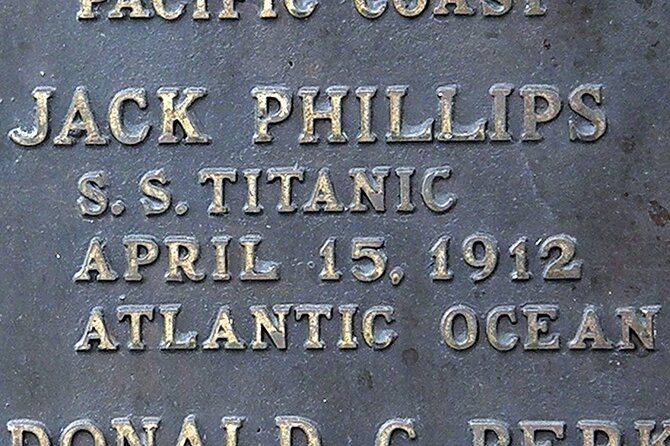
Battery Park City brings the group to a cenotaph, a memorial that marks the dead without containing their remains. The story here connects the monument with the Titanic.
This is one of the tour’s more thoughtful ideas. A cemetery holds bodies, while a cenotaph helps people remember those who died elsewhere or whose remains were never recovered. That distinction gives you a clearer sense of why memorials matter.
The stop is scheduled for around 10 minutes, enough time to explain the memorial and its Titanic connection without turning the walk into a long lecture. It is also a good example of the tour’s method: take a small physical object and use it to open a larger story about grief, public memory, and disaster.
More New York City Tours:
- NYC: SUMMIT One Vanderbilt Tickets
★ 4.7 · 51,195 reviews - NYC: Empire State Building Tickets – Observatory & Museum
★ 4.7 · 25,757 reviews - New York City: Statue of Liberty & Ellis Island with Ferry
★ 4.6 · 18,683 reviews - New York City: American Museum of Natural History Ticket
★ 4.5 · 15,447 reviews
Indigenous history at the National Museum of the American Indian
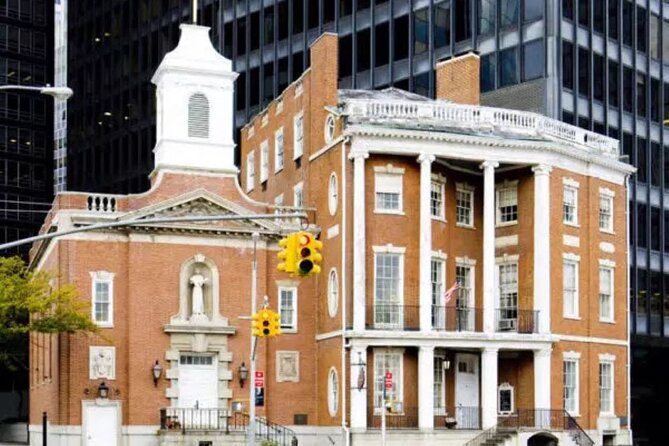
The National Museum of the American Indian provides another look at Indigenous history. The discussion also covers funerary objects and the difficult story behind museum acquisitions.
This is a serious and important part of the route. Museums do not simply collect objects in a neutral way. Sacred or funerary items can raise questions about ownership, respect, removal, and the right way to display material connected with the dead.
The stop is outside the museum as part of the walking route, and the stated time is about 10 minutes. If you want to explore the museum itself, that would require a separate visit. On this tour, the focus is on the historical issue and its connection to New York’s Indigenous past.
The Wall Street Bull and New Amsterdam’s first cemetery
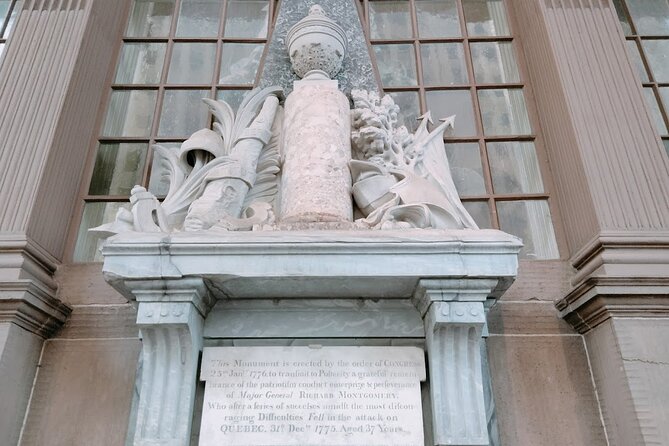
The Charging Bull is usually a photo stop linked with finance and ambition. Here, the story goes in a very different direction. You learn about New Amsterdam burial history and the site of the city’s first cemetery.
That contrast is one of the tour’s cleverest features. The bull represents modern Wall Street, while the ground beneath the surrounding streets connects to the earliest European settlement and its burial practices. A place that many people visit for a quick photograph becomes a reminder that the Financial District was once a much smaller colonial town.
The stop lasts about 10 minutes. Expect crowds or street activity around the bull, along with the possibility of vehicle noise. The route keeps moving, so you get the story without standing in one place for too long.
Trinity Church and the problems caused by epidemics

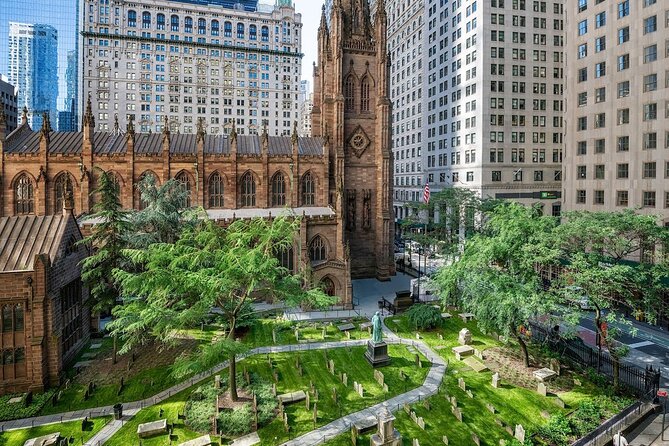
Trinity Church brings the group into the history of disease, burial restrictions, and potter’s fields. The key point is practical and grim: when epidemics killed large numbers of people, the city had to control where and how bodies were buried.
You hear about burial prohibitions and the use of potter’s fields for people who could not be buried in established churchyards or family plots. These stories show how public health rules, social class, and religious practice collided in a growing city.
This stop adds useful context to the grand church and its surroundings. Instead of seeing Trinity Church only as an old religious landmark, you consider the pressure placed on churches and city officials when death came faster than ordinary burial customs could handle.
The timing is again about 10 minutes. The subject can be unsettling, but the tour’s factual tone keeps it from becoming lurid.
St. Paul’s Chapel and the Irish presence in the graveyard
At St. Paul’s Chapel, the focus turns to the Irish representation in the graveyard. This part of the walk shows how burial grounds can reveal the communities that shaped New York.
A graveyard is not only a collection of names. It can show migration, religion, class, and the way an immigrant community established a place in the city. The Irish connection gives you a more personal sense of the people behind Lower Manhattan’s early population.
The stop is short, about 10 minutes, but that suits the route. You are not asked to spend half an hour at every church. Instead, the guide offers one focused theme and then moves you to the next location.
St. Peter’s Church and the old Catholic ban
St. Peter’s Church brings the Catholic story back into view, this time with the former New York ban on Catholicism and the city’s first Catholic burial ground.
This is a valuable reminder that religious freedom was not always a settled part of New York life. The story links official restrictions with the very practical question of where Catholics could bury their dead.
For you, the stop adds political context to the religious history introduced at the Seton Shrine. It also shows how burial space can become a marker of legal status. If a community could not worship openly or maintain its own institutions, burial grounds became part of that struggle.
Again, plan on about 10 minutes. The walk does not offer a long interior church visit, so treat this as an outdoor history tour with landmarks as its setting.
City Hall Park, almshouses, hospitals, and Lincoln’s funeral
The final stop is City Hall Park, where the tour brings several major themes together. This was the site of New York’s first almshouse, and the discussion moves into Bellevue Hospital, embalming, President Lincoln’s funeral, and the excavation of the dead.
The almshouse story points to poverty and the city’s responsibility for people without money or family support. Bellevue connects the subject to medical care and the changing treatment of illness and death. Embalming and Lincoln’s funeral add a national dimension, showing how public mourning and funeral practice changed in the nineteenth century.
The most striking theme here may be excavation. As New York expanded, construction repeatedly disturbed earlier burial places. That reality raises practical questions about who was buried where, how bodies were identified, and what happened when the city built over its own past.
The walk ends at City Hall Park near Broadway and Chambers Street. Since this is not the same place where you started, you should plan your onward route before booking dinner or another activity. The finish is well placed for continuing through Lower Manhattan, but the tour itself does not include transport back to Whitehall Terminal.
What the $36 price gets you
At $36 per person, the value depends on how much you enjoy guided interpretation. There are no separate admission tickets at the listed stops, so the cost goes toward the guide, research, route planning, and the small-group format.
I think the price is reasonable if you want a focused history experience rather than another standard sightseeing circuit. You are getting about 1 hour and 45 minutes, nine locations, and a subject that is hard to find in ordinary New York tours. The group limit of 15 also matters. A smaller group makes it easier to hear the guide and ask about a detail that catches your attention.
The value is weaker if you mainly want dramatic production, ghost stories, or access inside major attractions. This is a walking talk, not an attraction ticket or staged nighttime show. You are paying for unusual context.
The route also avoids the cost of a museum visit, though you will pass the National Museum of the American Indian rather than receive a full museum tour. That keeps the price contained but limits the experience to the outdoor route and the guide’s presentation.
Practical details for the evening walk
The stated start time is 7:00 pm at Whitehall Terminal, with an approximate duration of 1 hour and 45 minutes. The route ends at City Hall Park, so allow a little extra time afterward if you have a reservation elsewhere.
Wear comfortable shoes. The route covers nine stops, and even short walks add up across Lower Manhattan. A moderate level of fitness is recommended. The tour is near public transportation, and service animals are allowed.
The walk is offered in English and uses a mobile ticket. Confirmation is provided when you book. Street traffic can be noisy at times, especially around the Financial District, but that is part of the setting and not something the guide can fully control.
You can cancel for a full refund up to 24 hours before the start time. Changes or cancellations inside that window are not accepted for a refund.
Who will enjoy this tour most
I would choose this for someone who has already seen the major Lower Manhattan sights and wants a new way to understand them. It also suits New York residents who often pass these places without stopping. The route is short enough for an evening plan, but the subject matter gives you plenty to think about afterward.
History fans will find the mix especially rewarding. The tour touches Lenape history, colonial New Amsterdam, Catholic life, Irish communities, epidemics, military prisoners, piracy, public hospitals, and presidential mourning.
It can also work well for solo participants. The small group and conversational guide style make it easier to join in without feeling lost in a crowd. Krombie’s humor is useful here, since the subject is serious but the presentation is not gloomy from start to finish.
I would skip it if you want a family-friendly ghost show built around scares, or if you dislike walking between outdoor landmarks. The tour discusses death directly, including burial, disease, execution, and the handling of bodies. That is the point, but it may not suit every mood.
Should you book Death in New York?
Book it if you want unusual, place-based history and prefer real stories to ghost-tour theatrics. The route is manageable, the group is limited to 15, and the $36 cost is fair for a well-researched evening walk through nine important Lower Manhattan sites.
The best reason to go is the way familiar places change meaning. A harbor view becomes a lesson in Indigenous history and executions. The Wall Street Bull points toward an old cemetery. City Hall Park opens into stories about almshouses, hospitals, embalming, and public mourning.
Just bring the right expectations. This is quirky macabre history, not a paranormal investigation. If that sounds like your kind of evening, it offers one of the more distinctive ways to see the southern end of Manhattan.
FAQ
Where does the tour begin?
The tour begins at Whitehall Terminal, 4 Whitehall Street, New York, NY 10004.
Where does the tour end?
The tour ends at City Hall Park, Broadway and Chambers Street, New York, NY 10007.
What time does the tour start?
The stated start time is 7:00 pm.
How long does the tour last?
The tour lasts approximately 1 hour and 45 minutes.
How large is the group?
The maximum group size is 15 people.
Is the tour refundable if I cancel?
You can cancel at least 24 hours before the start time for a full refund. Cancellations or changes made less than 24 hours before the start time are not accepted for a refund.
Recently added in New York City
- NYC: Midtown Hands-On Bagel Baking Class★ 5.0 · 12 reviews
- Personalize Sightseeing Tour★ 5.0 · 92 reviews
- Central Park Pedicab Guided Tour★ 5.0 · 17 reviews
- Photographer, Professional Photo shoot – New York★ 5.0 · 16 reviews
- Central Park Pedicab Tour with Guide★ 5.0 · 63 reviews
- Official Central Park Pedicab Ride ( UP TO 3 PERSONS )★ 5.0 · 4 reviews
- JFK or LGA package only (Round trip transfer plus VIP Contrasts)★ 5.0 · 3 reviews
- Official Central Park Pedicab Tours★ 5.0 · 35 reviews
Lower Manhattan Tours, compared.

Guided Bike Tour of Lower Manhattan and Brooklyn Bridge
Read our review →
Wall Street, Financial District Walking Tour Lower Manhattan, NYC
Read our review →
Lower Manhattan Secrets And History Walking Tour
Read our review →
Lower Manhattan Tour: The Remnants of Dutch New Amsterdam!
Read our review →

Lower Manhattan Tour: Wall Street & 9/11 Memorial
Read our review →
Lower Manhattan: From Financial Power to Enduring Hope
Read our review →
Wall Street, Financial District Walking Tour Lower Manhattan
Read our review →Browse the lists this tour appears in