
Reviewed · NYC WALKING TOURS
Midtown Manhattan Art and Architecture Walking Tour
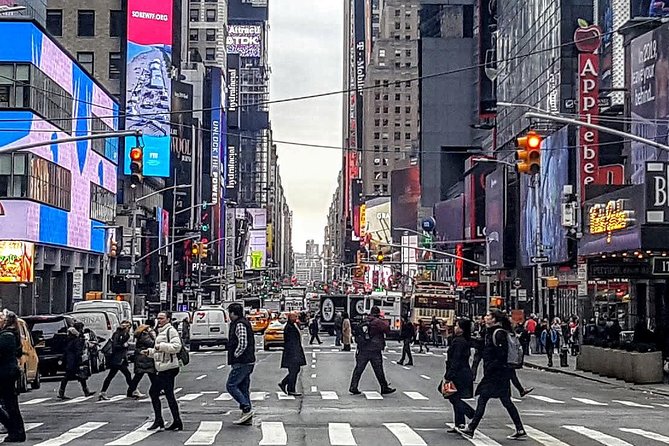
Midtown Manhattan looks familiar until you start noticing what hides behind its towers. This small-group walking tour connects Times Square, Rockefeller Center, St. Patrick’s Cathedral, Park Avenue, and Billionaire’s Row through art, zoning, and the odd bits of private space open to the public.
I like the maximum group size of five, which lets guide Rob Amell adjust the pace and answer real questions. I also like the mix of famous sights and lesser-known works by Roy Lichtenstein, Frank Stella, Sol LeWitt, and others. The possible drawback is pace: two to three hours covers a lot of ground, so this is better for curious walkers than for anyone wanting a slow, photo-heavy stroll.
Key points at a glance
- Start at Times Square’s quieter western edge: Begin at 810 8th Avenue, near Hell’s Kitchen, before following Midtown’s growth north and east.
- See art in places you might otherwise pass by: Corporate lobbies, subway entrances, plazas, arcades, and privately owned public spaces all become part of the tour.
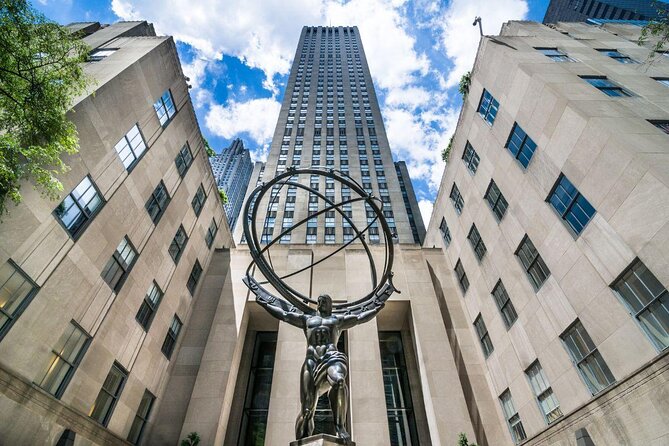
- Follow the change from Art Deco to modern towers: Rockefeller Center provides the clearest lesson in how New York’s architectural styles shifted during one major project.
- Keep the group very small: With no more than five people, Rob can adjust the route, answer questions, and sometimes add a stop.
- Finish beneath Billionaire’s Row: The walk ends near East 57th Street and Fifth Avenue, with views of the slim residential towers reshaping Midtown.
Why Midtown works so well as an outdoor classroom
The clever idea behind this tour is that you do not study New York art and architecture in isolation. You see buildings where they were built, then connect them to zoning rules, corporate money, cultural history, and changes in the city’s street plan.
The route begins near the boundary of Hell’s Kitchen and Times Square. That starting point helps explain New York’s historic move uptown and introduces the basic sequence of architectural styles, from Beaux Arts decoration to the stripped-down Modern period.
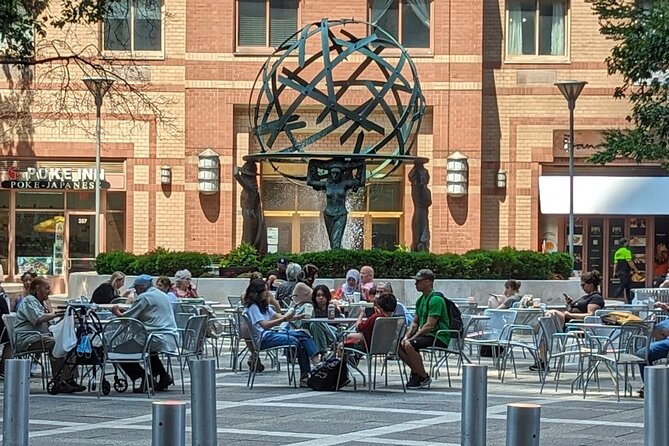
You also learn about POPS, or privately owned public spaces. These are plazas, arcades, lobbies, and passageways maintained by private companies but made available for public use. They are easy to miss when you are walking alone. With a guide pointing them out, Midtown’s private buildings begin to feel like part of a larger public network.
The tour is listed at $59 per person. That is fair value if you care about the stories behind the buildings and want access to places you might not identify on your own. It is less compelling if you only want a quick circuit of exterior landmarks, since many of Midtown’s famous sights can be seen without paying for a guide.
More Midtown Manhattan Tours:
- NYC: Circle Line “The Beast” Midtown/Downtown Speedboat Ride
★ 4.6 · 4,259 reviews - The Escape Game NYC: 60-Minute Adventures in Midtown Manhattan
★ 5.0 · 280 reviews - Midtown Manhattan Guided Tour w/ SUMMIT One Vanderbilt Entry
★ 4.2 · 188 reviews
From 8th Avenue to Worldwide Plaza

At the first stop on Eighth Avenue, you get a short grounding in architecture and city planning. Works by Sidney Simon and Matt Mullican add a visual starting point, while the surrounding POPS provides a practical example of how private development can create public gathering space.
The stop at 350 West 50th Street brings zoning into sharper focus. The subway station below Worldwide Plaza includes incised granite by Matt Mullican, linking public transit, corporate development, and public art in a compact space.
This part of the route is not about checking off a famous sight. It is about learning how to read the city. You begin to ask why a building sits where it does, why an open space exists, and how rules about height and setbacks shape the streets around you.
Near citizenM New York Times Square Hotel, the tour takes in Julian Opie’s large wall art. You also scan the skyline for the Hearst Tower and the New York Times Building. The stops are brief, so you should be ready to keep moving and listen while standing outdoors.
Times Square, the Brill Building, and American culture
From the north side of Times Square, you look toward the Allianz Building and Warner Music Group. Here, zoning rules produced a view with a more Tokyo-like feel, an unusual contrast to the older signs and theaters associated with Times Square.
The Brill Building offers a different kind of history lesson. The building becomes a doorway into Midtown’s role in American music, theater, radio, television, publishing, newspapers, advertising, and automobiles. The point is not simply that Midtown had offices and theaters. It helped create and distribute much of the culture consumed across the country.
That wider view makes Times Square easier to understand. You are not just looking at bright signs and crowds. You are looking at a district shaped by entertainment businesses, media companies, commercial pressure, and changing technology.
At BNP Paribas, the route passes the Winter Garden, the Taft Hotel, and the building linked to the song MONY MONY. The tour then enters the lobby of 787 Seventh Avenue, shifting from popular culture to corporate culture.
The lobby includes Roy Lichtenstein’s Mural with Blue Brushstroke, painted in place before the building opened. In the POPS behind the building, you may see works by Sol LeWitt and Barry Flanagan. This is one of the tour’s strongest ideas: corporate spaces are not empty corridors between elevators. They can hold serious works of art, often in places you would not think to enter.
The mid-block paths most people miss
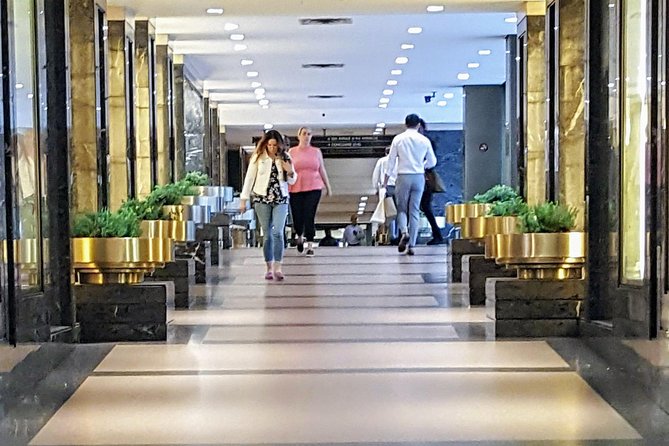
The walk along 6 1/2 Avenue is short but useful. This six-block mid-block arcade exists because of a zoning quirk. It does not quite connect Times Square with Central Park, yet it gives you a different way to understand how Midtown’s interior spaces work.
At the UBS Art Gallery, the lobby is divided between permanent and temporary displays. Works associated with Frank Stella and Sarah Morris are part of the art program. Access to corporate interiors can vary, so the exact indoor experience may depend on building conditions and timing, but the tour is designed around these public-access spaces.
The Time and Life Building at 1271 Avenue of the Americas offers a strong example of Modern design. Stainless steel panels and a terrazzo floor set a restrained tone, while Fritz Glarner’s wall art brings the geometry of Mondrian’s school into the building.
Nearby, monumental works by Hiroshi Senju and Kan Yasuda continue the scale of the discussion. Outside, La Gran Manzana adds a public artwork with a more playful presence.
You should expect some stops to last only a few minutes. That is useful for covering a large part of Midtown, but it also means you may not have time to linger at every artwork. Bring your own interest and questions. The value comes from the connections Rob makes between one stop and the next.
More NYC Skyline and Architecture Tours:
- Statue of Liberty & NYC Skyline Cruise – Freedom Liberty Tour
★ 4.0 · 1,499 reviews - Manhattan Architecture Yacht Cruise
★ 5.0 · 1,395 reviews - NYC: Dyker Heights Christmas Lights & Skyline View Bus Tour
★ 4.7 · 1,192 reviews - From Manhattan: Dyker Heights Lights & Skyline Tour
★ 4.6 · 1,005 reviews
Rockefeller Center, from Art Deco to modernism
The section around Sixth Avenue and Rockefeller Center is the tour’s architectural centerpiece. At 1221 Sixth Avenue, the McGraw Hill building includes a work by Mark Bradford. Outside, you face what the guide calls Skyscraper Alley, a useful point for discussing how zoning can produce rows of tall buildings that feel less human than the best parts of Midtown.
Across the street, Rockefeller Center offers a sharp contrast. Its Art Deco design became a model for the style, but the project also shows a shift toward Modern architecture as construction continued after the death of architect Raymond Hood.
The tour uses Rockefeller Center to explain how an enormous private development could also function as a civic project. That combination is one reason this complex remains so interesting. It was built through money, ambition, politics, and family decisions, yet it created plazas, public art, gathering places, and a visual identity known around the world.
At Radio City Music Hall, you learn the origin of the name Roxy, now attached to many venues. The nearby corporate lobby brings in the Rockefeller family, the politics of the period, and the role of radio executive David Sarnoff.
The rink area adds another layer of stories. You hear about property owners who resisted the project, the conflict involving Diego Rivera and the Rockefellers, the creation of the ice-skating rink, and a remarkable reversal of fortune connected with Rockefeller Center.
Inside the International Building, the lobby is treated as a work of art. Light and Movement by Michio Lhaza forms the central wall display, while Lee Lawrie’s Atlas faces St. Patrick’s Cathedral outside. These details reward close attention. You could walk through Rockefeller Center several times and still miss much of this visual program.
St. Patrick’s Cathedral and the changing Fifth Avenue
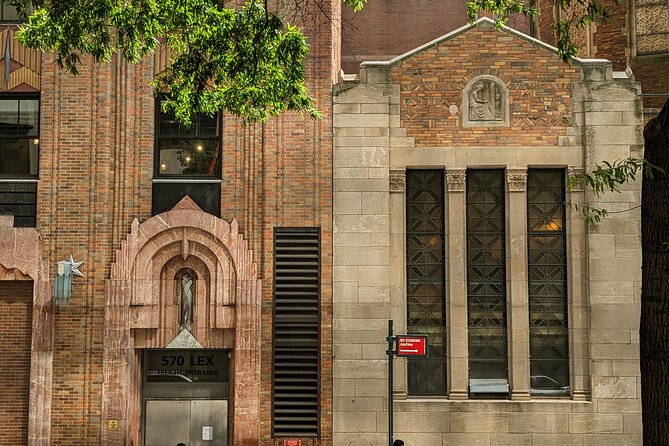
At St. Patrick’s Cathedral, the focus shifts from one building to the broader story of Fifth Avenue. The cathedral is an obvious landmark, but the tour uses it as a marker in the changing social and architectural character of the avenue.
As you continue toward Park Avenue, you pass sharp contrasts between Modern buildings and Beaux Arts survivors. The Villard Houses, now associated with the Palace Hotel, offer a reminder that older residential buildings once held their ground amid intense commercial development.
This is one of the tour’s most useful habits: it does not treat old and new buildings as separate attractions. You see them side by side and consider why some were preserved, why others were replaced, and how real estate pressure changed the avenue.
Park Avenue’s train tracks, towers, and corporate power
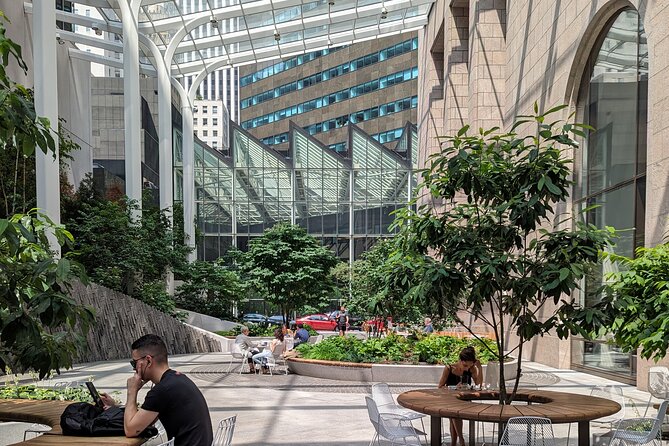
Park Avenue becomes a compact lesson in urban change. The guide explains its move from open train tracks to high-end residential development and then to a corridor dominated by corporate buildings.
Buildings discussed along the way include the Health and Racquet Club from 1918, St. Bartholomew’s Church from 1919, the New York Central Building from 1929, the Waldorf Astoria from 1931, and the GE Building from 1931.
The route then brings in later Modern landmarks, including Lever House from 1952, the Seagram Building from 1958, and the MetLife Building from 1963. You do not simply see a row of tall buildings. You get a timeline showing how materials, business needs, zoning rules, and design ideals changed over several decades.
For anyone interested in planning, architecture, or the mechanics of Manhattan development, this may be the most useful portion of the walk. One participant with a planning and architecture background found the route especially rewarding, but you do not need technical training to follow the basic ideas.
Madison Avenue, sculpture, and the final skyline
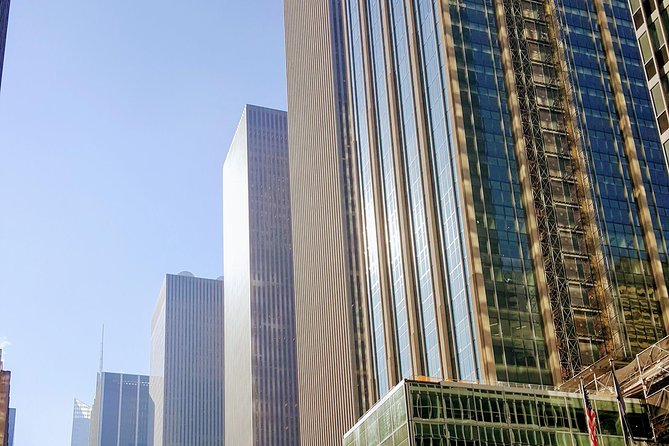
At Christie’s Sculpture Garden, 535 Madison Avenue brings together architecture, zoning, and works by three French artists from different periods. Fernand Léger, Jean Dubuffet, and François-Xavier Lalanne help show how public and corporate settings can frame sculpture in very different ways.
Papillon Bistro & Bar provides a quick look at a successful holdout, one property that resisted the intense pressure to conform to surrounding development. The restaurant is also a practical option if you want lunch or dinner after the walk.
The tour may continue to a Philip Johnson building with a redesigned outdoor POPS. If time allows, you may see Solid Sky by Alicia Kwade inside. The IBM Building’s POPS is another notable public space, with Applefest pieces included in its art program.
The final approach leads to 244 Fifth Avenue and 57th Street. The walk ends east of Tiffany’s, beneath the towers often called Billionaire’s Row. These slender residential skyscrapers represent the newest major change in Midtown’s skyline, defined by extraordinary height and prices.
That ending gives the tour a useful present-day conclusion. You have moved from early architectural styles and mid-century corporate ambition to the latest version of Manhattan development. The skyline is still being rewritten.
What the small group changes
The maximum of five people matters here. Much of the tour takes place in busy public areas, lobbies, passageways, and sidewalks. A large group would make it harder to hear, gather around artwork, or move through narrow spaces.
Rob Amell is the guide most often associated with this experience. He brings a prepared presentation but can also respond to questions and adjust the route. On one occasion, a holiday closure blocked several underground private spaces, so he offered a variation rather than simply ending the tour. That flexibility is valuable on a route that depends partly on access to corporate interiors.
The walk is also paced with practical needs in mind. Restroom breaks can be arranged, and the route is not presented as a race. Still, you should have a moderate level of physical fitness, wear comfortable shoes, and dress for the weather. The tour operates in all weather conditions, though poor weather can lead to cancellation and a choice of another date or a full refund.
Morning and afternoon departures give you some control over your day. The mobile ticket is convenient, and the route runs near public transportation. Service animals are allowed.
Who should book this Midtown walk?
I would choose this tour if you have already seen Times Square and Rockefeller Center but want to understand them better. It is especially well suited to people interested in architecture, city planning, public art, corporate history, and the less obvious spaces between major attractions.
It also works well for repeat visitors. The route includes passageways, lobbies, POPS, and artworks that are easy to miss even after several trips to New York. Rob’s explanations give familiar buildings a new purpose.
I would not choose it if your priority is a relaxed walk with long stops for photographs. The itinerary is dense, the stops are often short, and indoor access can change. The tour is educational and energetic rather than leisurely.
Book at least a day ahead if your schedule is fixed. The experience is often reserved about 30 days in advance, and the very small group size limits capacity. You can cancel for a full refund up to 24 hours before the start time. The tour also requires a minimum number of participants, so a cancellation for that reason comes with another date, another experience, or a full refund.
Should you book it?
Book this Midtown Manhattan Art and Architecture Walking Tour if you want New York explained through its buildings, not just photographed from the sidewalk. The strongest parts are the tiny public spaces, the corporate art, the Rockefeller Center stories, and the clear account of how zoning shaped the city.
At $59, the price makes sense for a small group, a specialist guide, and access to details you are unlikely to notice alone. Choose it for ideas and context. Skip it only if you want a short list of famous sights with plenty of free time at each one.
FAQ
How long does the Midtown Manhattan Art and Architecture Walking Tour last?
The tour lasts approximately two to three hours.
Where does the tour begin and end?
It begins at 810 8th Avenue in New York City. It ends near East 57th Street and Fifth Avenue, east of Tiffany’s, with views of Billionaire’s Row.
How many people can join the tour?
The tour has a maximum of five travelers, creating an ultra-intimate small-group experience.
What language is the tour offered in?
The tour is offered in English.
Is the tour available in the morning and afternoon?
Yes. You can choose from morning or afternoon departures.
What happens if the tour is canceled because of bad weather?
You will be offered a different date or a full refund. The tour operates in all weather conditions, so dress appropriately.
More NYC Walking Tours
- SoHo, Little Italy, and Chinatown Walking Tour in New York
★ 5.0 · 3,153 reviews - Secrets of Grand Central Station Walking Tour New York City
★ 5.0 · 1,796 reviews - Greenwich Village Walking and Food Tasting Tour
★ 5.0 · 1,572 reviews - Artistic, Alternative Greenwich Village Walking Tour
★ 5.0 · 971 reviews
Recently added in New York City
- NYC: Midtown Hands-On Bagel Baking Class★ 5.0 · 12 reviews
- Personalize Sightseeing Tour★ 5.0 · 92 reviews
- Central Park Pedicab Tour with Guide★ 5.0 · 63 reviews
- Central Park Pedicab Guided Tour★ 5.0 · 17 reviews
- Photographer, Professional Photo shoot – New York★ 5.0 · 16 reviews
- Official Central Park Pedicab Tours★ 5.0 · 35 reviews
- Official Central Park Pedicab Ride ( UP TO 3 PERSONS )★ 5.0 · 4 reviews
- JFK or LGA package only (Round trip transfer plus VIP Contrasts)★ 5.0 · 3 reviews
NYC Walking Tours, compared.
SoHo, Little Italy, and Chinatown Walking Tour in New York
Read our review →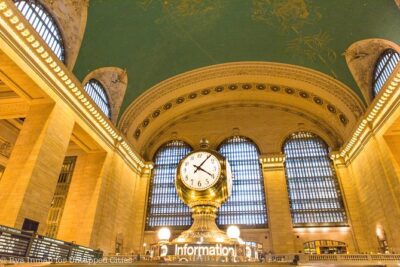
Secrets of Grand Central Station Walking Tour New York City
Read our review →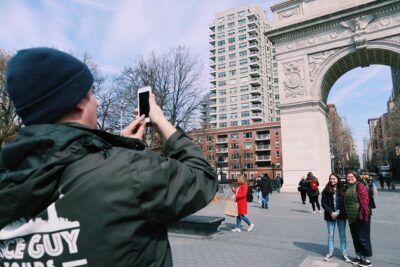
Greenwich Village Walking and Food Tasting Tour
Read our review →
Artistic, Alternative Greenwich Village Walking Tour
Read our review →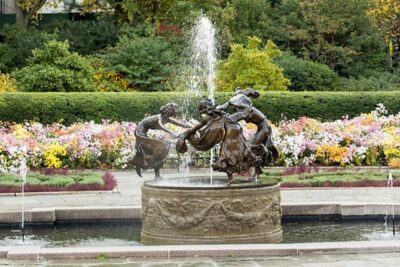


NYC Greenwich Village Italian Food Guided Walking Tour
Read our review →Browse the lists this tour appears in