
Reviewed · WALL STREET AND FINANCIAL DISTRICT TOURS
Wall Street to Chinatown: Dumplings & Taro bites walking tour
The clever part of this three-hour New York walk is the contrast. You begin among marble banks, stock-market symbols, and early American landmarks, then finish with chewy taro treats and hot dumplings in Chinatown. It gives you a clear story of Lower Manhattan instead of a string of unrelated photo stops.
I like the small group of no more than 10 and the way food is built into the route rather than tacked on at the end. I also like the human touch reported from guides Robert and Muhammad, who bring humor and personal attention to the walk. The main consideration is the price: at $119, this is worthwhile if you want a guide and food tastings, but less so if you only need a quick look at the sights.
Key points at a glance
- Start with Wall Street symbols: See the Charging Bull, the New York Stock Exchange, Federal Hall, and the Federal Reserve Bank.
- Connect finance with American history: Trinity Church, Alexander Hamilton’s grave, Federal Hall, and St. Paul’s Chapel add context beyond the famous street name.
- Pass through the Brooklyn Bridge area: The route includes this landmark and its East River views, though the exact amount of bridge walking is not specified.
- Explore old Five Points: Columbus Park and Chinatown reveal the immigrant neighborhoods that helped shape Lower Manhattan.
- Try two Chinatown specialties: Taro munchkins from Alimama Tea and dumplings from Tasty Dumpling are included.
- Keep the pace personal: The tour is offered in English, uses a mobile ticket, and has several time slots.
From the Charging Bull to the heart of Wall Street
The meeting point is at Bowling Green, a sensible place to begin because it puts you near the oldest part of the Financial District. The first stop is the Charging Bull, Arturo Di Modica’s enormous bronze sculpture created in 1989.
The bull is about 11 feet tall and weighs more than 7,000 pounds. Its horns, nose, and tail have become famous luck-rubbing targets. Your guide can do more here than point out the statue. The bull reflects the aggressive confidence of the stock market, but its location in Bowling Green also gives you a useful sense of how compact Lower Manhattan is.
You get about 15 minutes. That should be enough for photographs and a quick explanation, but not necessarily enough for a long wait if the statue is crowded. If you want a picture without other people around it, arrive a little early and use your pre-tour time wisely.
From there, the route turns toward Trinity Church Wall Street. The church was completed in 1846 and is one of the city’s oldest landmarks. Its Gothic Revival design, tall spire, stained glass, and cemetery provide a sharp change from the financial buildings nearby.
The churchyard is especially useful for understanding how old New York is. Alexander Hamilton is buried there, along with other important figures from the early United States. You get a quiet pause in a part of town usually associated with money, traffic, and office towers.
More Wall Street and Financial District Tours:
- NYC City Tour: Statue of Liberty, 9/11 Memorial, Wall Street
★ 4.5 · 2,059 reviews - Wall Street Insider Tour with a Finance Professional
★ 4.5 · 660 reviews - Wall Street Insider Tour with a Finance Professional
★ 4.5 · 571 reviews
Six short stops that explain American power
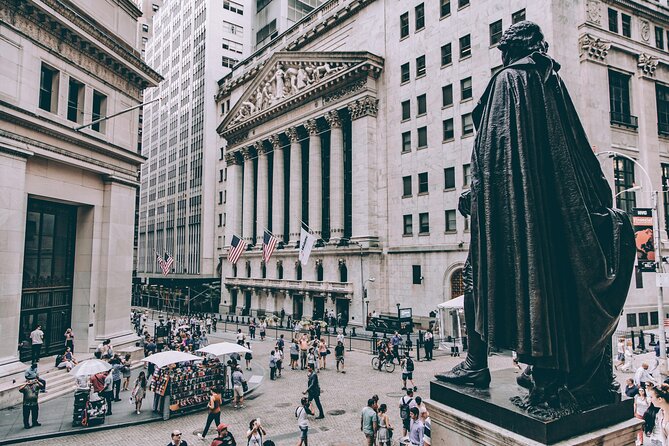
The next stop is the New York Stock Exchange at 11 Wall Street. The grand Corinthian columns and the pediment sculpture titled Integrity Protecting the Works of Man make the building easy to recognize, even if you know little about finance.
The tour does not promise entry into the exchange, so think of this as an exterior history stop. A guide is useful here because the building can otherwise seem like an impressive facade with no clear explanation. You can learn why this address matters and how Wall Street became a worldwide symbol of money and markets.
Federal Hall, at 26 Wall Street, gives the walk a stronger connection to the birth of the United States. George Washington took the oath of office as the first president here in 1789. The current neoclassical building has towering columns and a statue of Washington outside.
The listed time is about 15 minutes, so expect an overview rather than a full museum visit. If you have already visited Federal Hall or plan to return later, the guide’s explanation can help you decide if you need more time inside.
At the Federal Reserve Bank of New York on Liberty Street, the architecture becomes fortress-like. The building was inspired by Italian Renaissance palaces and is associated with one of the largest gold reserves in the world.
This stop gives you a chance to connect the street’s grand buildings with the less visible machinery of the American economy. The tour does not include a Federal Reserve interior visit or a gold-vault tour, so keep your expectations focused on the exterior and the guide’s explanation.
St. Paul’s Chapel is one of the most meaningful stops. Completed in 1766, it is the oldest surviving church building in New York City. Its Georgian design is modest compared with some grander churches, but its story is powerful.
The chapel became a place of help and rest after the September 11 attacks. It survived the collapse of the nearby Twin Towers and became known as the Little Chapel That Stood. The visit adds a human side to the Financial District, which can otherwise feel dominated by institutions and architecture.
Each of these six stops receives roughly 15 minutes. That format works well if you like a moving overview and clear commentary. It will feel rushed if you want to enter every building, read every exhibit, or linger for photographs. The value is in the guide connecting the stops.
The Brooklyn Bridge connection
The route also includes the Brooklyn Bridge, one of New York’s most recognizable pieces of engineering. Completed in 1883, it was the first steel-wire suspension bridge in the world and links Manhattan with Brooklyn across the East River.
The bridge is known for its Gothic-style towers, sweeping cables, and broad city views. It is also a busy public route used by walkers and cyclists. The supplied plan does not specify how much of the bridge you cross, so do not book this experience expecting a full bridge walk unless the operator confirms that detail.
Even a short look at the bridge can help you understand how Lower Manhattan connects to the neighborhoods across the river. The setting also gives you a useful change of scale after the close streets of Wall Street. Bring comfortable shoes and keep your phone ready, since the bridge is one of the better photo points on the route.
Columbus Park and the Five Points story
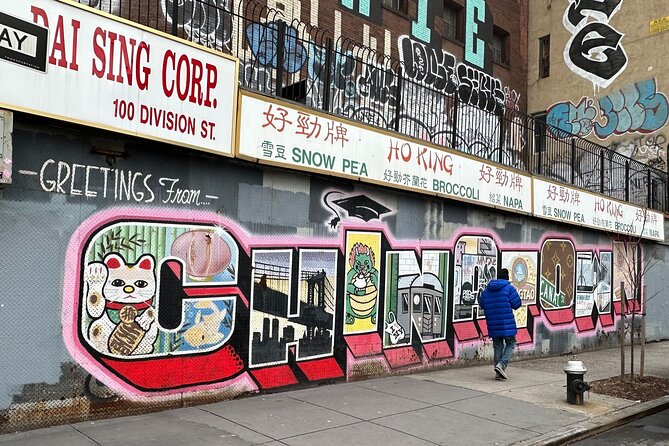
The move into Chinatown begins around Columbus Park. This open space occupies part of the former Five Points neighborhood, an area once known for severe overcrowding, poverty, tenement housing, and street violence.
Five Points formed around a five-way intersection involving what are now Worth, Baxter, and Mosco Streets. Its past is often reduced to crime stories, but the more important point is the mix of immigrant communities that lived there. Those communities helped shape New York’s identity and the city’s long connection to migration.
Columbus Park today is a community gathering place. You may see people playing mahjong, practicing tai chi, or listening to live music. Basketball courts and trees offer a break from the hard surfaces of the Financial District.
You get about 15 minutes in the park, followed by about 30 minutes focused on Chinatown and the old Five Points area. That is enough time to get your bearings and hear the main story, but not enough to explore every side street. I like this section because it prevents the food portion from feeling disconnected from the neighborhood.
More Little Italy and Chinatown Tours:
- SoHo, Little Italy, and Chinatown Walking Tour in New York
★ 5.0 · 3,153 reviews - NYC: Chinatown & Little Italy Food Tour with 7 Flavorful Tastings
★ 5.0 · 2,733 reviews - Original NYC Guided Food Tour of Chinatown and Little Italy
★ 5.0 · 2,194 reviews - NYC: Chinatown and Little Italy Food Tour
★ 4.7 · 703 reviews
Chinatown through two small but memorable bites
The first tasting is at Alimama Tea, where you try taro munchkins. These are small mochi donuts with a crisp outer layer, a chewy center, and taro custard inside. Taro has an earthy, lightly sweet flavor, so this is a good introduction if you have never tried it.
The contrast in texture is the main appeal. You get crispness outside, chewiness in the dough, and a creamy center. The portion is described as a tasting, not a full dessert stop, so think of it as one carefully chosen bite rather than a replacement for lunch.
Next comes Tasty Dumpling. The dumplings have golden, crisp bottoms, soft wrappers, and a juicy filling. Options include classic pork and chive as well as a vegetable choice. Soy sauce or vinegar can sharpen the flavor.
This is where the tour’s food focus feels most practical. Chinatown has many places to eat, but a first-time visitor may not know where to begin or what to order. A guide removes that guesswork and gives you two approachable stops. Still, two tastings are not a full meal, so plan another lunch or dinner afterward.
The food is also a useful way to connect the neighborhood’s past with its present. You are not only looking at Chinatown from the sidewalk. You are trying flavors associated with modern Asian food businesses while learning how Lower Manhattan developed over time.
What $119 buys you
The price is $119 per person. That is not cheap for a three-hour walk, especially because the major landmarks are viewed from outside and the two food portions are tastings.
The price makes more sense if you value the guide’s route planning, historical explanations, small-group setting, and the convenience of having food selected for you. A group capped at 10 is much easier to manage than a large coach tour. You can usually hear the guide better, ask questions, and move through crowded streets with less delay.
The strongest value comes from the combination of subjects. You are not paying for a standard Wall Street walk alone, and you are not paying for a Chinatown snack crawl alone. The route connects finance, government, religious history, immigration, architecture, and food in one outing.
I would compare it with the cost of booking separate sightseeing and food tours. If you would otherwise pay for two short activities, this combined format can be reasonable. If you are comfortable researching Wall Street yourself and already know where you want to eat, the price may feel high.
The tour is often reserved about 88 days ahead on average. That suggests you should not wait until the last minute if your schedule is fixed, particularly if you want a specific time slot. Several time choices are offered, which helps you fit it around a museum visit or another Lower Manhattan plan.
Pace, group size, and practical planning
The experience lasts about three hours and is offered in English. A mobile ticket keeps the meeting process simple, and the start at Bowling Green is near public transportation. The tour ends in Chinatown, not back at the starting point, which is useful if you plan to eat in the neighborhood afterward.
Wear shoes suited to city walking. The route includes streets, parks, landmark areas, and the Brooklyn Bridge area, so the surface and crowd levels can change. The short stops mean you will spend much of the time moving or listening while standing.
Most people can participate, and service animals are allowed. The maximum group size is 10, a real advantage on narrow sidewalks and around busy sights. Still, the schedule does not promise extended indoor visits, seating at every stop, or a long bridge crossing.
The two guides named in the available feedback are Robert and Muhammad. Their approach is described as friendly, organized, informative, and lighthearted. That matters on a walking tour because a dry guide can make even important places feel flat. With either guide, expect the experience to depend partly on the day’s group and the exact route conditions.
You can cancel for a full refund up to 24 hours before the start time. Changes or cancellations inside that window are not refunded, so leave some room in your plans if your New York schedule is uncertain.
Who should book this Lower Manhattan walk
I would recommend this tour to a first-time New York visitor who wants an introduction to Lower Manhattan without spending a full day inside museums. It suits you especially well if you like history in small pieces, prefer food tastings to a formal meal, and want a guide to handle navigation.
It is also a good choice for people who have seen the major Manhattan sights but have not connected them into one story. The transition from Federal Hall to Chinatown is the point. You see how political power, finance, religion, immigration, and local food all occupy the same small part of the city.
Families and mixed-age groups may appreciate the variety. Children may respond more to the bull, bridge, park, and dumplings than to monetary policy. Adults can focus on Washington, Hamilton, the Federal Reserve, and Five Points.
I would hesitate to book it if you want a slow architectural tour, a full meal, or guaranteed entry to the NYSE, Federal Reserve, Federal Hall, or St. Paul’s Chapel. The schedule is designed for movement and overview. It gives you a strong first look, not an exhaustive visit to each landmark.
Should you book it?
Book this walk if you want one compact route that links Wall Street and Chinatown and you value a local guide more than a low price. The small group, two food tastings, and mix of major landmarks make it more personal than simply following a map between the bull and Chinatown.
Skip it if you already know Lower Manhattan well, need substantial food, or want a full Brooklyn Bridge crossing. For the right visitor, the best feature is not any single stop. It is the change from grand civic buildings to a taro-filled pastry and a crisp-bottomed dumpling, all within one afternoon of New York streets.
FAQ
How long does the Wall Street to Chinatown tour last?
The tour lasts approximately three hours.
Where does the tour begin?
It begins at Bowling Green in Lower Manhattan, at the provided meeting point near the Charging Bull.
Where does the tour end?
The tour ends in Chinatown, New York City.
What food is included?
The tour includes a tasting of taro munchkins at Alimama Tea and dumplings at Tasty Dumpling.
How many people can join the tour?
The group has a maximum of 10 travelers.
Is the tour offered in English?
Yes. The experience is offered in English.
Can I cancel for a full refund?
Yes, if you cancel at least 24 hours before the scheduled start time. Cancellations within 24 hours are not refunded.
More NYC Walking Tours
- Secrets of Grand Central Station Walking Tour New York City
★ 5.0 · 1,796 reviews - Greenwich Village Walking and Food Tasting Tour
★ 5.0 · 1,572 reviews - Artistic, Alternative Greenwich Village Walking Tour
★ 5.0 · 971 reviews - Central Park Guided Walking Tour
★ 5.0 · 774 reviews
Recently added in New York City
- Squid Game: The Experience New York City★ 4.0 · 9 reviews
- New York: Private Professional Photoshoot at Central Park★ 5.0 · 9 reviews
- Professional Photoshoot at Brooklyn Bridge in New York★ 5.0 · 5 reviews
- New York Queens Indoor Skydiving Experience With 2 Flights★ 5.0 · 4 reviews
- New York 4-Day Tour to Niagara Falls & Washington★ 4.0 · 13 reviews
- New York: Times Square Professional Photoshoot★ 4.5 · 17 reviews
- New York Princess Cruises★ 3.0 · 4 reviews
- New York Midtown Scavenger Hunt Adventure★ 3.5 · 9 reviews
Wall Street and Financial District Tours, compared.

NYC City Tour: Statue of Liberty, 9/11 Memorial, Wall Street
Read our review →
Wall Street Insider Tour with a Finance Professional
Read our review →Wall Street Insider Tour with a Finance Professional
Read our review →
Manhattan Group Tour Including Wall Street and 911 Memorial
Read our review →
Wall Street Tour with 9/11 Memorial and Statue Ferry
Read our review →
Wall Street and Financial District Walking Tour
Read our review →
Wall Street, Financial District Walking Tour Lower Manhattan, NYC
Read our review →Browse the lists this tour appears in