
Reviewed · MUSEUMS
American Museum of Natural History Admission Ticket
The American Museum of Natural History packs dinosaurs, giant mammals, ancient cultures, space science, and a 94-foot blue whale into four enormous levels on Manhattan’s Upper West Side. It is the sort of museum where you can plan a three-hour visit and still leave with entire wings unseen. The dinosaur halls and mammal displays are the big crowd-pleasers, while the Rose Center for Earth and Space gives the visit a wider reach.
I like the freedom of general admission: you can move at your own speed and stay as long as you wish. I also like the family value, since children and adults can follow very different interests under one roof. The main drawback is the voucher process. Some visitors have had to exchange a booking voucher for the actual museum ticket, creating a long wait, so direct booking with the museum may be worth comparing before you pay.
Key points to know before you go

- Four levels and more than 40 galleries: Plan at least three hours, and longer if you want a relaxed visit.
- Classic highlights: Look for the Tyrannosaurus rex skeleton, Asian elephants, and the huge blue whale model.
- General admission included: Access covers permanent exhibition halls, the Rose Center, and the Richard Gilder Center.
- Extra-cost areas excluded: The planetarium space show, giant-screen film, butterfly vivarium, Invisible Worlds, and other ticketed exhibitions require separate admission.
- Bring a map: The museum is large and can be confusing, especially when several halls are closed or under repair.
- Mind the ticket exchange: A voucher may not be your final entry ticket, and the exchange line can be much slower than buying directly at the museum.
Why this museum deserves a half-day
You are not simply visiting one exhibition here. You are moving through a large collection of permanent halls that cover the natural world, the universe, human cultures, and life on Earth. The museum’s stated story reaches back 13 billion years, so the scale is intentionally huge.
That size is both the attraction and the challenge. You can spend an hour with dinosaurs, turn a corner into ancient Egypt or Mexico, then cross the building to see the blue whale. If you follow every label, stop for photographs, and let children set the pace, three to four hours will feel like a starting point rather than a finish line.
I would treat this as a half-day visit, even though the admission allows you to stay for the full day. Families often need breaks, and adults who want to read more than a few labels will appreciate the extra time. If you have only two hours, choose your priority halls before entering.
More Historical Tours in New York City:
- New York City: American Museum of Natural History Ticket
★ 4.5 · 15,447 reviews - NYC: Starship Landmark 90 Minute Sightseeing Cruise
★ 4.6 · 3,666 reviews - Starship Landmark 90 Minute Sightseeing Cruise
★ 4.5 · 2,073 reviews
Getting into the museum without losing your morning
The admission is listed at $37 per person, which is a reasonable price if you stay several hours and use the permanent galleries. It is less attractive if you rush through in an hour, especially since some of the museum’s most popular features require separate tickets.
The biggest practical warning is the voucher. This experience may give you a voucher that must be converted into a museum admission ticket. That extra step has caused long waits, including reports of more than an hour and, in one case, a line extending around the block. Other visitors have found entry quick, so conditions clearly vary, but you should not assume that a mobile voucher equals immediate entry.
I would compare the price and entry terms with the museum’s own website before booking. If your schedule is tight, or you have small children, the fastest admission method matters more than a modest difference in price. A delayed entry can eat up a large part of a planned museum visit.
Once inside, pick up a paper map at an entrance, information desk, or membership desk. The building can be hard to navigate, and some halls may be closed or partly closed for repairs. Mark your top choices before you start walking. Otherwise, it is easy to spend your best energy wandering and then discover that you missed the rooms you most wanted to see.
The dinosaur halls: the strongest first stop for many families
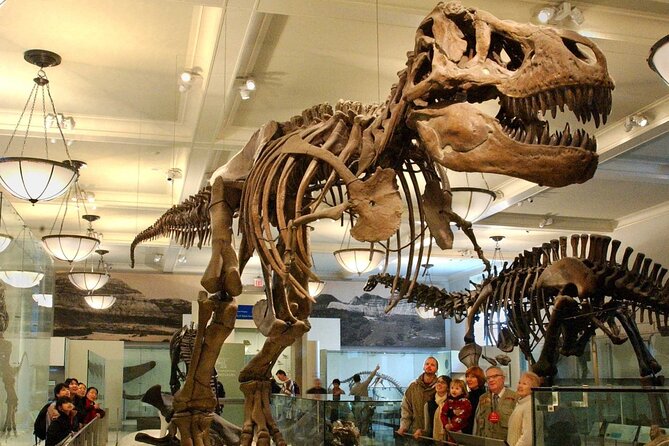
The Hall of Saurischian Dinosaurs is one of the museum’s major draws. The Tyrannosaurus rex skeleton gives children a clear focal point, while the broader dinosaur displays help place individual animals within the story of prehistoric life.
This is a good first stop if dinosaurs are your main reason for coming. The halls can become crowded, and young children tend to have plenty of energy at the beginning of a visit. Starting here also gives you a simple route into other natural history rooms.
The strength of the dinosaur section is its visual impact. You do not need to read every panel to understand why the displays work. The skeletons create an immediate sense of scale, and families can return to them later if attention fades in the more text-heavy rooms.
Keep your expectations practical. A large museum does not mean every dinosaur or fossil display will be open on every day. A few rooms may be under refurbishment, so use the map and current signs to adjust your route.
Mammals, oceans, and the museum’s most memorable animals

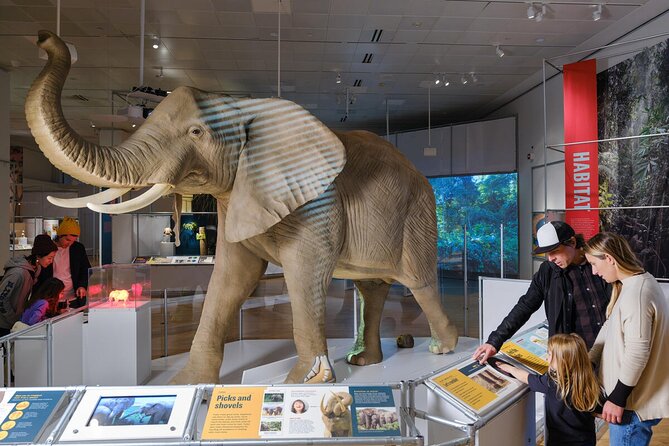
The Akeley Hall of African Mammals is home to the Asian elephants, another major highlight. The animal displays give you a chance to compare size, form, and habitat across species. This section tends to work well for mixed-age groups because the animals are easy to recognize, while the surrounding information adds more for adults who want context.
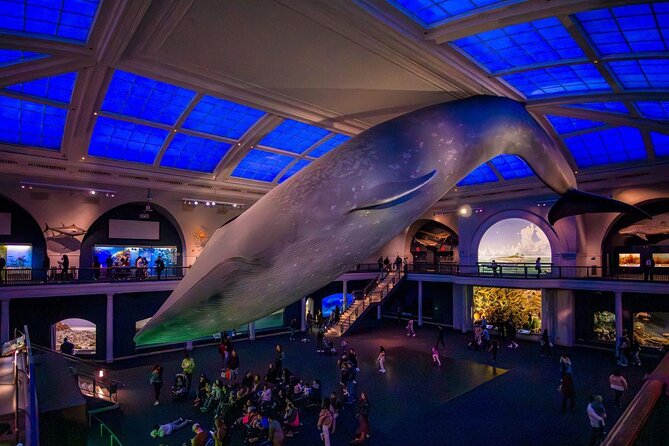
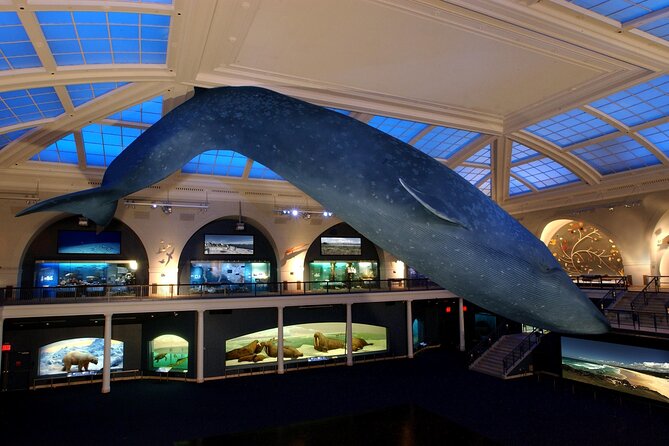
The Milstein Hall of Ocean Life contains the museum’s 94-foot-long blue whale model. Its size is hard to grasp from a photograph. Standing beneath a model that fills the room gives the ocean section a memorable sense of scale, even for children who have already seen plenty of museum displays.
These halls are also useful when your group has split interests. One person can focus on animals, another on marine life, and children can move between the large central displays without needing to follow a single subject for too long. I would place the whale and African mammals high on your list if you do not have time for the entire museum.
The animal halls are popular, so expect busy passageways at peak times. Early entry can help, but arriving early is not a guarantee of quiet rooms. One account describes the museum becoming crowded and warm within about 30 minutes of opening. Comfortable shoes and short pauses matter here because the floors are hard and the walking adds up.
More Museums in New York City:
- NYC: Empire State Building Tickets – Observatory & Museum
★ 4.7 · 25,757 reviews - NYC: Museum of Modern Art (MoMA) Entry Ticket
★ 4.6 · 12,540 reviews - 9/11 Memorial, Ground Zero Tour with Optional 9/11 Museum Ticket
★ 5.0 · 6,381 reviews - 9/11 Memorial Museum Admission Ticket
★ 4.5 · 6,376 reviews
Rose Center and the 13-billion-year story
General admission includes the Rose Center for Earth and Space. This gives the visit a useful change of pace after the animal halls. Instead of focusing on individual species, you shift toward planets, stars, Earth, and the long story of the universe.
The museum presents a 13-billion-year view of cosmic history, which gives the Rose Center a clear role in the overall visit. It is not simply another room of specimens. It asks you to think on a much larger scale, from the origins of the universe to the place of Earth within it.
Do not confuse access to the Rose Center with admission to the Hayden Planetarium Space Show. The planetarium show is listed as an extra ticket, along with the giant-screen film, the butterfly vivarium, Invisible Worlds, and other ticketed exhibitions. If one of those is important to you, check the cost and availability before you arrive.
This distinction is easy to miss. You may enter expecting every attraction to be included, then find that general admission covers the permanent halls but not special programs. Build your budget around the $37 general admission price only, unless you have confirmed the extras separately.
The Richard Gilder Center and newer science spaces
General admission also includes the Richard Gilder Center for Science, Education, and Innovation. It adds another layer to the visit, particularly for people who want science presented in a more current, interactive setting.
The Gilder Center is included in the general ticket, but the information provided does not specify every exhibit or activity inside it. I would use the museum map and current information desk guidance to see what is open during your visit. This is especially useful if you are visiting during a period of refurbishment.
The combination of the Gilder Center, Rose Center, and permanent halls makes the ticket more useful than a dinosaur-only visit. You can build a route around children’s interests, then add rooms that suit adults. That flexibility is a real advantage when your group does not share one favorite subject.
Ancient cultures and the museum’s wider reach
The museum is not limited to animals and space. Displays also include statues and material connected with Greece, Mexico, Asia, and Egypt. These areas give you a broader view of human societies and help break up the natural science galleries.
I would not try to see every cultural display in detail during a short visit. Instead, choose one or two areas that match your interests. The museum is too large for a rushed checklist to feel satisfying, and the building’s layout can make backtracking tiring.
If you are visiting with children, these rooms can work well as a change of subject after dinosaurs. If you are visiting as a couple or with friends, you may prefer to spend longer with the cultural displays and reduce the number of natural science halls. General admission lets you make that choice without committing to a guided route.
How to plan three hours, four hours, or a full day

For a focused three-hour visit, I would use this order:
- Pick up a paper map and confirm which rooms are open.
- Start with the dinosaur halls.
- Continue to the African mammals and the blue whale.
- Visit the Rose Center.
- Add the Gilder Center or one cultural section if time allows.
For four hours, slow down and add selected rooms rather than trying to cover every floor. You can also allow time for a food break. The museum’s food court has included gluten-free choices such as pizza and brownies, which is useful for families managing dietary needs.
A full-day plan works best when you accept that you will still not see every detail. Spend the morning on your top natural science halls, take a food break, then use the afternoon for space, cultural displays, and any included Gilder Center areas. The building is large enough that a map and planned pauses will save your legs.
The museum works well with strollers and has been described as manageable for visitors using ADA access. Service animals are allowed. You should still expect considerable walking, hard floors, and busy rooms, so plan rest stops rather than treating the visit as a quick indoor attraction.
When the museum is most valuable for children
This is a strong choice for families because the major displays are instantly readable. A giant whale, elephant, or dinosaur can hold a child’s attention before an adult explains the science. Older children and teenagers can move toward more detailed material, while younger children can enjoy the scale and shape of the exhibits.
The museum has also been useful for families looking for recognizable displays connected with the Night at the Museum films. Staff can help locate some of the familiar figures, which may give children an extra reason to engage with rooms they might otherwise skip.
Do not assume every child will last four hours without a break. The building is big, the floors are tiring, and crowds can make the rooms feel warm. Set one or two goals, allow time for food, and let the museum be a flexible outing rather than a test of endurance.
Children under three qualify for waived admission fees. That can make the visit easier to justify for families with a toddler, though you should still consider the ticket exchange issue before choosing a third-party booking route.
Who will enjoy it, and who may feel rushed
I would recommend this experience to families, first-time New York visitors, couples who like museums, and anyone who wants an indoor activity near Central Park. It is also a useful weather backup because you can spend several hours indoors and then continue with nearby plans.
Adults who prefer small, quiet museums may find the scale frustrating. The building can be confusing, crowds can build quickly, and some galleries may be closed or partly closed for repair. If you want a calm visit with time to read everything, choose a less busy period if possible and allow more than three hours.
The experience is offered in English. No tour guide is included in the admission ticket, so you are responsible for setting your route and pace. That is a benefit if you dislike fixed schedules, but less helpful if you want a person to explain the museum from start to finish.
Is the $37 admission good value?
At $37, the value depends on your time. For a three-to-four-hour visit covering dinosaurs, mammals, oceans, space, and cultural displays, the price is fair. The more of the permanent collection you see, the better the admission works.
The calculation changes if you also want a film, the Hayden Planetarium Space Show, the butterfly vivarium, or Invisible Worlds. Those are not included in general admission, so add-on costs can push the day beyond the simple $37 price.
New York residents have a different arrangement: the amount paid for general admission is up to them. This benefit applies to New York residents, not to every visitor staying in the city, so check the museum’s terms before relying on it.
Free cancellation is available if you cancel at least 24 hours before the experience start time. Cancellations inside that window are not refunded, and changes made within 24 hours are not accepted. That policy is useful if you are still shaping your New York plans, but it does not solve a same-day ticket problem.
Should you book this admission ticket?
Book it if you want a flexible, family-friendly museum day and can give the building at least three hours. The dinosaur skeleton, Asian elephants, blue whale, Rose Center, and Gilder Center give you plenty to choose from, and the permanent galleries cover far more than one narrow subject.
Before paying, compare the entry process with buying directly from the museum. The voucher-to-ticket exchange has been the most serious weakness, especially for families with small children or anyone arriving with a tight schedule. If direct admission avoids that line, it may be the better value even if the price difference is small.
For a first visit to New York, I would put the museum high on the list, but I would plan it carefully. Bring or collect a map, choose your must-see halls, check which extras are included, and leave room for a break. Do that, and the museum can fill a memorable half-day without forcing you to race from room to room.
FAQ
How long should I plan for the American Museum of Natural History?
Plan on at least three hours for a useful visit. The museum has more than 40 permanent galleries across four levels, and you can stay longer if you want to see more of the displays.
What does general admission include?
General admission includes more than 40 permanent exhibition halls, the Rose Center for Earth and Space, and the Richard Gilder Center for Science, Education, and Innovation.
Are the Hayden Planetarium Space Show and giant-screen film included?
No. General admission does not include the Hayden Planetarium Space Show, giant-screen film, Invisible Worlds, the butterfly vivarium, or other ticketed exhibitions.
Is the voucher the same as the museum admission ticket?
Not always. The voucher may need to be converted into an admission ticket at the museum, so allow extra time for that process.
Are children under three admitted free?
Yes. Children under three qualify for waived admission fees.
Is the museum suitable for visitors using strollers or ADA access?
The museum has been described as suitable for strollers and ADA access. Expect substantial walking on hard floors, and use a paper map to plan a manageable route.
Can I cancel for a full refund?
Yes, if you cancel at least 24 hours before the experience start time. Cancellations made less than 24 hours in advance are not refunded.
Recently added in New York City
- #1 Six Hour Bus Tour and Boat Ride By The Statue of Liberty★ 4.7 · 6 reviews
- Harlem: Mount Morris Gospel Tour with Brunch★ 4.5 · 111 reviews
- NYC: Greenwich Village Comedy Club Stand Up Comedy Show★ 3.6 · 38 reviews
- Stand Up Comedy LIVE in Times Square At Broadway Comedy Club★ 3.5 · 56 reviews
- New York Harbor Brunch Cruise★ 4.5 · 106 reviews
- NYC Combo: Statue of Liberty Cruise, St Patrick’s Cathedral & Moma entrance★ 4.0 · 8 reviews
- New York City Superheroes Private Walking Tour★ 5.0 · 103 reviews
- Stand Up Comedy Show + Mini Golf Ticket!★ 5.0 · 64 reviews
Museums, compared.
Empire State Building Tickets – Observatory & Museum
Read our review →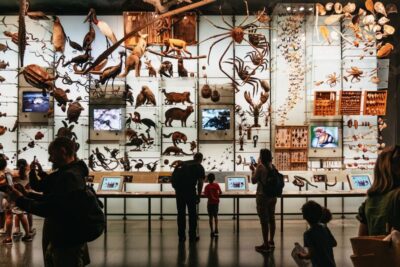


9/11 Memorial, Ground Zero Tour with Optional 9/11 Museum Ticket
Read our review →

All-Access 9/11: Ground Zero Tour, Memorial and Museum, One World Observatory
Read our review →

Browse the lists this tour appears in