
Reviewed · NYC WALKING TOURS
Hamilton and Washington Revolutionary Walking Tour
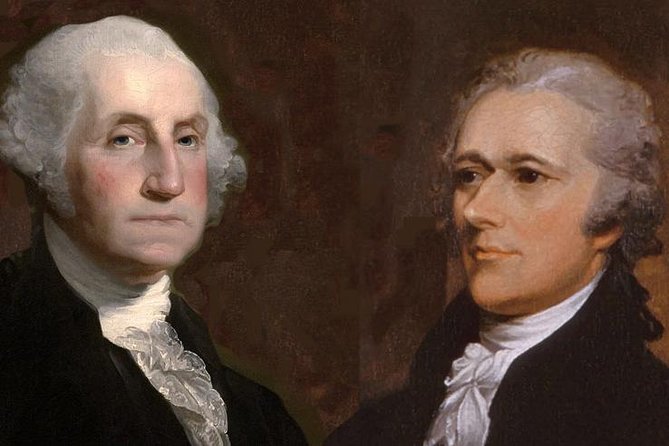
Alexander Hamilton’s New York comes alive on this three-hour Lower Manhattan walk, where a street corner, churchyard, or old tavern can open a window onto the American Revolution. You’ll connect the story behind the musical Hamilton with the actual people and places that shaped the new republic.
I especially like the small group limit of 16, which gives the guide room to answer questions, and the way the route links Washington, Hamilton, Aaron Burr, and Eliza Hamilton instead of treating them as separate textbook figures. The main drawback is simple: you’ll spend much of the tour outdoors, walking and standing, so cold, heat, snow, and rain can affect your comfort.
Key things to know before you book

- Hamilton’s financial world: See the places tied to Hamilton’s work as the first Treasury Secretary, his Bank of New York, and the early financial life of the nation.
- Real sites behind the musical: Visit Bowling Green, Wall Street, Trinity Church, and other Lower Manhattan locations connected with Hamilton’s life.
- Washington’s New York: Hear about his inauguration at Federal Hall and his farewell to officers at Fraunces Tavern.
- A guide-led history lesson: The tour is led by a licensed New York City guide and historian, with more than 20 years of experience.
- Compact but active route: The historic area is small, yet the tour includes walking, standing, and several outdoor stops.
- Best for curious history fans: You’ll get the most from it if you enjoy context, questions, and stories that go beyond the famous names.
Why this Lower Manhattan walk works
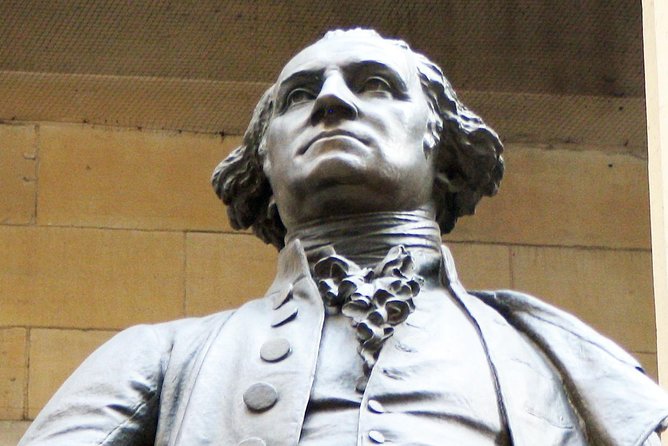
The strongest feature here is the setting. Lower Manhattan is not a preserved Colonial village, and many Revolutionary-era buildings are gone. You’ll see modern streets, office towers, and crowded sidewalks. Yet the guide uses the surviving landmarks, street plan, churchyard, and documented events to rebuild the old city in your imagination.
That approach matters. You are not simply ticking off famous names. You are following the political and financial arguments that shaped the new United States. Hamilton appears as a soldier, political thinker, Treasury Secretary, and city builder. Washington appears as a military commander who had to decide when to give up power. Aaron Burr is not just the man who shot Hamilton, but a politician with ambitions of his own.
The guide makes a big difference. Bruce is the name most often associated with this experience, and his style comes through as warm, clear, funny, and highly prepared. One booking was led by George, who handled a multigenerational group with ease. You should expect a guide who welcomes questions and adjusts the explanation to the group rather than delivering a fixed speech.
The pace is not frantic. The route covers a compact section at the southern end of Manhattan, but you will stop often to listen. One past participant described the walk as involving plenty of standing, while another found that the area itself is small and packed with stories. Both points are useful. You will not march across half of New York, but you should wear comfortable shoes and plan for outdoor time.
More NYC Walking Tours:
- SoHo, Little Italy, and Chinatown Walking Tour in New York
★ 5.0 · 3,153 reviews - Secrets of Grand Central Station Walking Tour New York City
★ 5.0 · 1,796 reviews - Greenwich Village Walking and Food Tasting Tour
★ 5.0 · 1,572 reviews
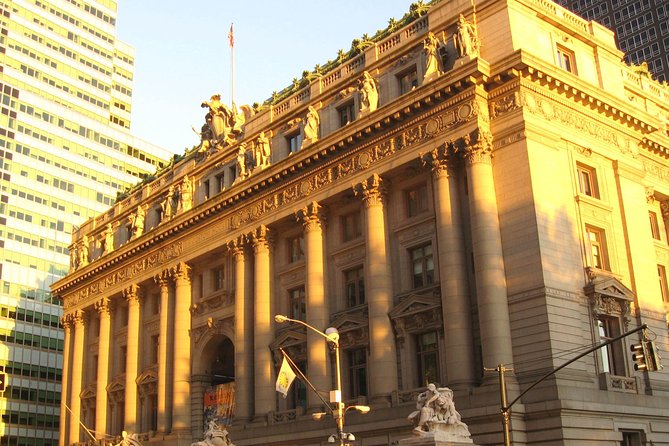
Alexander Hamilton U.S. Custom House and the Treasury connection
The walk begins at 1 Bowling Green, beside the Alexander Hamilton U.S. Custom House. The building is an important starting point because it links Hamilton to the financial machinery of the new country.
Hamilton served as the first Secretary of the Treasury, and his financial program helped define how the young United States would manage money, debt, and national institutions. At this stop, the guide explains why a building associated with customs revenue matters to Hamilton’s story.
The stop lasts about 20 minutes. Admission to the interior is not included, so the focus may be on the exterior and the surrounding history. That is no great loss for a walking tour centered on storytelling, but you should not book this expecting a full museum visit at every stop.
I like this opening because it gives the tour a clear theme. Hamilton was not only a dramatic figure from a stage show. He helped create the financial structure that allowed the new government to function, and Lower Manhattan was the setting where those ideas took practical form.
Bowling Green and the fallen statue of King George III
Bowling Green is the first major Revolutionary-era scene. Today it is a small public park framed by tall buildings, but it became a flashpoint before and during the Revolution.
Here you hear about the events that pushed New York toward open rebellion and the destruction of the 4,000-pound lead statue of King George III. That detail gives the political conflict a physical edge. The dispute was not just a debate in Parliament or a line in a history book. It reached the streets, where a royal symbol could be pulled down and destroyed.
The stop is free and lasts about 20 minutes. It also helps you understand why New York was so important. The city was a center of trade, government, protest, and military strategy, making it a natural stage for the conflict between Britain and the American colonies.
Bowling Green is an easy place to appreciate the guide’s role. The remaining park is modest, and the buildings around it are much newer than the events being discussed. Without explanation, you could walk past without realizing what happened here. With a good guide, the site becomes one of the most memorable points on the route.
Peter Minuit Plaza and Hamilton’s early New York
At Peter Minuit Plaza, the tour turns toward New York at the start of the Revolutionary War and Hamilton’s origins. The plaza is a modern public space, but it sits in an area tied to the earliest development of Manhattan.
This is where the wider city story comes into view. Hamilton’s rise did not begin in a grand Manhattan mansion. His early life and arrival in the American world form part of the explanation for his drive, education, and political ambition.
The stop runs about 20 minutes and is free. You can expect the guide to connect the location with the city’s development and with the political conditions that shaped Hamilton’s choices.
This part may appeal most if you want more than musical trivia. The tour treats Hamilton as a complicated historical person, not simply a fast-talking founder. His origins, his hunger for advancement, and his ability to move into the center of American public life are essential to understanding the later stops.
A completely different way to spend a day in New York City:
- NYC: SUMMIT One Vanderbilt Tickets
★ 4.7 · 51,195 reviews - NYC: Empire State Building Tickets – Observatory & Museum
★ 4.7 · 25,757 reviews - New York City: Statue of Liberty & Ellis Island with Ferry
★ 4.6 · 18,683 reviews - New York City: American Museum of Natural History Ticket
★ 4.5 · 15,447 reviews
Fraunces Tavern and Washington’s farewell
Fraunces Tavern gives the tour one of its most personal moments. This is the tavern where George Washington bade farewell to his officers after the Revolutionary War.
The story matters because Washington’s departure was unusual. Military leaders have often held onto power after victory. Washington’s decision to leave military command helped shape the public image of the new nation and showed that the army would not automatically rule the country.
The scheduled stop lasts about 15 minutes. Museum admission is not included, so you should treat this as an exterior and storytelling stop unless your guide confirms that an interior visit is part of your departure time.
I find this a useful counterweight to the Hamilton material. Hamilton wanted an energetic national government and spent much of his life arguing, writing, and building institutions. Washington’s farewell shows another side of the founding period: the question of restraint, public duty, and when a leader should step away.
The New York Stock Exchange and Hamilton’s financial plan
The route then reaches the New York Stock Exchange, where the guide explains Hamilton’s financial plan and his connection to the institution.
This is not a stop for a trading-floor visit. Admission is not included, and the value comes from understanding how Hamilton’s ideas affected the city’s commercial life. His plans involved national credit, public debt, and a stronger federal structure. Those subjects can sound dry in a classroom, but here they connect to the streets where New York’s financial power developed.
The stop takes about 15 minutes. For me, this is one of the places where the guide’s ability to make numbers and policy understandable matters most. You will get more from the tour if you are willing to listen to the political argument behind the money.
Wall Street, the Bank of New York, and Aaron Burr
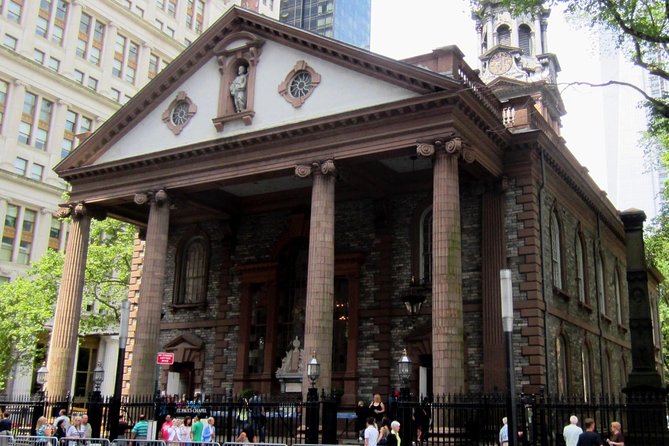
At Wall Street, the focus shifts from Hamilton’s financial ideas to his Bank of New York and Aaron Burr’s political ambitions. The name Wall Street is now shorthand for global finance, but the tour takes you back to a much earlier moment, when the country was still deciding how much power the federal government should have.
Hamilton and Burr make a useful pair. Hamilton pushed for a strong national structure, while Burr pursued his own route through New York politics. Their rivalry was not merely personal drama. It grew out of different political goals, networks, and ambitions.
The Wall Street stop lasts about 20 minutes and is free. It is also one of the busiest parts of the route, so you should expect city noise and modern activity around the explanation. That contrast is part of the appeal. You are hearing about early national finance while standing in one of the world’s most important financial districts.
Federal Hall and Washington’s inauguration
Federal Hall is among the most important stops on the route. The site served as the first Capitol of the United States under the Constitution, hosted the first meeting of Congress, and was where Washington took the oath of office.
This is where the tour’s separate threads come together. Washington’s military service, Hamilton’s financial ideas, and the new federal government all meet at this location. The guide explains what the building represented and why New York briefly served as the national capital.
The stop lasts about 20 minutes. The building is closed on weekends, so timing matters. You can still learn about the site from outside, but you should not expect an interior visit on Saturday or Sunday.
Federal Hall is especially valuable if you are interested in the early mechanics of government. It is easy to think of the Constitution as a finished document. This stop reminds you that the new system had to be put into practice, with people arguing over powers, money, offices, and the meaning of the republic.
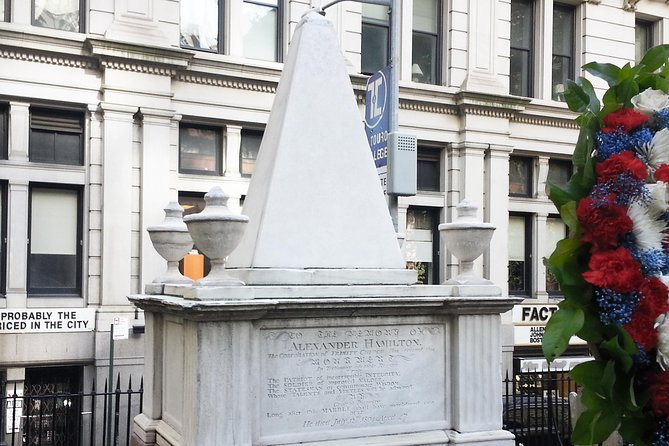
Trinity Church and the Hamilton family graves
The final stop is Trinity Church, where Alexander Hamilton and Eliza Hamilton are buried. The churchyard also includes other figures connected with the Revolutionary period, including Hercules Mulligan.
This is a quieter ending than the financial district stops. After hearing about Hamilton’s political battles, public plans, and fatal conflict with Burr, you stand at his grave. Eliza’s presence adds an important human element, since her life continued long after Hamilton’s death and was tied to preserving his memory and work.
The churchyard stop lasts about 20 minutes and is free. The tour enters only when the church and graveyard are open, so access depends on the day and time. If the churchyard is closed, the guide can still explain the location, but the visit will not have the same impact as standing beside the graves.
I like ending here because it brings the tour back to individuals. The route begins with institutions and public money, but it finishes with names carved in stone. That shift helps keep the founders from becoming distant symbols.
What the $52.95 price gives you
At $52.95 per person, this is not the cheapest way to see Lower Manhattan. You are paying for a guided interpretation of a compact area, not for admission to a series of museums. Several stops are free, and admission to the Custom House, Fraunces Tavern Museum, New York Stock Exchange, and Federal Hall is not included.
The value depends on how much context you want. If you already know the neighborhood and prefer to read plaques at your own pace, the price may feel high. If you want a clear story connecting Hamilton, Washington, Burr, the Revolution, and the birth of national government, the fee is more reasonable.
The group maximum of 16 is important. A smaller group makes it easier to hear on city streets and gives you a better chance to ask questions. The guide’s experience is also part of the cost. Bruce has more than 20 years as a licensed New York City guide, and his ability to explain complicated events in plain language is central to the experience.
Weather, walking, and practical planning
Plan on roughly three hours, with repeated stops and outdoor standing. The route is compact, but the tour is still active. Wear comfortable shoes and dress for the forecast.
The southern tip of Manhattan can feel especially cold in winter, while summer can be hot and muggy. One useful feature of an experienced guide is the ability to use available shade or breeze when conditions are uncomfortable, but you should still bring suitable clothing and water.
Tours operate in rain, snow, and sunshine. The policy says there are no rain or snow cancellations or rescheduling within 24 hours of the start time, so do not assume poor weather gives you an automatic last-minute change. If the operator cancels because of poor weather or because the minimum number of participants is not reached, you are offered another date or a full refund.
You receive a mobile ticket, and the tour is offered in English. Children must be with an adult. Service animals are allowed, the route is near public transportation, and most people can take part, though the walking and standing deserve attention if you have mobility concerns.
Free cancellation is available up to 24 hours before the start time. Inside that window, changes and refunds are not accepted.
Who should take this tour?
I would choose this walk if you want American history tied to real city locations. It suits fans of Hamilton, but you do not need to know the musical to enjoy it. The guide covers the broader story, including Washington’s leadership, the Revolutionary War, the early federal government, and the political conflict between Hamilton and Burr.
It also works well for families with older children, couples, solo visitors, and mixed-age groups. The guide’s conversational approach helps if one person in your group loves history and another needs a little more drama to stay interested.
You may want a different activity if you dislike standing outdoors, want long interior visits, or prefer a quick sightseeing loop with minimal narration. This is a history walk first. The buildings and streets provide the setting, but the guide provides most of the substance.
Should you book the Hamilton and Washington Revolutionary Walking Tour?
Book it if you want story-led history in the actual streets of Lower Manhattan, especially if Hamilton has made you curious about the people behind the songs. The strongest reasons are the small group, the route’s compact design, and the guide’s ability to connect politics, finance, war, and personal rivalry.
Think twice if you expect every historic building to be open or want a tour with little walking and standing. Check the schedule carefully for a weekend visit because Federal Hall is closed on weekends, and Trinity Church access depends on opening hours.
For most history-minded visitors, $52.95 is a fair price for a focused three-hour lesson with a seasoned guide. You will leave with more than a list of landmarks. You will understand why this small corner of New York mattered so much when the United States was still being built.
FAQ
How long is the Hamilton and Washington Revolutionary Walking Tour?
The tour lasts approximately three hours.
Where does the tour begin?
It begins at 1 Bowling Green, New York, NY 10004.
Where does the tour end?
The tour ends at Trinity Church, 89 Broadway, New York, NY 10006.
What is the price?
The listed price is $52.95 per person.
Is the tour offered in English?
Yes. The tour is offered in English.
Is the tour led by a licensed guide?
Yes. A licensed New York City tour guide and historian leads the experience. The guide has more than 20 years of experience.
How large is the group?
The tour has a maximum of 16 participants.
Are admission fees included?
Admission is not included for the Alexander Hamilton U.S. Custom House, Fraunces Tavern Museum, New York Stock Exchange, or Federal Hall. Several outdoor stops are free.
Is Federal Hall open during the tour?
Federal Hall is closed on weekends. The tour can still cover the site, but weekend visits do not include access when the building is closed.
Can I cancel for a refund?
You can cancel up to 24 hours before the start time for a full refund. Cancellations or changes made less than 24 hours before the start time are not accepted.
Recently added in New York City
- #1 Six Hour Bus Tour and Boat Ride By The Statue of Liberty★ 4.7 · 6 reviews
- Stand Up Comedy Show + Mini Golf Ticket!★ 5.0 · 64 reviews
- Woodbury Common Premium Outlets Shopping Tour from Midtown★ 4.5 · 92 reviews
- Harlem: Mount Morris Gospel Tour with Brunch★ 4.5 · 111 reviews
- NYC: Greenwich Village Comedy Club Stand Up Comedy Show★ 3.6 · 38 reviews
- Stand Up Comedy LIVE in Times Square At Broadway Comedy Club★ 3.5 · 56 reviews
- New York Harbor Brunch Cruise★ 4.5 · 106 reviews
- NYC Combo: Statue of Liberty Cruise, St Patrick’s Cathedral & Moma entrance★ 4.0 · 8 reviews
NYC Walking Tours, compared.

SoHo, Little Italy, and Chinatown Walking Tour in New York
Read our review →
Secrets of Grand Central Station Walking Tour New York City
Read our review →
Greenwich Village Walking and Food Tasting Tour
Read our review →
Artistic, Alternative Greenwich Village Walking Tour
Read our review →


NYC Greenwich Village Italian Food Guided Walking Tour
Read our review →Browse the lists this tour appears in