
Reviewed · HISTORICAL TOURS
The Bowery Official Historic District Tour
The Bowery’s past is far stranger and more layered than its current street scene suggests. In 90 minutes, this walk connects Chinatown, old theaters, immigrant neighborhoods, banks, music clubs, and the punk era, ending at Cooper Union. Doyers Street’s old nickname, Murder Alley, gives you an early hint of the district’s rough reputation.
I like two things right away: the route covers several distinct chapters of New York life, and it leaves room for questions rather than treating you like a passenger on a moving script. Guide Ramona is singled out for her passion for the area and historic preservation. The one catch is that the tour moves quickly, with roughly five minutes at most stops, so you should expect a brisk introduction rather than a long visit inside any one site.
Key points about the Bowery walk
- Immigrant stories across one short route: Learn about Chinese, Irish, Italian, German, and Jewish communities that shaped the street.
- Doyers Street and the Bloody Angle: See the entrance to one of old Chinatown’s most notorious locations.
- New York’s first entertainment district: Hear about opera houses, Yiddish theater, music halls, and later punk clubs.
- CBGB’s former neighborhood: Stop near the Bowery Poetry Club and the site of the legendary club.
- A useful final stop: The tour ends at Cooper Union, close to McSorley’s Ale House and several notable Cooper Square buildings.
- Simple logistics: The English-language walk begins at 3:30 pm, lasts about 90 minutes, and costs $38 per person.
Why the Bowery makes a strong walking tour
The Bowery is not one tidy historic district with a single story. It is a corridor where New York’s immigrant life, commerce, entertainment, poverty, art, and nightlife repeatedly replaced one another. That makes it a good place for a guide-led walk, because many of the most important clues are easy to miss from the sidewalk.
You may pass a modern building without realizing it replaced a theater, bank, music hall, or mission. A guide can point out what once occupied the space and explain why the Bowery attracted that particular business or community. I like this approach more than a walk that simply names old buildings. The useful question is not only what stood here, but why it stood here.
The route also gives you a compact look at Lower Manhattan. It begins beside Confucius Plaza, follows the Bowery north, passes the Manhattan Bridge entrance, and finishes around Cooper Square. You will not need a subway transfer between stops, and most travelers can take part, though you should be comfortable walking and standing outdoors for the full 90 minutes.
The group can reach as many as 50 people. That is a fairly large maximum for a historic walk, so your experience may depend partly on where you stand near the guide. Staying close will help you hear names, dates, and building details, especially on noisy streets.
More Historical Tours in New York City:
- New York City: American Museum of Natural History Ticket
★ 4.5 · 15,447 reviews - NYC: Starship Landmark 90 Minute Sightseeing Cruise
★ 4.6 · 3,666 reviews - Starship Landmark 90 Minute Sightseeing Cruise
★ 4.5 · 2,073 reviews
Starting at Confucius Plaza and the Statue of Confucius
The meeting point is the Statue of Confucius at Confucius Plaza, at the corner of Bowery and Division Street. This is a smart starting place because it puts you directly into the Chinese history of the area rather than beginning with a general overview somewhere downtown.
The first stop lasts about five minutes and is free. That may sound brief, but the purpose is to set the scene. You begin by considering how the Bowery connects with Chinatown and how immigrant communities gave different stretches of Lower Manhattan their own character, businesses, institutions, and social networks.
I would arrive a little early at this meeting point. The address is 1-9 Bowery, and the walk starts at 3:30 pm. Since the group may include as many as 50 people, finding the guide before the start time is more sensible than trying to catch up after the walk begins.
Doyers Street and old Chinatown’s dangerous reputation
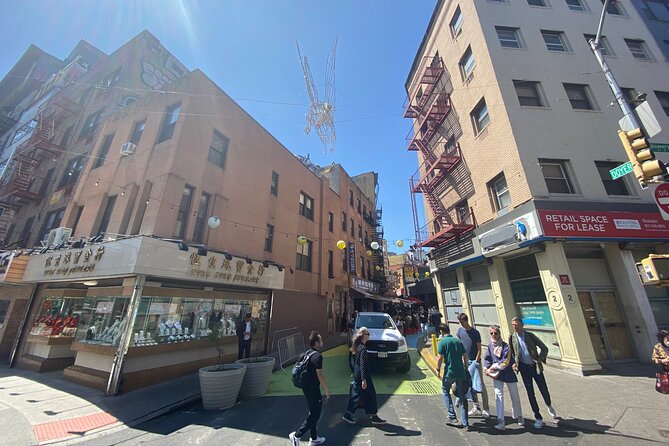
The next stop is the entrance to Doyers Street, known during the 19th century by the grim names Murder Alley and the Bloody Angle. You do not spend a long time here, but the location gives the tour a strong sense of place.
Doyers Street helps explain how the Bowery and nearby Chinatown were viewed in the popular imagination. The street’s reputation came from conflict and violence in the 19th century, and its unusual shape made it a memorable setting. Your guide can connect this small bend in the street to larger stories about immigrant life, crowded neighborhoods, and the way newspapers and city residents described them.
This is also a good example of the tour’s limits. You are stopping at the entrance, not taking a long architectural tour of every surrounding block. If you want a detailed Chinatown food, architecture, or gang-history walk, this experience is not designed for that. Here, Doyers Street is one chapter in a wider Bowery story.
The Manhattan Bridge, old banks, and the original Diamond District
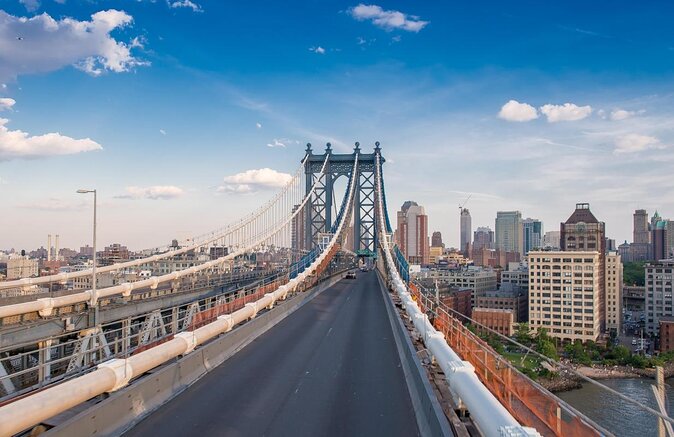
Near the Manhattan Bridge, the tour pauses by the bridge’s Triumphal Arch and Colonnade. This section brings together infrastructure, finance, immigrant commerce, and buildings that no longer serve their original purpose.
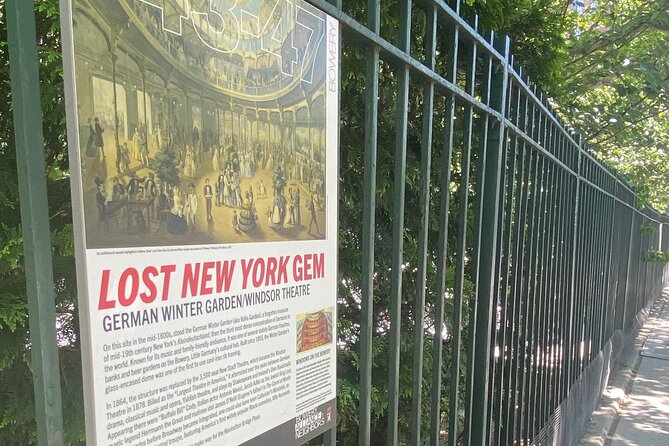
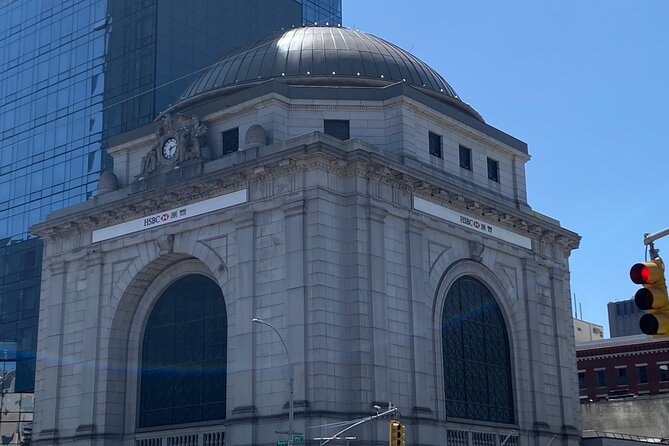
You will hear about the original Diamond District around Bowery and Canal, along with the old Citizens Bank Building. The guide also discusses Confucius Plaza and the former German Winter Garden and Windsor Theatre. Those names show how quickly this part of the city changed. A single stretch could serve as a commercial center, a theater zone, an immigrant meeting place, and a major traffic route at different points in its history.
This is one of the more useful stops for anyone who likes to read the city through its buildings. The Manhattan Bridge is easy to photograph, but the real value is understanding what surrounded it before the modern streetscape took shape. The stop lasts about five minutes, so listen closely when the guide identifies a building or former venue.
More New York City Tours:
- NYC: SUMMIT One Vanderbilt Tickets
★ 4.7 · 51,195 reviews - NYC: Empire State Building Tickets – Observatory & Museum
★ 4.7 · 25,757 reviews - New York City: Statue of Liberty & Ellis Island with Ferry
★ 4.6 · 18,683 reviews - Statue of Liberty and Ellis Island Tour: All Options
★ 5.0 · 13,571 reviews
The Bowery Ballroom and the last traces of music culture
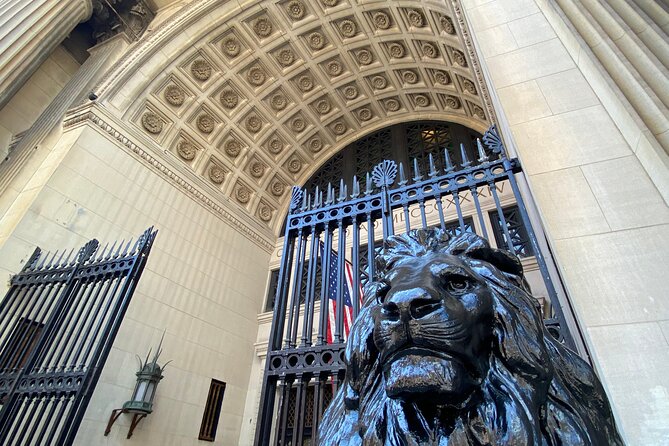
The walk then reaches the area near the Bowery Ballroom, described as one of the last music-related reminders of the old Bowery. This part of the route turns from early commercial history toward the street’s long connection with entertainment.
The guide also covers the former Lincoln Hotel and the location of one of the Germania Bank buildings. This combination is revealing. The Bowery was not only a place for grand theaters or famous clubs. Hotels, banks, and everyday businesses helped support the people who worked, performed, and lived nearby.
I like that the route does not reduce the Bowery to its punk reputation. Punk is important, but it came after earlier waves of theater, music, migration, and commerce. The Bowery Ballroom stop helps you see the music scene as part of a much longer pattern rather than as the street’s entire identity.
Again, the stop is brief and outside. You are hearing the story near the former or surviving locations, not entering a museum or concert hall. That makes the tour best for people who want context and orientation, not a long indoor visit.
The New Museum, the Bowery Mission, and theater history
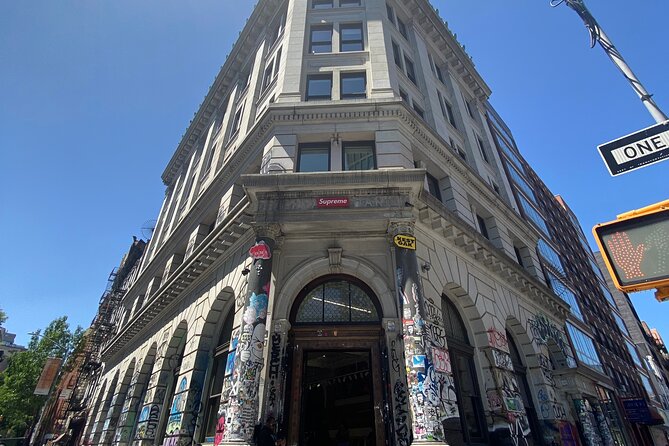
Near the New Museum of Contemporary Art, the walk opens another set of subjects: the Bowery Mission, Italian opera houses, and Yiddish theater. This is one of the route’s most varied portions because it moves between art, religion, language, and performance.
The Bowery Mission adds a social-history angle. Italian opera houses and Yiddish theater show how different immigrant audiences built entertainment spaces that reflected their own languages and traditions. These venues were not simply places to watch a performance. They were meeting points where communities could hear familiar languages, meet others from similar backgrounds, and take part in New York’s cultural life.
The New Museum gives the stop a modern reference point. You can look at the present-day institution while learning how the same area once supported very different forms of public life. This contrast is one of the reasons a guide helps. Without explanation, you might see only a contemporary art building. With context, the location becomes part of a chain of changes.
If your main interest is contemporary art, this is not a museum visit and does not include admission. The stop is near the building, with the emphasis on the Bowery’s past.
Bowery Poetry Club, CBGB’s, and the punk-rock chapter
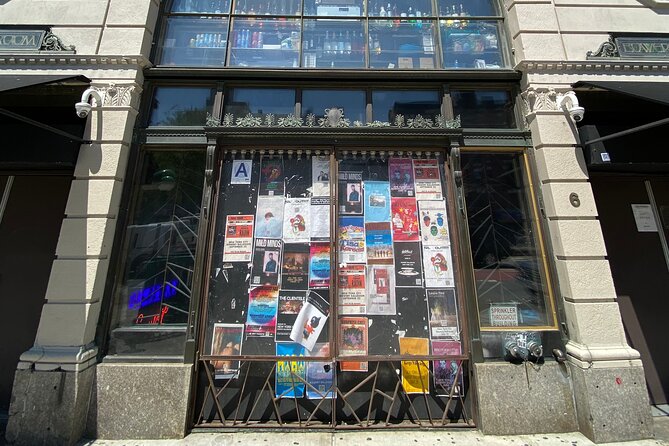
Near the Bowery Poetry Club, the tour turns to the punk-rock era. Across the street was the former location of CBGB’s, one of the best-known music sites in New York. The guide also points toward Electric Ladyland and the former residence of Deborah Harry of Blondie.
This section will likely be the most exciting part for anyone interested in rock music and downtown culture. It places CBGB’s within the actual street rather than treating it as an isolated name from music history. You can connect the club’s former location with the nearby poetry and music institutions that helped make this stretch of the Bowery so important.
The mention of Deborah Harry and Blondie adds a personal thread to the story. You are not only hearing about clubs and buildings, but also about the artists associated with the neighborhood. Electric Ladyland adds another music-related reference, giving the stop more range than a single-club story.
The drawback is simple: the club is a former site, and there is no indoor performance or exhibit included. If you expect to enter CBGB’s, you will be disappointed. If you want to understand where the punk scene took place and how it fits into the Bowery’s larger story, this is a useful stop.
Cooper Square and the Cooper Union Foundation Building
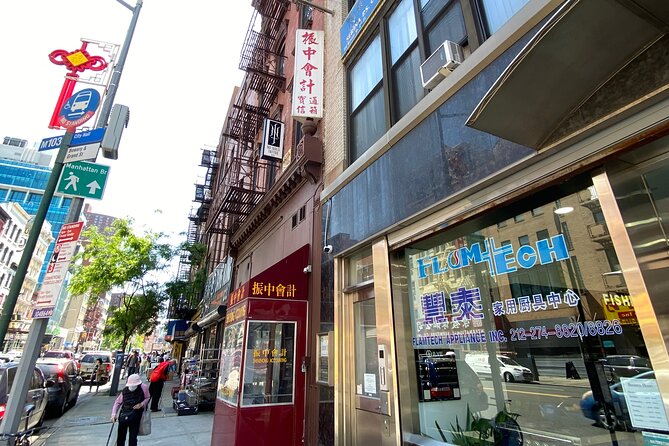
The final part of the walk approaches Cooper Union’s Foundation Building at 7 East 7th Street. The tour ends here, with about 10 minutes devoted to the building and nearby Cooper Square.
This area brings together several reminders of New York’s commercial and cultural life. You may hear about the old Village Voice building, the Carl Fischer Music Building, McSorley’s Ale House, and other nearby sites. The range is typical of the tour: newspapers, music, food and drink, education, and old architecture all appear within a short distance.
Ending at Cooper Union is practical. The Foundation Building gives the route a clear finish, and Cooper Square offers more to explore if you want to continue on your own. McSorley’s Ale House is especially useful as a nearby follow-up for anyone interested in old New York institutions, although the tour does not include a visit or meal there.
The 10-minute stop is slightly longer than most earlier pauses, which helps the tour close with several related buildings rather than stopping after a single point. You can also ask final questions here before the guide departs.
What $38 buys you
At $38 per person, this is not the cheapest way to spend 90 minutes in Lower Manhattan, but the price is reasonable if you value interpretation. Admission to every listed stop is free, so you are paying for the guide’s research, storytelling, route planning, and ability to connect scattered sites into one story.
The value is strongest for a first visit to the Bowery or for anyone who has walked through Chinatown and NoHo without knowing what used to be there. You get a broad introduction to immigrant communities, entertainment, banking, theater, music, and preservation in one compact outing.
The value is weaker if you prefer to explore at your own pace or spend 20 minutes inside each historic building. Most stops last about five minutes, and the tour does not include food, drinks, museum admission, or gratuity. Plan to tip separately if you feel the guide earned it.
The tour is offered in English and uses a mobile ticket. Confirmation arrives when you book, and the activity is near public transportation. It requires good weather, and cancellation is free up to 24 hours before the 3:30 pm start. A cancellation made less than 24 hours in advance is not refunded. If poor weather cancels the walk, you are offered another date or a full refund.
Who should book this Bowery tour
I would recommend this walk to you if you want a fast, well-organized introduction to Lower Manhattan’s changing identity. It suits history fans, architecture watchers, music followers, and first-time New York visitors who want more than a photo stop at the Manhattan Bridge.
It is also a good choice if you enjoy asking questions. The guide is available for questions throughout the route, and Ramona’s approach is described as especially passionate about the Bowery and preservation. That personal interest matters on a street where the evidence is often subtle.
You may want something else if you need a slow pace, indoor access, or a narrow focus on one subject. A maximum group of 50 can feel less personal, and the five-minute stops leave little time for extended discussion. Service animals are allowed, and most people can participate, but the experience remains an outdoor walking tour with repeated standing and street crossings.
Should you book it?
Book this tour if you want the Bowery to make sense as more than a street of old clubs and modern buildings. For $38, you get a compact route through Chinese, Irish, Italian, German, Jewish, theater, banking, and punk-rock chapters, with a clear finish at Cooper Union.
I would choose it especially for a first or second New York visit, then continue exploring around Cooper Square after the tour. Skip it if your priority is entering attractions or moving at a very relaxed pace. The best reason to go is the guide’s ability to make ordinary corners, former venues, and altered buildings part of one connected story.
FAQ
Where does the Bowery tour begin?
It begins at the Statue of Confucius in Confucius Plaza, at 1-9 Bowery, New York, NY 10002, at the corner of Bowery and Division Street.
Where does the tour end?
The tour ends at the Cooper Union Foundation Building, 7 East 7th Street, New York, NY 10003.
What time does the tour start?
The scheduled start time is 3:30 pm.
How long does the tour last?
The walk lasts approximately 1 hour and 30 minutes.
What language is the tour offered in?
The tour is offered in English.
Is admission to the stops included?
The listed stops have no admission charge. The experience includes a sightseeing guide, but gratuity is not included.
Can I cancel for a full refund?
Yes. You can cancel at least 24 hours before the start time for a full refund. Changes or cancellations made less than 24 hours before the start are not accepted or refunded. If poor weather causes the tour to be canceled, you are offered a different date or a full refund.
Recently added in New York City
- Brooklyn: 3-Hour Williamsburg Bites Food Tour★ 4.5 · 58 reviews
- World Trade Center, 911 and Ground Zero Walking Tour★ 5.0 · 4 reviews
- Welcome to New York: A Tour of Taylor Swift Hotspots★ 5.0 · 11 reviews
- Your NYC Story in Photos: Custom 2-Hour Tour & Photo Shoot★ 4.9 · 60 reviews
- Wall Street: The birth place of NYC in French/English tour★ 5.0 · 6 reviews
- Washington from New York in Spanish★ 5.0 · 4 reviews
- NYC: Empire State Building Sunrise Experience Ticket★ 4.6 · 55 reviews
- New York City: Walk This Way Harlem Hip Hop Walking Tour★ 4.8 · 42 reviews
Historical Tours, compared.

Starship Landmark 90 Minute Sightseeing Cruise
Read our review →
Starship Landmark 90 Minute Sightseeing Cruise
Read our review →
American Museum of Natural History Admission Ticket
Read our review →
Top Rated Brooklyn Half-Day Food, History & Culture Tour via bus
Read our review →

The Original Greenwich Village Food & Cultural Tour Since 1999
Read our review →
The Speakeasy Adventure: A Tipsy Trip Through History
Read our review →Browse the lists this tour appears in