
Reviewed · MUSEUMS
New York City: Museum of Illusions Entry Ticket
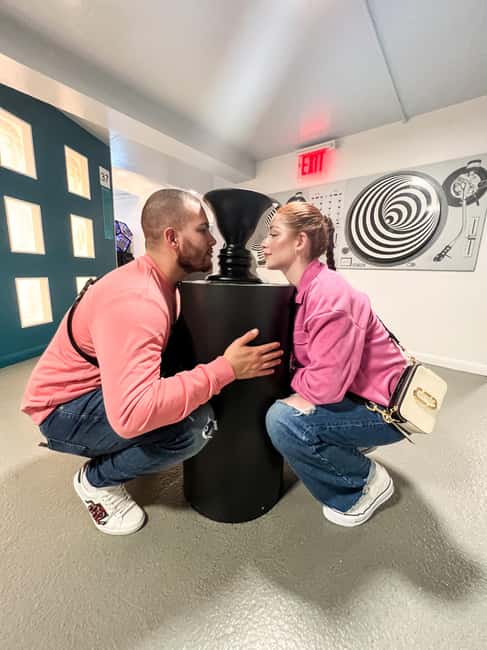
New York’s Museum of Illusions turns optical science into a hands-on play session. You can appear to grow or shrink, challenge gravity, step into a life-size kaleidoscope, and watch holograms play tricks on your eyes. It is less a traditional museum than a series of photo-friendly experiments.
I like the range of 50+ exhibits, since the visit gives you more than one clever trick to try. I also like the Chelsea location at 14th Street and 8th Avenue, which makes this an easy indoor stop during a day in Manhattan. The main caution is value: at $35 per person, the experience may feel expensive if you move through it quickly.
- More than 50 hands-on exhibits turn optical illusions into activities rather than displays you only look at.
- Illusion rooms and holograms offer the most memorable moments for photos and shared laughs.
- The science angle helps explain how your brain interprets visual information.
- The Chelsea location puts the museum at 77 8th Ave., near the corner of West 14th Street.
- Wheelchair access makes the venue suitable for visitors who need an accessible attraction.
- A short visit is possible, so plan your timing and expectations carefully before paying $35.
What the Museum of Illusions actually offers

This is a visual, sensory, and educational attraction built around one question: can you trust what your eyes tell you?
Inside, you work through more than 50 exhibits designed to confuse your senses and reveal how perception works. Some are rooms that change your sense of size or balance. Others use mirrors, installations, holograms, and visual patterns to make ordinary objects seem impossible.
The appeal is simple. You do not need a background in science, art, or psychology. You look, move, pose, and test what you see. Then the exhibit gives your brain a problem to solve.
I would think of it as an indoor activity with museum labeling, not as a quiet museum of important objects. The exhibits are the point. Many are built for participation, and the fun comes from trying them with another person and comparing what each of you sees.
Entering at 77 8th Avenue in Chelsea

The museum is at 77 8th Ave., with the building entrance on the corner of West 14th Street and 8th Avenue. That address matters because the venue is part of a city block rather than a large, separate museum complex. Keep the corner location in mind as you approach.
The Chelsea setting also makes the attraction easy to pair with other Manhattan plans. You could use it as an indoor break during a day around 14th Street, or make it the main stop for a family outing, date, or meet-up with friends.
There is no transportation service included. Your ticket covers entry only, so you are responsible for getting to the building. Since the exact starting times vary, check the available time before you book and allow enough room in your schedule to find the entrance.
More Museums in New York City:
- NYC: Empire State Building Tickets – Observatory & Museum
★ 4.7 · 25,757 reviews - New York City: American Museum of Natural History Ticket
★ 4.5 · 15,447 reviews - NYC: Museum of Modern Art (MoMA) Entry Ticket
★ 4.6 · 12,540 reviews
The first illusions: learning to distrust your eyes
The opening exhibits set the tone. Instead of asking you to stand back and read, they invite you to test your perception.
You might see an object appear different in size, find that a room changes your apparent proportions, or watch a fixed image seem to move. The important point is not simply the surprise. The museum uses these effects to show that the brain does not passively record reality. It interprets light, shape, distance, and movement.
This educational side gives the attraction more purpose than a collection of novelty photographs. You can enjoy the joke first, then think about why it worked. For children, that can make an abstract idea about perception easier to grasp. For adults, it adds a little substance to the fun.
The exhibits are also social by design. You will get more from them if you are willing to participate rather than rush from one sign to the next. A friend or family member can help with poses, compare what each person sees, and take the photos that make the illusion clear.
Illusion rooms that change your sense of size and gravity
The rooms are likely to be the most memorable part of the visit because they place you inside the trick.
The attraction specifically includes effects that can make you appear to grow or shrink and others that let you challenge the feeling of gravity. These are not passive wall displays. They depend on where you stand and how you frame the scene, so your position matters.
That creates a small tradeoff. The best result may require patience while you work out the correct angle or pose. If the museum is busy, you may not get as much time as you would like at every exhibit. Still, the hands-on format is a good fit for families and groups because one person can try the illusion while another takes the picture.
The rooms also explain why the visit can feel short for some people. A collection of visual tricks can be entertaining without taking an entire afternoon. If you inspect the effects, read the explanations, and take part in each activity, you will get more value than if you treat the museum as a quick photo stop.
Holograms, installations, and the life-size kaleidoscope
The holograms add a different kind of visual puzzle. They use light and perspective to make images seem present in a way that feels more physical than a normal photograph. You are still looking at an illusion, but the effect changes as you move around it.
The installations broaden the experience beyond standard optical pictures. The standout promise is a life-size kaleidoscope, which turns the familiar childhood toy into a space you can enter. The point is not historical interpretation. It is scale, pattern, reflection, and the odd pleasure of seeing yourself surrounded by repeating shapes.
These exhibits are valuable because they break up the visit. You are not doing the same task 50 times. Some displays ask you to look closely, some ask you to move, and some work best as a shared photo. That variety helps the museum appeal to mixed-age groups.
I would still keep expectations in check. The attraction is compact enough that the number of exhibits does not automatically mean a long visit. The quantity gives you options, but your pace and interest will determine how much time you spend inside.
More New York City Tours:
- NYC: SUMMIT One Vanderbilt Tickets
★ 4.7 · 51,195 reviews - New York City: Statue of Liberty & Ellis Island with Ferry
★ 4.6 · 18,683 reviews - Statue of Liberty and Ellis Island Tour: All Options
★ 5.0 · 13,571 reviews - New York in One Day Guided Sightseeing Tour
★ 5.0 · 13,166 reviews
Why the science matters
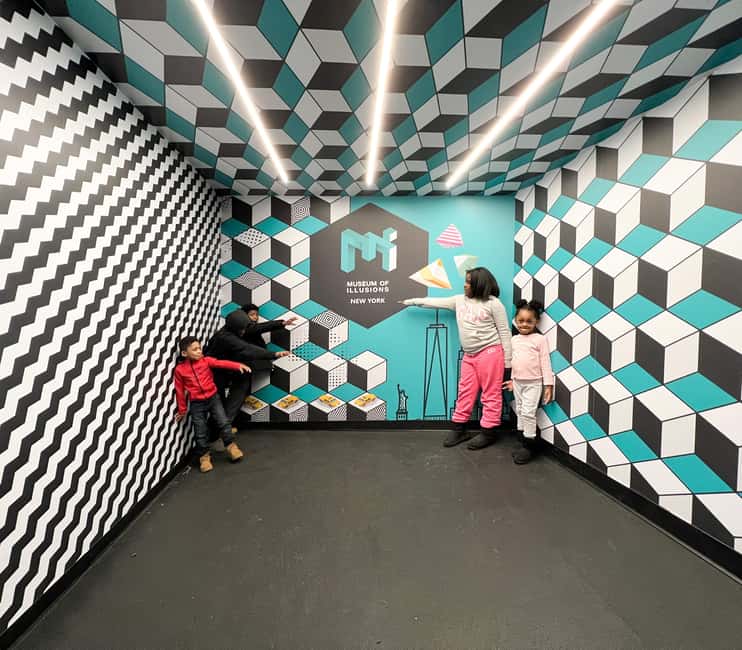
The Museum of Illusions works best when you pay attention to the explanation behind the trick.
Your eyes receive visual information, but your brain has to organize it. It makes assumptions about size, distance, balance, and movement. The exhibits exploit those assumptions, then show you how easily perception can be nudged in the wrong direction.
That makes the museum more useful for children than a simple room of strange pictures. A young visitor can laugh at a distorted reflection and still leave with a basic lesson about the senses. Parents can turn each exhibit into a question: What changed? Did the object move, or did your viewpoint change? Why does the room feel tilted?
The experience does not require a formal guide, and no guide names are provided with the booking information. You should expect to explore the exhibits themselves rather than join a tour led by a named expert. That keeps the visit flexible, but it also means you may need to read the explanations and make your own connections.
How much time should you allow?

The ticket is valid for one day, but the available information does not give a fixed visit length. One useful warning comes from the experience itself: some people find the museum small and the visit short.
Plan this as a focused attraction rather than an all-day museum. You can take your time with the exhibits, but do not assume that a $35 ticket guarantees hours of entertainment. If you enjoy taking photos, testing each illusion, and reading the science notes, you will get more from the space.
For a five-year-old, the visual tricks may be exciting, but the visit still depends on the child’s patience and interest. One recent booking problem involved a family arriving to find changed closing times and no useful advance notice, so it is sensible to check the current time before setting out. That is especially important when traveling with children.
Is $35 a fair price?

At $35 per person, this is not a casual bargain attraction. A family of four will spend $140 before any other costs, so the length and quality of your visit matter.
The price makes more sense if you want a shared activity with lots of photo opportunities and a clear science theme. Friends can make a game of the exhibits. A date can use the displays as conversation starters. Parents can give children something active to do instead of asking them to look quietly at cases.
The value is weaker if you want a large, traditional museum or a long, carefully guided program. Some people find the space too small for the price, and a few minutes of quick photo-taking may leave you feeling that you paid too much.
My advice is to book when the attraction itself is the goal, not simply because you need to fill an hour in Manhattan. The experience can be enjoyable, but your willingness to participate is part of what you are paying for.
Who will enjoy this most?
I would recommend the museum most strongly to:
- Families with children who like puzzles, visual effects, and hands-on activities
- Friend groups who want funny photos and shared challenges
- Couples looking for a light indoor date activity
- Visitors curious about optical illusions and how perception works
- Groups seeking an accessible attraction in the Chelsea area
It is less suitable for someone expecting a large art collection, a long guided tour, or extensive historical displays. You should also think twice if your schedule is tight and the $35 price only seems worthwhile for a lengthy visit.
The experience is wheelchair accessible, which is an important practical advantage. The supplied information does not provide further details about individual exhibit access, so visitors with specific mobility needs may want to confirm those details before booking.
The booking risks to consider
This activity is non-refundable, so check the date and starting time carefully before you commit. Availability includes different starting times, and the booking information advises checking availability for the current options.
The changed-hours problem described above is the most serious practical warning. If you are making a special trip, particularly with a child, verify the museum’s current hours and entry time close to your visit. A ticket is not much help if you arrive after an unexpected closing change.
The experience provider is Museum of Illusions New York City. No tour guide, meal, transportation, or other add-on is included. You are purchasing entry to the attraction itself.
My verdict: book it for play, not scale
I would book the Museum of Illusions if you want a playful indoor activity in Chelsea, enjoy taking part in visual tricks, and plan to visit with friends, family, or a date. The best parts are the hands-on rooms, holograms, life-size kaleidoscope, and the chance to connect each trick to the way your brain reads the world.
I would skip it if you expect a big museum, a long visit, or strong value from every dollar. The 3.1 rating from 56 reviews reflects that split: the concept appeals to some people, while others find the venue too small and too expensive.
At $35, book with realistic expectations. Arrive at a confirmed time, give yourself room to try the exhibits instead of racing through them, and treat the museum as a lively experiment in perception. Done that way, it can be a good shared outing. Treat it as a full-day museum, and you may come away disappointed.
FAQ
Where is the Museum of Illusions New York located?
It is located at 77 8th Ave. in Manhattan’s Chelsea area. The building entrance is on the corner of West 14th Street and 8th Avenue.
How much does admission cost?
The listed price is $35 per person.
How many exhibits are included?
The museum offers more than 50 interactive exhibits, including illusion rooms, installations, holograms, and other visual displays.
What can I do inside the museum?
You can explore optical illusions, challenge your sense of gravity, appear to grow or shrink, view holograms, and enter a life-size kaleidoscope.
Is the Museum of Illusions suitable for children?
It is presented as an activity for family adventures, and its hands-on visual exhibits can suit children. The information specifically describes it as suitable for families, friends, dates, and group outings.
Is the museum wheelchair accessible?
Yes. The museum is wheelchair accessible.
How long is the ticket valid?
The ticket is valid for one day. Available starting times vary, so check availability when booking.
Is the ticket refundable?
No. This activity is non-refundable.
Is transportation or a guide included?
No. The inclusion listed is the entry ticket. The information does not name a guide or include transportation.
Recently added in New York City
- New York City Night Skyline Tour by Helicopter★ 4.8 · 98 reviews
- New York City: New York Hall of Science Admission Ticket★ 4.0 · 8 reviews
- New York City: Mini Yacht Boat Ride with Sightseeing★ 5.0 · 9 reviews
- New York City: Museum of Broadway Entry Ticket★ 4.6 · 113 reviews
- New York City: Museum at Eldridge Street Docent-Led Tour★ 4.6 · 28 reviews
- New York City: Panoramic Skyline Tour★ 5.0 · 3 reviews
- New York City: Multicultural Contrasts Tour★ 4.6 · 66 reviews
- New York City: Minivan Tour★ 4.6 · 4 reviews
Museums, compared.
Empire State Building Tickets – Observatory & Museum
Read our review →


9/11 Memorial, Ground Zero Tour with Optional 9/11 Museum Ticket
Read our review →

All-Access 9/11: Ground Zero Tour, Memorial and Museum, One World Observatory
Read our review →

Browse the lists this tour appears in