
Reviewed · LITTLE ITALY AND CHINATOWN TOURS
New York: Mafia and Gangster History Tour in Little Italy
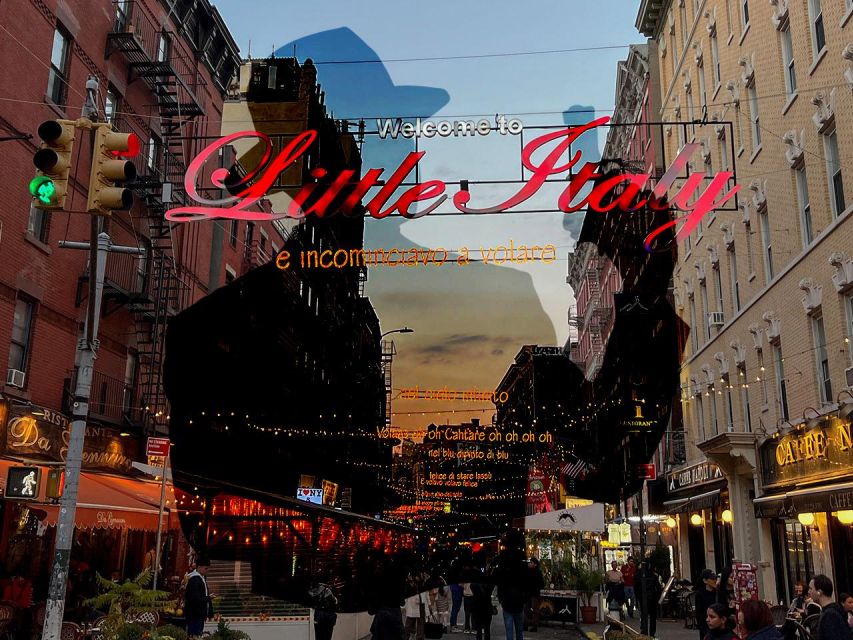
Little Italy’s mob story is best understood on foot, where a social club, police building, and old restaurant can carry more weight than a museum label. This two-hour walk follows the neighborhood’s criminal past from Black Hand gangs and Prohibition battles to Lucky Luciano, John Gotti, and the bloody shooting of Crazy Joey Gallo.
I like the compact route and the small groups, capped at 10 people. I also like the guide’s use of old photographs and newspaper pages, which helps you picture buildings that have changed. The main drawback is that this is an outdoor walking tour, and the guide may speak quickly for some listeners. Bad weather can also cancel the outing.
Key points to know before you book
- The route covers about one mile: You walk between Spring and Mulberry Streets, the Ravenite Social Club, Lt. Petrosino Square, the Police Building, and Umberto’s Clam House.
- The story follows a clear timeline: The tour moves from early Black Hand gangs through Prohibition, Luciano’s Commission of Five Families, Gotti’s era, and police reform.
- The Ravenite Social Club is a major stop: This was linked with John Gotti and the public image of the Dapper Don.
- The ending has real criminal history: Umberto’s Clam House is tied to the 1971 killing of Crazy Joey Gallo.
- You may get film history too: The guide can point out locations connected with The Godfather and The Sopranos.
- Small groups improve the experience: With no more than 10 people, it is easier to hear the guide and ask questions.
Why this Little Italy walk works
This is not a tour of grand mob mansions or preserved crime scenes. New York has changed, and many buildings now serve new purposes. The appeal is the connection between ordinary-looking streets and the people, police operations, business disputes, and shootings that shaped American gangster lore.
The route also gives you more than a parade of famous names. You hear about the early Black Hand gangs, whose threats and extortion tactics helped create the conditions for later crime syndicates. From there, the story moves into liquor smuggling during Prohibition, the rise of Joe Masseria, and Luciano’s effort to reorganize crime into a more efficient system.
That structure matters. If you only know the mob through films and television, it is easy to imagine one all-powerful boss running everything. This walk shows the rivalries and changes behind that image. It also includes the people trying to stop organized crime, including Lieutenant Giuseppe Petrosino and police officer Frank Serpico.
The small group size is a real advantage here. A group of 10 is large enough to have some energy but small enough for the guide to show photographs, answer questions, and keep everyone together on busy sidewalks. Several guides have led the experience, including Tom and Thomas. Tom has been praised for carrying a thick binder of photographs and newspaper articles, a simple touch that adds a great deal to the storytelling.
More NYC Mafia and True Crime Tours:
- New York City Mafia and Local Food Tour led by NYPD Guides
★ 5.0 · 1,197 reviews - True Crime NYC: Mafia Walk w/Ret. NYPD Detective and Local Food
★ 5.0 · 848 reviews - True Crime New York: NYPD-Guided Mafia Walking Tour w/ Food
★ 4.6 · 318 reviews
Starting at Spring and Mulberry Streets
Meet on the sidewalk at the corner of Spring and Mulberry Streets, beside DaSalvio Playground at 44 Spring Street. Look for a guide wearing a white cap, and arrive about 10 minutes early. The tour begins promptly, and you cannot join once the group has left.
This is a useful meeting point because you start right in the area being discussed, rather than wasting time on a long transfer. Take a moment to get your bearings before the guide begins. Little Italy’s streets can feel compact and crowded, especially around restaurants, storefronts, and passing foot traffic.
Bring comfortable shoes. The route is only about one mile, or 1.5 kilometers, but the experience lasts two hours, and much of that time is spent standing outside. The activity is not suited to people with mobility impairments, so consider the walking and standing requirements before booking.
From Black Hand gangs to Joe Masseria
The opening section explains the violent methods used by early Black Hand gangs. These groups relied on threats, extortion, and intimidation. The guide then connects those tactics with the later struggle to control New York’s liquor trade during Prohibition.
This part is important because it gives the tour a foundation. You are not simply jumping from one celebrity gangster to the next. You see how local criminal groups developed, competed, and changed as new money entered the picture.
Joe Masseria, known as Joe the Boss, becomes a key figure in this part of the story. His rise helps explain the battles that eventually made a more organized form of crime attractive to some bosses. The guide sets up the shift from loose gangs and neighborhood power brokers toward larger syndicates with more formal cooperation.
You will likely find this section most useful if your interest goes beyond famous nicknames. It gives context to the later stories about Luciano, the Five Families, and the Mafia’s business structure.
Lt. Petrosino Square and the fight against organized crime
Lt. Petrosino Square turns the focus toward law enforcement. Lieutenant Giuseppe Petrosino was an early crime fighter who took on organized criminal groups at a time when police work was dangerous and investigative methods were still developing.
The stop helps keep the tour balanced. Without it, the story could become a greatest-hits collection of gangsters. Instead, you see the pressure placed on police officers and the risks involved in confronting powerful criminal networks.
The square itself is one of the shorter stops, scheduled for about 10 minutes. Do not expect a long visit with a large exhibit. Its value comes from the explanation given on site and from how Petrosino fits into the wider story of New York’s struggle with organized crime.
Frank Serpico adds another angle. His story concerns police corruption rather than gang warfare alone. Including him broadens the tour from Mafia history to the institutions that were supposed to fight it. That is a good choice, since corruption and public trust are part of the real story behind the popular crime dramas.
More Little Italy and Chinatown Tours:
- SoHo, Little Italy, and Chinatown Walking Tour in New York
★ 5.0 · 3,153 reviews - NYC: Chinatown & Little Italy Food Tour with 7 Flavorful Tastings
★ 5.0 · 2,733 reviews - Original NYC Guided Food Tour of Chinatown and Little Italy
★ 5.0 · 2,194 reviews - NYC: Chinatown and Little Italy Food Tour
★ 4.7 · 703 reviews
The Police Building and New York’s changing institutions
The Police Building is another short stop, also planned for roughly 10 minutes. Here, the guide links the architecture and location to the work of law enforcement and the city’s response to criminal activity.
The building is not presented as a theme-park attraction. You are looking at a real city site while the guide supplies the background. This kind of stop works best when you pay attention to the timeline and keep the physical setting in view.
The tour’s treatment of Serpico is especially useful for anyone who knows the 1970s police-corruption story but not the earlier history of crime fighting in New York. Petrosino and Serpico represent different periods and different dangers. Together, they show that the fight against organized crime was not only about raids and arrests. It also involved internal police problems and the personal cost of exposing them.
The Ravenite Social Club and John Gotti’s public image
The Ravenite Social Club is the tour’s most recognizable Mafia stop. It is associated with John Gotti, the Gambino crime family boss who became known as the Dapper Don.
The guide explains Gotti’s rise and fall while you stand at the place that became part of his public image. This is where the tour connects most directly with the era often shown in newspapers, television reports, and crime films.
The Ravenite is valuable because it illustrates how much the Mafia story changed by Gotti’s time. Earlier bosses worked through secrecy and tightly guarded contacts. Gotti became a public figure, and the social club became a visible symbol of his authority.
Do not expect a preserved interior or a museum-style display. The appeal is the location and the story attached to it. Old photographs and newspaper images help you see how the club looked and how Gotti was presented to the public.
This is also a good point to ask questions. With a maximum of 10 people, the guide can usually pause for discussion without losing control of the group. If you are mainly booking for Gotti, this is the stop you will care about most.
Lucky Luciano and the Commission of Five Families
The story then reaches Lucky Luciano, one of the most important figures on the route. The guide explains how Luciano helped transform organized crime by creating the Commission of Five Families.
The key idea is organization. Luciano’s importance was not simply that he was another powerful gangster. He helped develop a system in which major crime families could cooperate, settle disputes, and protect their interests without constant open warfare.
The tour also covers Luciano’s unlikely deal with the United States government during World War Two. That story gives the walk a wider setting and shows how organized crime could intersect with official institutions during a national crisis.
This section rewards listeners who enjoy cause and effect. The guide is not only listing crimes. You are hearing how power moved from street gangs toward a more structured network, and how political and military events could affect that network.
The material can be dense, particularly if you do not already know the names. Pay attention to the sequence: Black Hand tactics, Prohibition, Masseria, Luciano, the Commission, and then the later public era represented by Gotti. That order makes the tour much easier to follow.
Umberto’s Clam House and the story of Crazy Joey Gallo
The final major stop is Umberto’s Clam House, where mobster Crazy Joey Gallo was gunned down. This is one of the tour’s strongest locations because the restaurant is tied to a specific and famous event rather than a general period of Mafia activity.
The guide also discusses Sally Bugs Briguglio, another mobster whose violent death forms part of the tour’s closing stories. These stops bring the earlier talk about rivalries and power struggles back to human scale. The names may sound colorful, but the events were real and violent.
The restaurant is a working place, not a crime museum. You should be respectful of the business and the people around it. The guide handles the historical explanation outside, and you get the significance without expecting an elaborate display.
This ending gives the tour a natural finish. After hearing about organized systems and famous bosses, you end with the consequences of those rivalries. The route then returns to 44 Spring Street.
Film locations for The Godfather and The Sopranos
If you enjoy crime films and television, ask about the optional connections to The Godfather and The Sopranos. The tour can include locations associated with both.
These references are an extra layer, not the entire purpose of the walk. The strongest material is the real history of Little Italy and the people connected with it. Film locations are useful because they show how producers used the neighborhood’s streets and buildings to create a sense of old New York.
I would book this tour for the history first and the screen connections second. That way, you will still get good value even if you are not a major fan of either production.
Guide style, pace, and weather
The guide is the heart of this experience. Tom and Thomas have been praised for clear preparation, humor, enthusiasm, and the use of photographs. One guide even continued through freezing conditions, while another rescheduled a walk because of bad weather.
The overall style is conversational but information-heavy. You will hear many names, dates, organizations, and connections in two hours. One piece of practical feedback is worth noting: the guide may speak too quickly for some people. If you need a slower pace, ask early and politely.
The tour runs in English only. The small group helps with hearing, but Little Italy is an active city neighborhood, so street noise may occasionally compete with the presentation.
Weather is the biggest outside factor. The tour can be canceled because of poor conditions or too few bookings, with a full refund in that situation. The experience can still work in cool weather if you dress properly, but comfortable shoes and suitable clothing are essential.
Is $40 a fair price?
At $40 per person, the tour offers solid value if you want a focused introduction to Mafia history in New York. You get two hours with a live guide, a small group capped at 10, and a walking route that links several significant locations.
The value depends heavily on the guide’s delivery. There are no museum admissions, transport services, or meals included. You are paying for the research, storytelling, photographs, and the chance to understand the sites while standing in the neighborhood itself.
I think the price makes sense for visitors who would otherwise wander Little Italy without knowing what they were seeing. It is also a good add-on for fans of The Godfather, The Sopranos, or American crime history.
Free cancellation is available up to 24 hours before the start, and you can reserve now and pay later. That gives you some flexibility, especially since weather may affect the schedule.
Who should book this walk?
This tour suits adults and older children who enjoy real crime history, New York history, police stories, or the background behind gangster films. You do not need to be an expert. The route starts with basic context and builds toward Luciano, Gotti, and the famous shooting at Umberto’s.
It may not suit you if you dislike stories about violence, want indoor shelter, or have difficulty walking and standing. It is also not the right choice if you expect preserved Mafia interiors or a theatrical reenactment.
Book it if you want a lively, well-structured history lesson that takes place on the actual streets connected with the story. Skip it if your main goal is food, shopping, or a relaxed stroll through Little Italy. For $40, the strongest reason to go is the guide’s preparation and the way photographs turn ordinary streets into readable pieces of New York’s past.
FAQ
How long is the Mafia and Gangster History Tour?
The tour lasts two hours and covers about one mile, or 1.5 kilometers.
Where does the tour meet?
Meet on the sidewalk at the corner of Spring and Mulberry Streets, next to DaSalvio Playground at 44 Spring Street. Look for the guide in a white cap.
How early should I arrive?
Plan to arrive 10 minutes before the start. The tour begins promptly, and you cannot join after it has started.
Is the tour offered in English?
Yes. The live tour guide speaks English.
How many people can join the tour?
The group is limited to a maximum of 10 participants.
Is the tour suitable for people with mobility impairments?
No. The experience is listed as unsuitable for people with mobility impairments. Comfortable shoes are recommended, and pets are not allowed, except for assistance dogs.
More Historical Tours in New York City
- New York City: American Museum of Natural History Ticket
★ 4.5 · 15,447 reviews - NYC: Starship Landmark 90 Minute Sightseeing Cruise
★ 4.6 · 3,666 reviews - Starship Landmark 90 Minute Sightseeing Cruise
★ 4.5 · 2,073 reviews - American Museum of Natural History Admission Ticket
★ 4.0 · 1,931 reviews
Recently added in New York City
- NYC TV & Movie Locations Bus Tour – Friends, Seinfeld & More★ 4.4 · 93 reviews
- New York City: Personal Travel and Vacation Photographer★ 4.9 · 35 reviews
- New York: Madame Tussauds and Big Bus Hop-on Hop-off Tour★ 4.2 · 5 reviews
- New York: La Guardia Airport Transfer★ 4.4 · 9 reviews
- NYC: Liberty Cruise on New York Harbor with Live Guide★ 3.7 · 35 reviews
- New York: JFK Airport Transfer★ 3.9 · 50 reviews
- New York City: Lower East Side Food Tour★ 4.9 · 31 reviews
- New York City: History of Lower Manhattan Walking Tour★ 4.7 · 3 reviews
Little Italy and Chinatown Tours, compared.

SoHo, Little Italy, and Chinatown Walking Tour in New York
Read our review →
Chinatown & Little Italy Food Tour with 7 Flavorful Tastings
Read our review →
Original NYC Guided Food Tour of Chinatown and Little Italy
Read our review →

SoHo, Little Italy, and Chinatown 2-Hour Guided Walk
Read our review →
SoHo, Little Italy, and Chinatown NYC Guided Walking Tour
Read our review →
3 Neighborhoods Tour: Soho, Chinatown & Little Italy
Read our review →Browse the lists this tour appears in