
Reviewed · WALL STREET AND FINANCIAL DISTRICT TOURS
Financial District NYC Architecture Walking Tour
Lower Manhattan packs four centuries of New York into a two-hour walk. You move from Battery Park and Trinity Church to Federal Hall, the Federal Reserve, the Woolworth Building, Ground Zero, and Santiago Calatrava’s striking Oculus. The focus is architecture, but the route also gives you a clear view of how the city rebuilt and reshaped this part of Manhattan.
I like the small group of no more than 15 people and the individual headsets, which should make it easier to follow a guide on busy streets. I also like the route’s range: old churches, early skyscrapers, modern banks, memorial spaces, and new World Trade Center buildings all appear in one compact outing.
The main drawback is the walking. You cover a lot of ground in about two hours, and several stops last only five or ten minutes. This is not the best choice if you have trouble walking or want long interior visits at each site.
Key points at a glance
- Battery Park to the Oculus: The route crosses Lower Manhattan from its southern tip to the World Trade Center.
- Architecture across centuries: See buildings by Cass Gilbert, Frank Gehry, Gordon Bunshaft, Santiago Calatrava, REX, Grimshaw, and others.
- Ground Zero included: The walk visits the 9/11 Memorial and Museum area, Liberty Park, and the surrounding World Trade Center buildings.
- Small-group format: A maximum of 15 people keeps the walk more personal than a large coach-style tour.
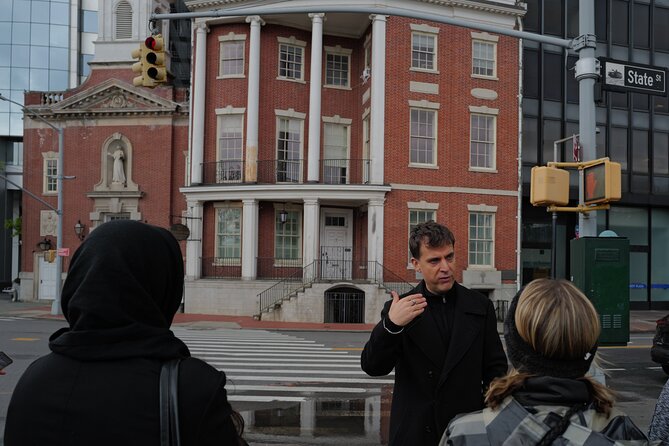
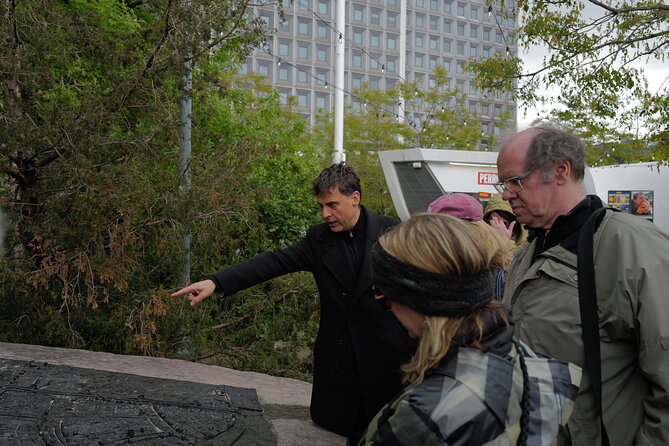
- Professional guide and headsets: Dr. Ivan Shumkov is listed as the guide, and each participant receives an individual headset.
- Useful end point: The tour finishes inside the Oculus PATH station, near major subway connections.
Why this Lower Manhattan walk works
I like tours that give a neighborhood a clear shape, and this one does that well. You begin at Castle Clinton in Battery Park, close to New York Harbor, then walk north through the old financial district before reaching the World Trade Center complex.
That progression matters. You are not simply ticking off famous buildings. You can compare different eras of city design in a short period: nineteenth-century churches, grand civic buildings, early twentieth-century towers, postwar corporate architecture, and the angular forms of the rebuilt World Trade Center.
The route also mixes major sights with useful local explanation. The guide is expected to go beyond basic guidebook facts and answer questions along the way. The tour listing names licensed guide Dr. Ivan Shumkov, while one account of the experience mentions a guide named William who helped a group reach a lunch reservation afterward. Guide assignments can vary, so check the confirmation for the name connected with your departure.
At $59 per person, the price is reasonable if you want a guided introduction to Lower Manhattan rather than a simple self-guided walk. You are paying for about two hours with a professional guide, individual headsets, and a group limited to 15 people. The value is weaker if you plan to spend serious time inside the museum, church, or other buildings, since most stops are brief and admission to interior attractions is not the main purpose.
More Wall Street and Financial District Tours:
- NYC City Tour: Statue of Liberty, 9/11 Memorial, Wall Street
★ 4.5 · 2,059 reviews - Wall Street Insider Tour with a Finance Professional
★ 4.5 · 660 reviews - Wall Street Insider Tour with a Finance Professional
★ 4.5 · 571 reviews
Battery Park and the Glass Carousel starting point
The walk begins at the Glass Carousel in Battery Park, at Castle Clinton National Monument. This is a practical meeting point with a strong sense of place. You are at the southern edge of Manhattan, where the harbor, park, and financial district meet.
The opening stop lasts about ten minutes and does not require an admission ticket. Expect an introduction to the route and the setting rather than a long visit inside a building.
Give yourself enough time to find the meeting point. Battery Park has several paths, monuments, and entrances, and the official starting location is Castle Clinton National Monument, not the Oculus or a general Financial District address.
Trinity Church and the early financial district
From Battery Park, the walk continues to Trinity Church, a landmark dating from 1846. The scheduled visit is short, about five minutes, so this is mainly a guided look rather than an extended church visit.
Trinity Church helps you understand how old Lower Manhattan is beneath its modern office towers. It also creates a sharp visual contrast with the commercial buildings that surround it. I would pay close attention to the guide’s explanation here, since the value of a brief stop comes from context rather than time spent inside.
The tour then points out the Federal Reserve building by York and Sawyer, completed in 1924. The building is associated with the storage of much of the world’s gold, which gives the stop an unusual financial angle. You should not expect a vault visit. The attraction here is the exterior, the institution, and the role this district plays in global finance.
Federal Hall and the Woolworth Building
Federal Hall, designed by Town and Davis and dating from 1842, is another short stop of about five minutes. It is a useful counterpoint to the Federal Reserve. One represents an earlier civic and national era, while the other points to the machinery of modern finance.
The route also brings you near the Woolworth Building, designed by Cass Gilbert and completed in 1912. This is one of the more visually memorable buildings on the walk. Its scale and detail make it an important example of early skyscraper design, and it helps explain why Lower Manhattan became a symbol of vertical ambition.
Since the schedule is tight, the guide will likely keep moving after pointing out the building. If you want interior access or a close study of decorative details, plan a separate visit if that is available to you. This tour is better at connecting the buildings than lingering over one façade.
More NYC Skyline and Architecture Tours:
- Statue of Liberty & NYC Skyline Cruise – Freedom Liberty Tour
★ 4.0 · 1,499 reviews - Manhattan Architecture Yacht Cruise
★ 5.0 · 1,395 reviews - NYC: Dyker Heights Christmas Lights & Skyline View Bus Tour
★ 4.7 · 1,192 reviews - From Manhattan: Dyker Heights Lights & Skyline Tour
★ 4.6 · 1,005 reviews
One Chase Manhattan Plaza and modern corporate design
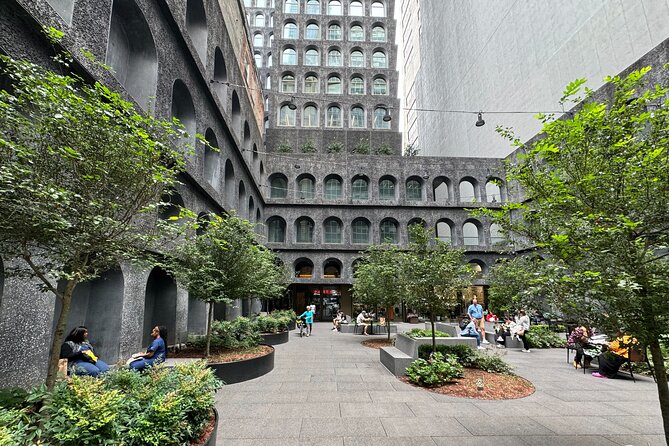
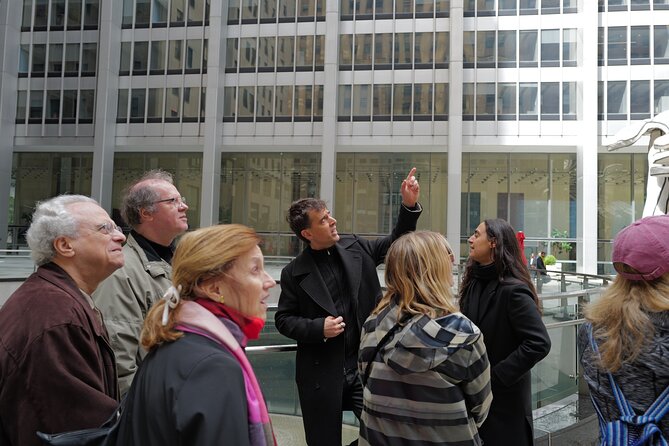
One Chase Manhattan Plaza, designed by Gordon Bunshaft of Skidmore, Owings and Merrill and completed in 1960, brings the tour into the postwar period. The stop lasts about ten minutes and includes the building’s public art and architecture.
This is one of the places where a guide adds real value. A modern office plaza can be easy to pass without a second glance, but the design reflects a different idea of how a financial company should present itself. The building, open space, and art work together in a way that differs sharply from the older masonry landmarks nearby.
I appreciate this part of the route because it prevents the walk from becoming a parade of only famous old buildings. You get a more complete view of Lower Manhattan, including the clean lines and public spaces associated with mid-century corporate design.
Fulton Center and the leap to 8 Spruce Street
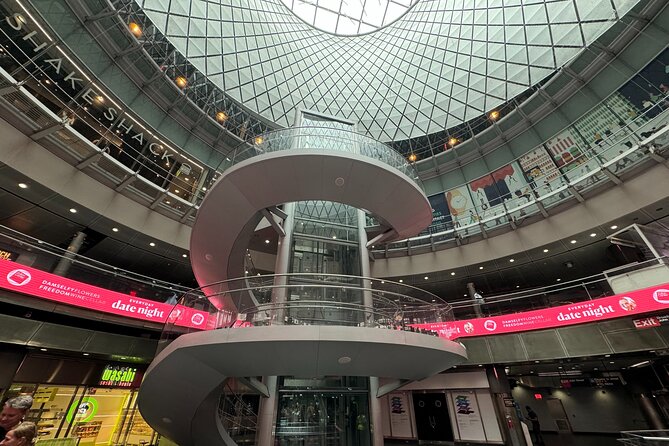
Fulton Center, completed by Grimshaw in 2015, is another quick stop. The building is a transportation hub, so it gives you a chance to see how architecture can shape a daily commute as well as a skyline.
The tour also points out 8 Spruce Street, designed by Frank Gehry and completed in 2010. Known for its unusual exterior, the residential tower adds a sculptural note to the route. Its form differs greatly from the nearby office towers and civic buildings.
These stops show the tour’s broad design range. In just a few blocks, you move from a historic church to a major transit project and then to a contemporary residential skyscraper. The drawback is that the timetable allows only a short look at each. You will want to remember the names and return later if one building catches your interest.
Ground Zero and the 9/11 Memorial area
The tour visits the National September 11 Memorial and Museum, designed by Snohetta, Michael Arad, and Peter Walker, with the memorial completed in 2011. The scheduled stop is about ten minutes.
This part of the walk requires a respectful pace. The memorial is not simply another architectural sight. It is a place of remembrance, and the guide’s role is to help you understand the design and setting without turning the visit into a rushed photo stop.
The museum is included in the route, but the tour price does not list museum admission as a separate inclusion. Treat this as an exterior and site visit unless your confirmation says otherwise. If you want time inside the museum, plan that for a different part of your day.
A professional photo is also listed among the tour highlights. The supplied details do not explain exactly where or when it is taken, so ask the guide at the start if that keepsake matters to you.
Saint Nicholas Church and the Perelman Performing Arts Center
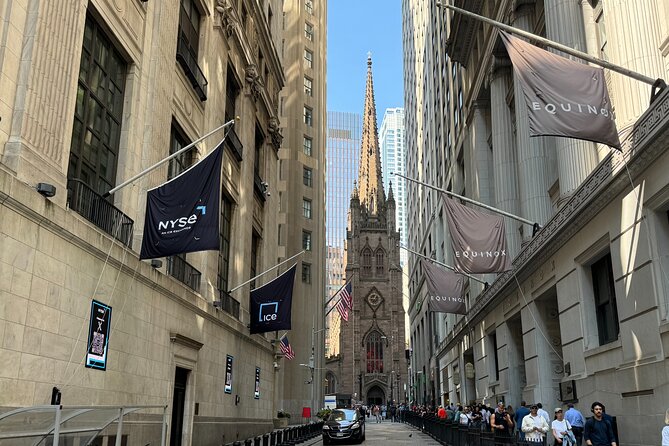
The route continues to Saint Nicholas Greek Orthodox Church and National Shrine, designed by Santiago Calatrava and completed in 2020. The visit lasts about five minutes.
This church is especially interesting because it brings a place of worship into the rebuilt World Trade Center district. Its design is by the same architect responsible for the Oculus, but the building serves a very different purpose. That contrast makes the stop more meaningful than a quick architectural photo alone.
Next comes the Perelman Performing Arts Center, designed by REX and completed in 2023. Its presence shows that the World Trade Center site is not only a memorial and office district. It also includes space for culture and performance.
Both stops are brief, so you should expect an explanation from the outside rather than a full interior tour. The value lies in seeing how different architects and institutions have shaped the area over time.
Liberty Park and the World Trade Center buildings
At World Trade Center Liberty Park, the guide points out the surrounding buildings, including One World Trade Center, Two World Trade Center, Three World Trade Center, Four World Trade Center, Five World Trade Center, and Seven World Trade Center.
The buildings represent several stages of the site’s redevelopment. One World Trade Center was designed by David Childs of SOM and completed in 2015. Three World Trade Center, by Richard Rogers, and Four World Trade Center, by Fumihiko Maki, were also completed in the mid-2010s. Seven World Trade Center was designed by David Childs of SOM and completed in 2015.
Two World Trade Center and Five World Trade Center are listed as in process. That detail is useful because the skyline and pedestrian experience continue to change. If you return to Lower Manhattan later, you may see a different version of the district.
The scheduled stop lasts about ten minutes. Liberty Park provides a useful viewpoint, but this is not a dedicated skyline photography session. The guide is likely to focus on the buildings, the rebuilding process, and how the pieces fit together.
Ending inside the Oculus
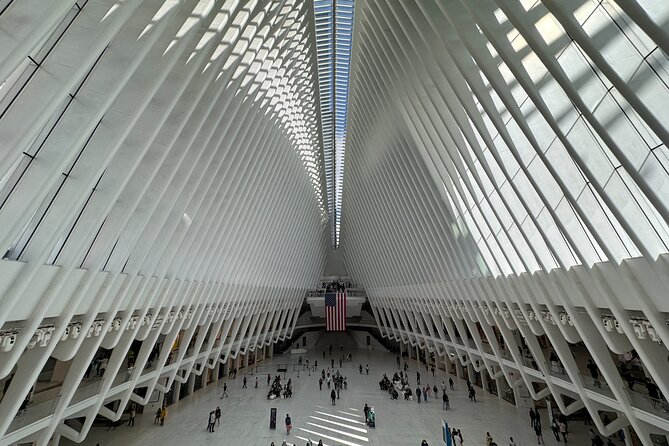
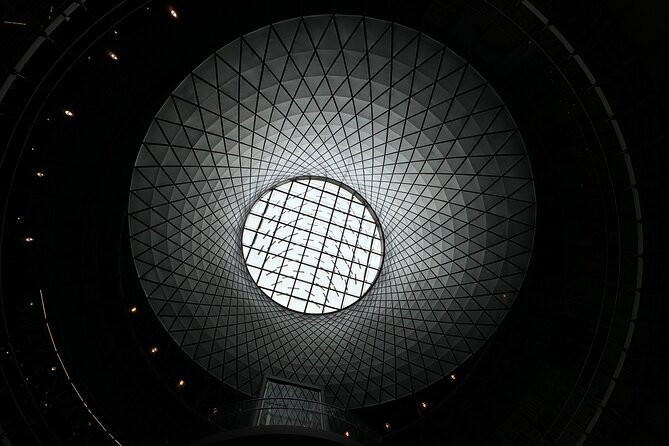
The tour ends at the Oculus PATH station at the World Trade Center, at 185 Greenwich Street. The building was designed by Santiago Calatrava and completed in 2015.
This is a strong ending. The Oculus is both a transportation hub and an architectural statement, with a bright interior and a dramatic ribbed form. After seeing older stone buildings, glass offices, memorial spaces, and residential towers, you finish with one of Lower Manhattan’s most recognizable modern structures.
Ending here is also practical. You are near public transportation, and the location works well if you want to continue exploring the World Trade Center district, shop, eat, or connect to another part of the city.
One practical point: the tour finishes inside the Oculus rather than returning you to Battery Park. That makes the route efficient, but you should plan your day around a one-way walk.
Group size, pace, and equipment
The group is capped at 15 people, which is a useful middle ground. You get more personal attention than on a large sightseeing walk, but the tour still has enough people to create a social atmosphere.
Each participant receives a professional individual headset. That matters in Lower Manhattan, where traffic, construction, and city noise can make a walking explanation hard to hear. The headsets should also help you keep listening while standing slightly apart from the guide.
The total time is about two hours. Because the schedule includes many stops, the pace is purposeful. Wear comfortable shoes and expect to remain on your feet for most of the outing. The activity is not recommended for people who have problems walking.
Service animals are allowed, and the route is near public transportation. Most people can take part, but the amount of walking remains the main physical consideration.
Booking, weather, and cancellation details
The experience uses a mobile ticket, and confirmation is provided at booking. It is commonly reserved about 27 days ahead, so booking early is sensible if your New York schedule is fixed.
The price is $59 per person, with fees and taxes included. Tips are not included. Cancellation is free up to 24 hours before the start time, with a full refund. Changes or cancellations inside 24 hours are not accepted for a refund.
The tour requires good weather. If poor weather forces a cancellation, you are offered another date or a full refund. The experience also requires a minimum number of participants. If that minimum is not reached, the provider offers another date or experience, or a full refund.
Who should book this walk
I would choose this tour if you want a compact introduction to Lower Manhattan and care about buildings, city planning, and the way the World Trade Center district has changed. It is also a good fit for families with older children and teenagers, since the route mixes recognizable landmarks with visual variety and does not rely only on a solemn museum visit.
The included headsets and small group are valuable for anyone who wants to ask questions without losing the guide’s commentary. The route also works well early in a New York visit because it gives you a map of the Financial District and ends near several other major sights.
I would skip it if you want long interior visits, a slow photography walk, or a tour focused only on the 9/11 Museum. The short stops are designed to connect many sites, not examine each one in detail.
Should you book it?
Book this $59 walk if you want an efficient, guided route through Lower Manhattan with architecture as the main thread. You get Battery Park, Federal Hall, the Federal Reserve, the Woolworth Building, Ground Zero, Liberty Park, and the Oculus in one directionally sensible outing.
The best reason to book is the combination of small-group attention and architectural range. The main caution is the pace. If you are comfortable walking steadily and prefer seeing many landmarks with context, this is a strong choice. If you prefer to linger, choose fewer sights and explore them independently.
FAQ
How long does the Financial District architecture tour last?
The tour lasts approximately two hours.
How much does the tour cost?
The price is $59 per person.
Where does the tour begin?
The tour begins at Castle Clinton National Monument in Battery Park, near the Glass Carousel, at Liberty Island, New York, NY 10004.
Where does the tour end?
The tour ends inside the Oculus PATH station at the World Trade Center, at 185 Greenwich Street, New York, NY 10006.
What is the maximum group size?
The tour has a maximum of 15 participants.
Is a mobile ticket available?
Yes. The experience uses a mobile ticket, and confirmation is provided at the time of booking.
Are headsets provided?
Yes. Each participant receives an individual professional headset.
Are admission fees included?
All fees and taxes are included. The listed stops do not require a separate admission ticket as part of the walking route. Tips are not included.
Is the tour suitable for people with walking problems?
The tour is not recommended for people who have problems walking. Most people can participate, but the route covers many stops on foot.
What happens if the weather is poor?
The experience requires good weather. If it is canceled because of poor weather, you are offered a different date or a full refund.
More NYC Walking Tours
- SoHo, Little Italy, and Chinatown Walking Tour in New York
★ 5.0 · 3,153 reviews - Secrets of Grand Central Station Walking Tour New York City
★ 5.0 · 1,796 reviews - Greenwich Village Walking and Food Tasting Tour
★ 5.0 · 1,572 reviews - Artistic, Alternative Greenwich Village Walking Tour
★ 5.0 · 971 reviews
Recently added in New York City
- NYC Central Park Bicycle Rental All Day Pass★ 4.5 · 5 reviews
- NYC Airports All Inclusive Private Arrival Transfer JFK LGA EWR★ 4.5 · 35 reviews
- Bike Rental-Easy GO NYC★ 3.5 · 3 reviews
- NYC Adventure Pass – Edge Observation Deck, The Beast and RiseNY★ 4.5 · 21 reviews
- NY: Statue of Liberty, Ellis Island, 9/11 Memorial Museum, Cruise★ 3.5 · 3 reviews
- NYC After-Dark Photography Tour★ 5.0 · 15 reviews
- New York Tours and New York City Sightseeing Tours.Flexible Tours★ 5.0 · 19 reviews
- Guided Tour in the West Village of New York City★ 5.0 · 4 reviews
Wall Street and Financial District Tours, compared.

NYC City Tour: Statue of Liberty, 9/11 Memorial, Wall Street
Read our review →
Wall Street Insider Tour with a Finance Professional
Read our review →Wall Street Insider Tour with a Finance Professional
Read our review →
Manhattan Group Tour Including Wall Street and 911 Memorial
Read our review →
Wall Street Tour with 9/11 Memorial and Statue Ferry
Read our review →
Wall Street and Financial District Walking Tour
Read our review →
Wall Street, Financial District Walking Tour Lower Manhattan, NYC
Read our review →Browse the lists this tour appears in