Reviewed · PRIVATE
Private Theatre District Tour
Broadway’s magic is easier to grasp when you stop looking only at the marquees. This private two-hour walk connects the Majestic Theatre, Sardi’s, Hamilton’s Richard Rodgers Theatre, Times Square, and Wicked’s Gershwin Theatre while an industry professional explains how the theater district grew into the center of American musical theater.
I like the direct access to people who understand the business, and I like the focus on stories you would miss while rushing between shows. Patrick is praised for his warm storytelling, while Lucas is noted for explaining the theaters in a way that worked well for both adults and a theater-loving child. The main drawback is simple: you do not enter the theaters, so this is a street-level history tour, not a backstage visit.
Key points to know before booking
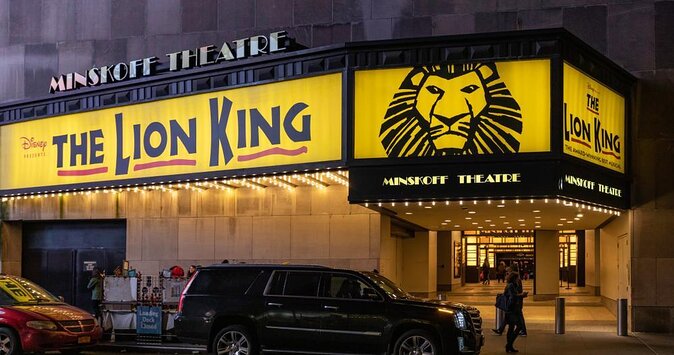
- Start at the Majestic Theatre: Meet outside the home of The Phantom of the Opera at 245 West 44th Street.
- Finish near Wicked: The walk ends outside the Gershwin Theatre on West 51st Street.
- Private format: Only your group takes part, which gives you room to ask questions and shape the conversation.
- Broadway stories, not show tickets: You learn about venues, creators, musical theater, and Times Square, but admission is not included.
- A real walking tour: Wear comfortable shoes and prepare for all-weather conditions.
- Strong guide element: Patrick and Lucas have received especially warm praise for storytelling, theater facts, and personal anecdotes.
Starting beneath the Majestic Theatre marquee
The tour begins outside the Majestic Theatre at 245 West 44th Street. That is a useful meeting point because the building is one of Broadway’s best-known homes, and the opening conversation immediately places you inside the working theater district rather than at a general New York sightseeing stop.
Your guide starts with the Majestic and the productions connected with it, including The Phantom of the Opera. The point is not simply to identify the building. You get a sense of how one theater can carry several layers of Broadway history, with different shows and creative teams passing through the same doors over many years.
This opening also gives you a chance to settle into the pace. The tour lasts about two hours, and much of that time is spent outdoors, walking from one theater to another. You should arrive ready to move rather than expecting a seated talk or a theater visit.
Because the tour is private, you can ask questions as they come up. That matters here. A public group tour often has to keep moving through a fixed script, while a private walk gives your guide more room to explain the part of Broadway that interests you most, such as performance, directing, choreography, composing, or the business side of producing a show.
More New York City Tours:
- NYC: SUMMIT One Vanderbilt Tickets
★ 4.7 · 51,195 reviews - NYC: Empire State Building Tickets – Observatory & Museum
★ 4.7 · 25,757 reviews - New York City: Statue of Liberty & Ellis Island with Ferry
★ 4.6 · 18,683 reviews
From Sardi’s to the Shubert Theatre
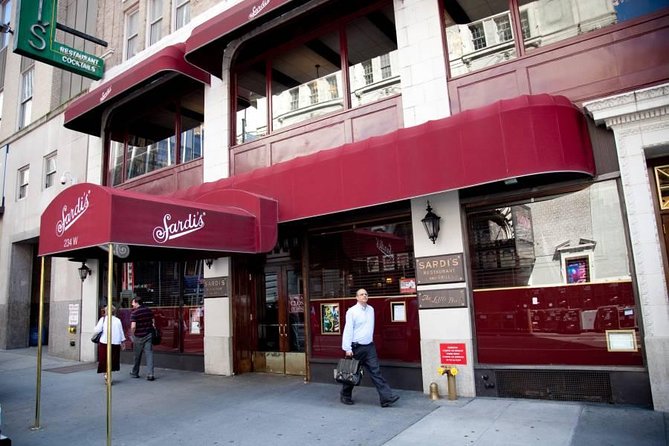
After the Majestic, the route heads along the theater-lined streets toward Sardi’s. This famous restaurant has long been associated with Broadway people and theater fans, making it a natural stop for a discussion of the social life around the shows.
You will view Sardi’s from outside rather than sit down for a meal. That is worth knowing before you book. The value of the stop is the context: your guide can explain why certain restaurants and gathering places became part of the theater world, and how the district works beyond the performance inside each auditorium.
The walk continues toward the Shubert Theatre. Here, the focus shifts back to the buildings themselves and the creative work that has taken place in them. The tour is designed to show how close these theaters are to one another, yet each has its own name, identity, and place in Broadway’s story.
I like this part because it helps you read the streets differently. Without a guide, the theater district can look like a wall of bright signs and ornate entrances. With the right explanation, you start to see the area as a cluster of working venues where actors, directors, producers, choreographers, and composers have shaped more than a century of theater.
Theater names along West 45th Street
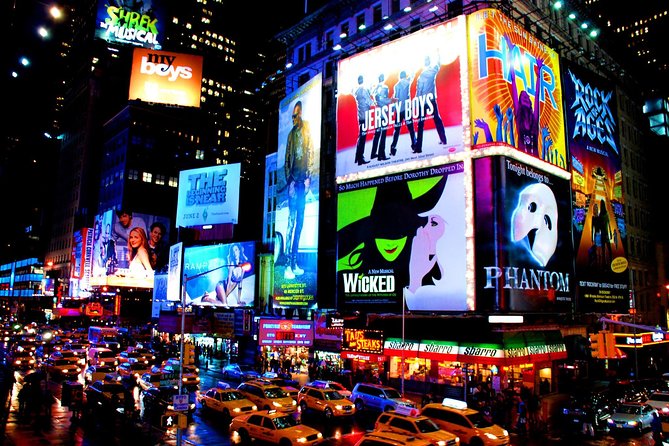
The route turns onto West 45th Street, where you pass a dense run of major theaters. The Booth Theatre, Jacobs Theatre, Golden Theatre, Imperial Theatre, Hirschfeld Theatre, and Music Box Theatre are all part of this stretch.
The guide’s job here is less about rushing from one photo stop to the next and more about attaching stories to the buildings. You will hear about the venues and the productions associated with them, along with the way Broadway’s creative roles fit together.
This is also where a private format earns its keep. If you are interested in how a musical is built, you can ask about the relationship between a composer, lyricist, director, choreographer, producer, and performers. If your interest is more historical, you can stay with the changing role of the theaters and the district itself.
There is a practical limitation. These are exterior views, and you should not assume that a theater lobby or backstage area will be open. Lobby and backstage access is not guaranteed. The walk works best for someone who values explanation and atmosphere more than interior access.
The Marriott Marquis and the Marquis Theatre
The next part of the walk brings you to the Marriott Marquis Hotel and the Marquis Theatre. You learn about the hotel, the theater, and what occupied this area before the current complex was built.
That detail gives the tour a wider New York frame. Broadway is not frozen in an old photograph. Hotels, theaters, businesses, and streets have changed, and the district has been rebuilt and reshaped over time. Learning what used to stand here helps you see Times Square as an evolving part of Manhattan rather than a collection of permanent signs.
The Marriott Marquis is also a useful landmark within the route. It helps break up the line of theater facades and shows how large modern developments sit alongside older theater institutions. You will view the venues from outside, so this stop remains part of the walking narrative rather than a hotel visit.
If you are planning to see a Broadway show later the same day, the route may help you understand the area before you return for your performance. Just leave enough time for your ticketed event, since the tour does not include transportation and traffic around Times Square can make a short distance feel slow.
More Private in New York City:
- Private Central Park Pedicab Tour
★ 5.0 · 6,981 reviews - Private Transfer from Manhattan to NYC Airports (JFK/EWR/LGA)
★ 3.5 · 1,683 reviews - New York City: Private Central Park Pedicab Tour
★ 4.9 · 1,637 reviews - Carriage Ride in Central Park (VIP – PRIVATE) Since 1964™
★ 4.0 · 1,074 reviews
Hamilton at the Richard Rodgers Theatre
The Richard Rodgers Theatre is one of the most important stops for anyone interested in modern Broadway. It is the home of Hamilton, and the guide uses the theater to discuss the musical’s cultural impact and the way it became a major phenomenon.
You should expect an outside view, not a tour of the theater interior or a Hamilton ticket. Still, this is a meaningful stop because it links the physical building with a show that changed recent conversations about casting, American history, hip-hop, and the musical form.
The larger theme is the creation of the musical. You will hear about how musical theater developed, how the golden age shaped the form, and how later productions pushed it in new directions. Hamilton gives the conversation a current reference point, but the tour is not limited to one show.
This section should appeal to you if you want more than a list of famous titles. A good guide can explain why a production matters, how different creative jobs fit together, and why a theater district remains important even when individual shows close.
Duffy Square and the making of Times Square
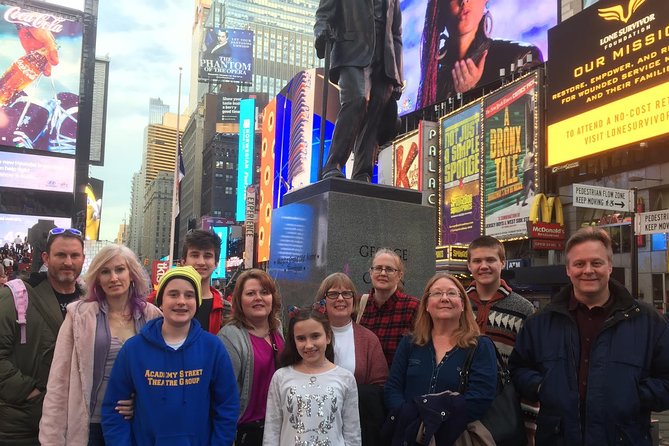
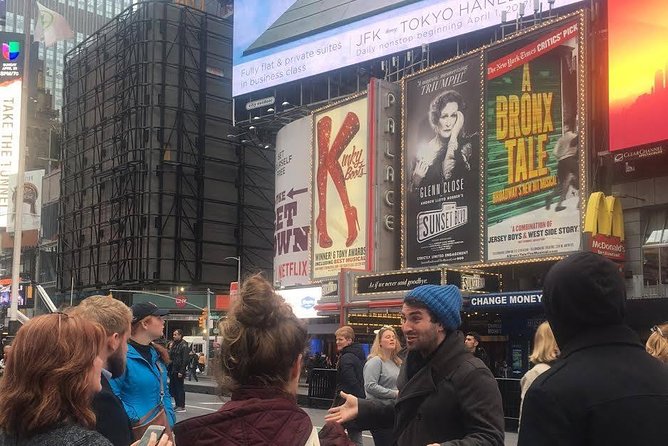
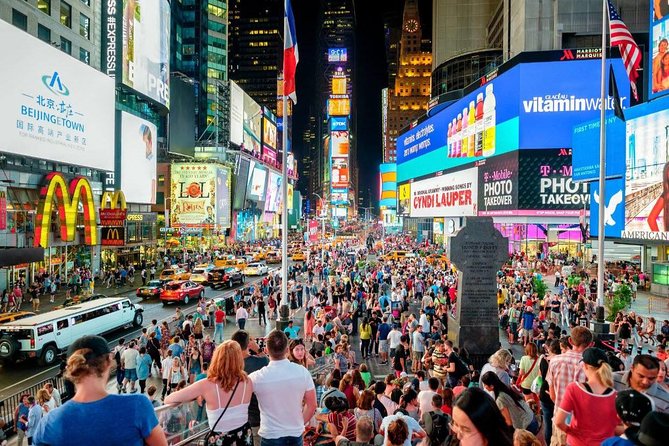
The walk continues to Duffy Square, the central part of Times Square. Here, the focus broadens from Broadway to the neighborhood that made Broadway famous.
You learn how Times Square became such a well-known location. The tour connects the theaters with the larger public image of the area, including the signs, crowds, hotels, restaurants, and constant attention that now define it.
This is likely to be the busiest portion of the walk. You should be prepared for noise, crowds, and frequent stops on sidewalks. The guide needs to keep the group together while still being heard, and comfortable shoes matter more than stylish footwear.
Duffy Square is a good place to ask questions about how the theater district became a symbol of New York. It also gives you a chance to understand the difference between Times Square as a commercial spectacle and Broadway as a working art form. They overlap, but they are not quite the same thing.
Hell’s Kitchen and the Off-Broadway connection
After Times Square, the route passes more theaters and moves into stories about Hell’s Kitchen. The neighborhood adds another layer to the walk, since the theater district does not exist in isolation from the surrounding streets.
The guide also introduces you to Off-Broadway. That matters because Broadway is only one part of New York’s theater world. Off-Broadway venues often operate on a different scale, and they have their own role in developing plays, musicals, performers, and creative ideas.
The tour does not promise visits to Off-Broadway theaters, and the supplied details do not identify specific Off-Broadway venues on the route. Think of this section as an introduction to the wider theater scene rather than a separate Off-Broadway tour.
I find that useful for first-time visitors who assume every important New York production happens inside a Broadway house. The discussion helps explain why the city’s theater culture extends beyond the best-known marquees.
Ending at the Gershwin Theatre
The final stop is the Gershwin Theatre at 222 West 51st Street, home of Wicked. Ending here gives the walk a clear modern Broadway finish.
As with the Richard Rodgers Theatre, you view the building from outside. The guide can connect Wicked with the broader story of the musical, the theater district, and the shows that continue to draw audiences to this part of Manhattan.
The end point is convenient if you have plans nearby, but no transportation is included. The activity begins at the Majestic Theatre and ends at the Gershwin Theatre, so you should plan your route to and from those locations yourself.
The two-hour length is well judged for a walking introduction. It is long enough to cover a substantial number of theaters and themes, but short enough to fit into a day that also includes a museum, meal, or Broadway performance.
What the private format adds at $80
The price is $80 per person. That is not the cheapest way to look at Broadway’s theaters, since you can walk through Times Square on your own for free. The real question is whether you want interpretation, access to an industry professional, and the freedom to ask questions.
For a private group, the price can make sense, especially if several people share an interest in theater. You are not paying for admission to a building. You are paying for two hours of focused commentary, a planned route, and a guide who can connect individual theaters to the development of musical theater and New York culture.
The strongest value comes when your group is curious and engaged. Patrick has been praised for his storytelling, historical background, and obvious love of theater. Lucas has been singled out for explaining Broadway theaters in a way that worked for both adults and a theater-loving child.
Those names should not be treated as a guarantee that either guide will lead your booking. Still, they show the kind of guide this experience is built around: someone who can add anecdotes and context rather than simply point at buildings.
The price is harder to justify if you mainly want interior access, a backstage visit, or a ticketed theater experience. None of those are included. The tour should supplement a Broadway show, not replace one.
Who will get the most from this walk
I would recommend this tour most strongly to:
- People who already love musical theater and want more background on how Broadway works.
- First-time New York visitors who want a guided introduction to Times Square and its theaters.
- Families with a theater-loving child, provided the child is under the supervision rules.
- Small groups who prefer a private conversation instead of a large scheduled tour.
- Visitors planning to see Hamilton, Wicked, or another Broadway show who want more context beforehand.
- Anyone who enjoys stories about creative work, theater buildings, and the people behind productions.
It may not suit you if you dislike walking, want guaranteed indoor access, or prefer a tour built around one specific production. The route covers many theaters, so the experience is broad rather than a detailed examination of one show.
Children under 18 must be accompanied by an adult at least 21 years old. Service animals are allowed, and the tour is near public transportation. Most people can take part, but you should still be comfortable walking for about two hours.
Timing, weather, and what to wear
The tour operates Monday through Sunday between 10:00 a.m. and 4:00 p.m. Confirmation is sent within 48 hours of booking, subject to availability, and the experience is commonly booked about 14 days ahead. If you have a particular date in mind, booking early is sensible.
Wear shoes you can walk in comfortably. The route covers several blocks and includes frequent stops on city sidewalks. The tour runs in all weather conditions, so dress for the forecast rather than assuming the theater district will provide shelter.
If dangerous weather cancels the experience, you can choose another date or receive a full refund. You can also cancel for a full refund up to 24 hours before the start time. Cancellations or changes made less than 24 hours ahead are not accepted for a refund.
The experience is offered in English. An audio guide that translates the tour is not included, so you should be comfortable following spoken English for the full two hours.
Should you book the Private Theatre District Tour?
Book it if you want Broadway explained by someone who knows the theater world and you value stories more than entry tickets. The route covers the Majestic, Sardi’s, Shubert, the West 45th Street theaters, the Marriott Marquis, Richard Rodgers, Duffy Square, Hell’s Kitchen, Off-Broadway, and the Gershwin Theatre in one focused walk.
Skip it if you are hoping to go backstage or step inside several theaters. You will see the venues from outside, and the quality of the experience depends heavily on the guide’s ability to tell a good story.
At $80 per person, I see this as a specialist tour for theater fans rather than a basic Times Square orientation. If Patrick, Lucas, or another strong industry guide leads your walk, the private format gives you a chance to ask the questions that make Broadway feel less like a row of bright signs and more like a living creative district.
FAQ
Where does the tour begin?
The tour begins outside the Majestic Theatre at 245 West 44th Street, New York, NY 10036.
Where does the tour end?
The walk ends outside the Gershwin Theatre at 222 West 51st Street, New York, NY 10019.
How long does the tour last?
The tour lasts approximately two hours.
Is the tour private?
Yes. Only your group participates in the private tour.
Does the tour include theater admission?
No. Entrance to theaters is not included, and backstage or lobby access is not guaranteed.
What language is the tour offered in?
The tour is offered in English. An audio guide that translates the tour is not included.
What should I wear?
Wear appropriate walking shoes and dress for the weather. The tour operates in all weather conditions unless dangerous weather causes cancellation.
Can I cancel for a refund?
Yes. You can cancel at least 24 hours before the start time for a full refund. If dangerous weather cancels the tour, you can choose another date or receive a full refund.
Recently added in New York City
- Private Tour: Niagara Falls Day Trip from New York City★ 4.0 · 4 reviews
- Private Tour of Historic Lower Manhattan and the Financial District NYC★ 5.0 · 6 reviews
- New York Private Food Tour with 6+ Tastings in Greenwich Village★ 5.0 · 107 reviews
- Brooklyn, Queens, and the Bronx Private Tour with a Driver-Guide★ 4.5 · 8 reviews
- Private Tour: Personal Travel Photographer Tour in New York★ 5.0 · 24 reviews
- Private Walking Tour: 5th Avenue and the Gilded Age Mansions★ 5.0 · 4 reviews
- Private Tour New York City in the Gilded Age: A History of High Society★ 5.0 · 125 reviews
- Private Tour Alexander Hamilton and the Founding Fathers New York City★ 5.0 · 23 reviews
Private, compared.

Private Transfer from Manhattan to NYC Airports (JFK/EWR/LGA)
Read our review →

Carriage Ride in Central Park (VIP – PRIVATE) Since 1964™
Read our review →