
Reviewed · NYC WALKING TOURS
Private Walking Tour: Footsteps of Dylan and Springsteen
Bob Dylan and Bruce Springsteen did not begin as legends. They began in small Village rooms, playing for modest pay, chasing an audience, and sharing stages with musicians who later shaped American music. This private walk follows those early footsteps through Greenwich Village, with stops tied to Dylan, Springsteen, Joni Mitchell, Jimi Hendrix, and others.
I like the one-group format, which lets Ann McDermott adjust the pace and spend more time on the stories that interest you. I also like the use of historic photos, concert advertisements, and newspaper clippings, a useful way to connect today’s streets with the clubs that once filled them.
The main drawback is that this is a two-hour walking tour built around exterior sites and neighborhood storytelling. Several famous venues no longer operate in their original form, and the experience requires good weather. If you want live music or entry into historic clubs, this is not that kind of tour.
Key points at a glance
- Follow Dylan’s Greenwich Village years: See the former Hotel Earle, Cafe AuGoGo, The Gaslight Cafe, Gerde’s Folk City, and the former home of Bob Dylan and Suze Rotolo.
- Stand at the Freewheelin’ album-cover corner: The tour ends at Jones Street and West Fourth Street, where Dylan and Rotolo were photographed.
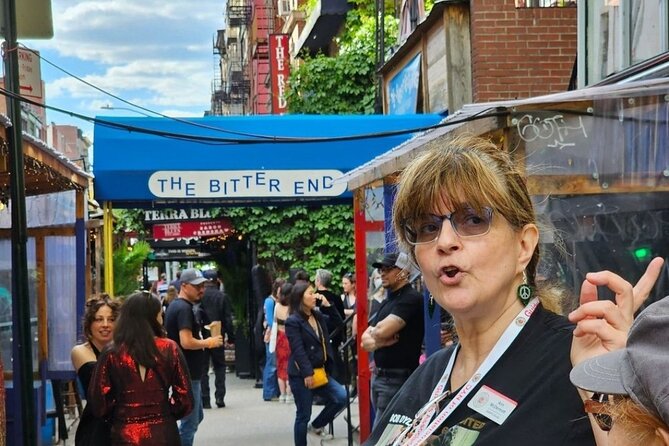
- Hear the Village’s performance history: Washington Square Park, The Bitter End, and Cafe Wha? each tell a different part of the neighborhood’s music story.
- Use a private guide’s visual archive: Ann brings historic photos, concert advertisements, and newspaper clippings to help you picture lost venues.
- Keep an easy pace: You can stop for photographs and ask questions without keeping up with a large group.
- Plan for weather: The tour is outdoors, lasts about two hours, and may be rescheduled or refunded if conditions are poor.
Why Greenwich Village matters to Dylan and Springsteen
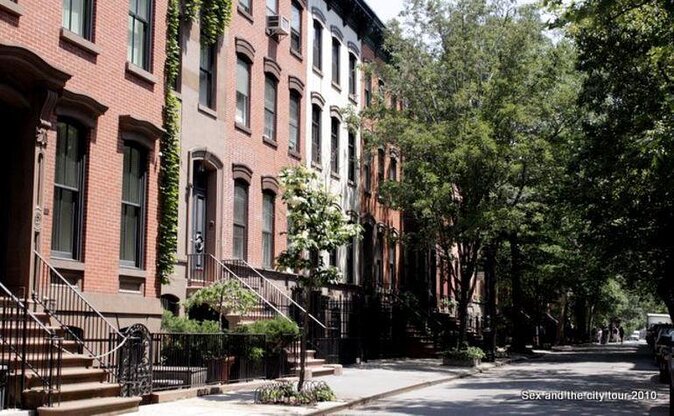
Greenwich Village is more than a pleasant area for a walk. For decades, it gave young musicians a place to play, listen, experiment, and meet other performers. The clubs were often small, the pay modest, and the line between audience and performer fairly thin.
That setting matters to this tour. You are not simply being shown a list of famous addresses. You are being led through the streets where careers took shape, with attention to the music rooms, coffeehouses, parks, and apartments that formed the neighborhood’s informal network.
Bob Dylan’s connection is especially strong. His early Village years are tied to Washington Square Park, Cafe Wha?, The Gaslight Cafe, Cafe AuGoGo, Gerde’s Folk City, and the apartment he shared with Suze Rotolo. Bruce Springsteen appears in the story through Cafe Wha? and the Village’s wider club circuit.
I would book this for the setting as much as for the musicians. You get a sense of how close together many of these places were, and why a young performer could move through the neighborhood, hear another act, meet a musician, and find another stage nearby.
More NYC Walking Tours:
- SoHo, Little Italy, and Chinatown Walking Tour in New York
★ 5.0 · 3,153 reviews - Secrets of Grand Central Station Walking Tour New York City
★ 5.0 · 1,796 reviews - Greenwich Village Walking and Food Tasting Tour
★ 5.0 · 1,572 reviews
Starting at West Fourth Street
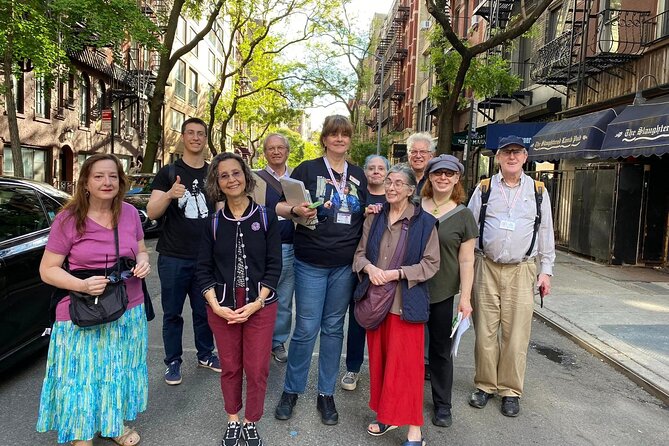
The meeting point is 1 West Fourth Street, with an 11 a.m. start. The walk then moves through Greenwich Village at a relaxed pace. Since this is a private experience, your group is the only group participating, which gives the guide room to shape the conversation around your interests.
Ann McDermott is a native New Yorker, and her personal connection to the city helps give the walk a local feel. Her approach is not limited to dates and names. She uses a binder of historic photographs, newspaper clippings, and concert advertisements, which is particularly useful when the original buildings have changed or disappeared.
That visual material solves one problem common to music history walks. A present-day storefront or apartment building can tell you very little on its own. Seeing an old concert notice or photograph helps you picture the room, the performers, and the period being discussed.
The walk is not described as strenuous, but you should be comfortable walking outdoors for about two hours. Wear shoes that can handle city sidewalks, and consider the season carefully. One very cold-day outing required hand and foot warmers, so winter visitors should dress for standing outside as well as walking.
Washington Square Park, the Village’s open-air stage
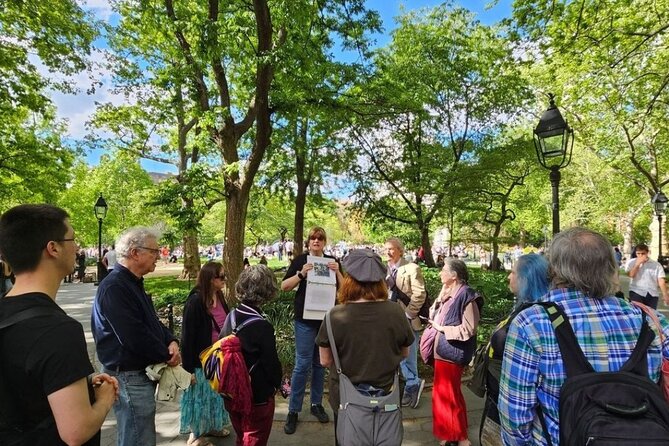
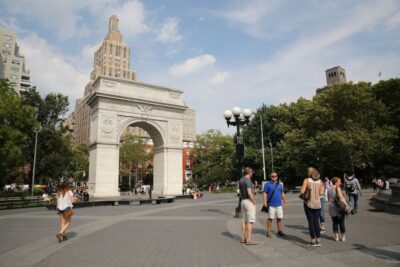
Washington Square Park is the spiritual center of the walk. It has long been associated with spontaneous music, public gatherings, and free speech. During the 1960s, Sunday hootenannies brought musicians together in the park, and Bob Dylan is closely linked to that early Village setting.
The park gives you a helpful contrast to the clubs. Inside a small venue, a performer faced a paying audience and a stage. In the park, musicians could play in a looser public setting, surrounded by passersby and other performers.
The park segment lasts about 30 minutes and includes an audio tour component. That extra time makes sense because the site is not just a quick photo stop. It helps explain the social side of Greenwich Village music, including the connection between folk performance and free speech.
I like this part of the experience because it shows that the Village music scene was not created only by club owners. Public space mattered too. If you care about the cultural setting behind the songs, Washington Square Park may be one of the most useful stops.
The tradeoff is that the park itself does not offer a preserved 1960s performance room. You are using the setting and the stories to imagine what happened there. The value comes from Ann’s explanation and the historic material, not from seeing an intact old venue.
The Bitter End and the clubs that survived
The Bitter End is one of the most important stops because it remains connected to live music. The club helped launch performers who later became widely known, including Taylor Swift, and its earlier years were tied to Bob Dylan, Joni Mitchell, John Denver, and many other major names.
That gives the tour a link between the Village’s past and its continuing music life. You can discuss the 1960s and 1970s without treating that era as sealed off from the present.
The stop lasts about 30 minutes. That is generous for a club frontage, but the point is not simply to look at the entrance. Ann can place The Bitter End within the wider network of Village rooms and explain how different performers moved through them.
You should keep your expectations clear. The tour does not state that admission to a performance or an interior visit is included. Treat The Bitter End as a historical and exterior stop, with the club’s ongoing role providing context.
For me, this is also where the tour works best for people who like music beyond Dylan and Springsteen. Joni Mitchell and John Denver broaden the story, while the mention of Taylor Swift shows how the Village club tradition continues to matter.
A completely different way to spend a day in New York City:
- NYC: SUMMIT One Vanderbilt Tickets
★ 4.7 · 51,195 reviews - NYC: Empire State Building Tickets – Observatory & Museum
★ 4.7 · 25,757 reviews - New York City: Statue of Liberty & Ellis Island with Ferry
★ 4.6 · 18,683 reviews - New York City: American Museum of Natural History Ticket
★ 4.5 · 15,447 reviews
Cafe Wha? and early-career ambition
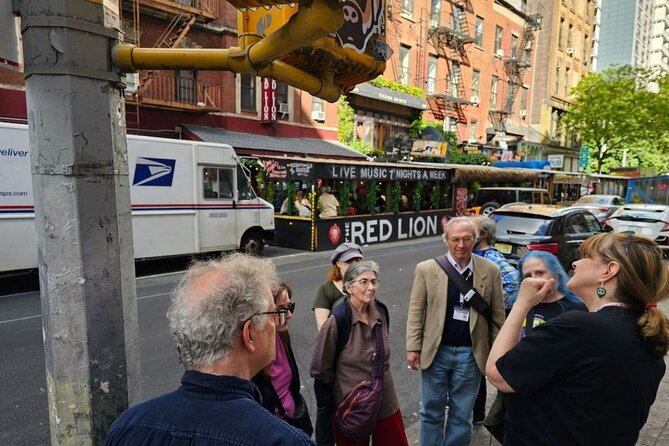
Cafe Wha? is another major stop. Dylan, Jimi Hendrix, and Bruce Springsteen all played there before they became famous. Dylan is said to have done backup harmonica work for one dollar a day, a small detail that brings the early-career struggle into focus.
That detail is valuable because it strips away the mythology. Before the records, awards, and large stages, musicians took whatever work they could find. A club like Cafe Wha? could give a performer a first foothold, but it did not guarantee success.
The stop is allotted about 30 minutes. That gives you time to connect the venue to the people who passed through it, rather than treating it as a quick address on a route.
I would pay close attention here if Springsteen is your main reason for booking. The tour title gives him equal billing with Dylan, but the supplied route and stories lean heavily toward the broader Village music scene and Dylan’s early years. You will hear about Springsteen’s early club performances, yet this is not a detailed biography of his entire career.
Former clubs and lost music rooms
The walk also points out sites connected with Gerde’s Folk City, The Bottom Line, Cafe AuGoGo, The Gaslight Cafe, Cafe Society, and The Hotel Earle. These names help map the old music district, even when the original rooms are no longer operating as they once did.
Gerde’s Folk City and The Gaslight Cafe are especially useful for understanding the folk side of the neighborhood. Cafe AuGoGo and Cafe Society add more layers to the club circuit. The Bottom Line connects the story to a later period of New York performance history.
The Hotel Earle and the former home of Dylan and Suze Rotolo bring the focus down from the stage to daily life. Musicians did not only perform in Greenwich Village. They lived nearby, walked the same streets, and built relationships in the neighborhood.
This is where the historic binder earns its place. Without old images and printed material, a vanished club can feel abstract. With them, you can compare the past with the street in front of you and understand how much of the old music district has changed.
You should also expect some stops to be about location rather than access. The tour is designed to tell the story of these sites, not to provide entry into every former club. If you want a preserved interior, check current venue details separately before booking.
Ending at the Freewheelin’ photo location
The tour finishes at Jones Street and West Fourth Street. This corner is tied to the photograph of Bob Dylan and Suze Rotolo used on the cover of The Freewheelin’ Bob Dylan.
The ending is well chosen. After hearing about clubs, parks, apartments, and early performances, you arrive at a precise image known around the world. You can take your own photograph at the same corner, creating a simple souvenir tied to the music history you have just followed.
The final stop also gives the walk a clear shape. It begins in the Village’s performance world and ends with a personal moment from Dylan’s life. That is more satisfying than finishing at an unrelated subway entrance or generic meeting point.
The end location is at Jones Street and West Fourth Street, while the starting point is at 1 West Fourth Street. You should check the exact map details before setting out, especially if you are coordinating this walk with lunch or another activity afterward.
What the private format adds
At $50 per person, the value depends on your group size and interest in the subject. For a private group, the price buys more than a standard neighborhood walk. You get direct access to Ann, a route focused on your group alone, and time for questions without competing with a large crowd.
The format is particularly useful for a pair, a family, or friends on a music-focused trip. A small group can pause for photographs, ask about a favorite artist, or spend extra time at a club that matters most to them.
I would be less certain about the value if you are only mildly curious about Dylan or New York music history. Much of the experience comes through storytelling, historical images, and place-based context. If you prefer major attractions with a clear interior visit, the price may feel less compelling.
The tour is offered in English, and confirmation is sent within 48 hours of booking, subject to availability. It is near public transportation, service animals are allowed, and most people can participate. You can cancel for a full refund up to 24 hours before the start time. Poor weather may lead to a different date or a full refund.
Who should book this Greenwich Village walk
I would recommend it most strongly to:
- Bob Dylan fans who want to connect songs and photographs with real Village addresses
- Bruce Springsteen fans interested in his early club performances
- People who enjoy folk, rock, and singer-songwriter history
- First-time visitors who want a neighborhood walk with a focused subject
- Repeat New York visitors looking for something beyond major sights
- Small groups that prefer a private guide and an easy pace
It also suits a girls’ trip, a couples’ outing, or a day built around music. One group used the walk as part of a trip with three friends, and the format worked because everyone could share the experience without being folded into a large tour.
Ann also offers useful local suggestions during the walk, including ideas for lunch and places to hear live music later that day. Those recommendations can help you turn a two-hour history walk into a full Greenwich Village music day.
My verdict on the Dylan and Springsteen tour
Book this private walk if you want the stories behind Greenwich Village’s music clubs, not just a list of famous names. Ann McDermott’s local background, visual archive, and passion for 1960s and 1970s live music give the route substance.
The strongest parts are Washington Square Park, Cafe Wha?, The Bitter End, and the final Freewheelin’ photo location. The lost venues also matter, but you need to enjoy imagining the past because many stops are viewed from the street.
Skip it if you want a concert, club admission, or a broad New York sightseeing tour. Choose it if you want a focused, personal walk through the places where Dylan, Springsteen, Hendrix, Mitchell, and other performers worked before fame found them.
FAQ
How long is the private walking tour?
The experience lasts approximately two hours.
Where does the tour begin?
It begins at 1 West 4th Street, New York, New York 10012.
Where does the tour end?
It ends at Jones Street and West 4th Street, at the corner connected with the photograph used on the cover of Bob Dylan’s The Freewheelin’ Bob Dylan album.
What time does the tour start?
The listed start time is 11 a.m.
Is this a private tour?
Yes. Only your group participates in the private tour or activity.
What happens if the weather is poor?
The experience requires good weather. If it is canceled because of poor conditions, you will be offered a different date or a full refund. You can also cancel up to 24 hours before the start time for a full refund.
Recently added in New York City
- NYC: Midtown Hands-On Bagel Baking Class★ 5.0 · 12 reviews
- Personalize Sightseeing Tour★ 5.0 · 92 reviews
- Central Park Pedicab Tour with Guide★ 5.0 · 63 reviews
- Central Park Pedicab Guided Tour★ 5.0 · 17 reviews
- Photographer, Professional Photo shoot – New York★ 5.0 · 16 reviews
- Official Central Park Pedicab Ride ( UP TO 3 PERSONS )★ 5.0 · 4 reviews
- JFK or LGA package only (Round trip transfer plus VIP Contrasts)★ 5.0 · 3 reviews
- Official Central Park Pedicab Tours★ 5.0 · 35 reviews
NYC Walking Tours, compared.
SoHo, Little Italy, and Chinatown Walking Tour in New York
Read our review →
Secrets of Grand Central Station Walking Tour New York City
Read our review →
Greenwich Village Walking and Food Tasting Tour
Read our review →
Artistic, Alternative Greenwich Village Walking Tour
Read our review →
NYC Greenwich Village Italian Food Guided Walking Tour
Read our review →Browse the lists this tour appears in