
Reviewed · NYC SUBWAY AND UNDERGROUND TOURS
New York City Slavery and Underground Railroad Tour
New York’s financial district was built partly through enslaved labor, and this walking tour puts that fact directly under your feet. Over about 2.5 hours, you follow the city’s African-American Freedom Trail from Bowling Green to the solemn African Burial Ground National Monument.
I like the tour’s clear route through places most sightseeing walks skip, especially Wall Street and the former site of New York’s first slave market. I also like the human focus: guides such as Ludie, Maia, and Sean use photographs, personal stories, and historical context to make the past easier to grasp. The main drawback is practical: much of the tour involves standing outdoors while listening, with limited visual remains.
Key points to know before booking
- A walking route through Lower Manhattan: Begin at Bowling Green and finish at African Burial Ground National Monument on Broadway.
- New York’s uncomfortable connections: Learn how enslaved labor helped shape colonial Manhattan, Wall Street, and the city’s growth.
- A serious, thoughtful tone: The tour deals plainly with slavery, racism, escape, abolition, and the lives affected by them.
- Strong individual guides: Ludie, Maia, Sean, and other guides have been praised for clear storytelling, passion, and useful visual aids.
- Mostly an outdoor listening tour: Expect street-corner talks and prolonged standing, not a sequence of large indoor exhibits.
- Good value for history fans: At $49, the tour offers a focused introduction to a part of New York many visitors miss.
Why this Lower Manhattan tour matters
I like tours that change the way you see familiar streets. This one does that by showing how slavery was not a distant Southern issue, but part of New York City’s own development.
The route links colonial Manhattan, the Revolutionary era, Wall Street, abolitionist activity, the Underground Railroad, and the African Burial Ground. You are not simply hearing a general lesson about slavery. You are connecting events to specific corners, buildings, streets, and memorials.
The Underground Railroad was not one physical railroad. It was a loose network of routes, safe houses, guides, and allies that helped enslaved people seek freedom. New York was an important northern destination and passage point. People escaping slavery, including Frederick Douglass, moved through the city with help from abolitionists and other supporters.
The tour also gives needed attention to New York’s role in slavery. That part can be uncomfortable, but it is central to the experience. The city’s trade and financial growth did not happen apart from slavery. At Wall Street, you hear how enslaved people helped build the former wall and how commerce connected New York to the wider system of human trafficking.
More NYC Subway and Underground Tours:
- NYC Underground Subway Walking Tour
★ 4.5 · 361 reviews - NYC: History of Slavery & Underground Railroad Walking Tour
★ 4.7 · 87 reviews - Guided Private Underground New York Subway Tour
★ 5.0 · 51 reviews
Meeting at the National Museum of the American Indian
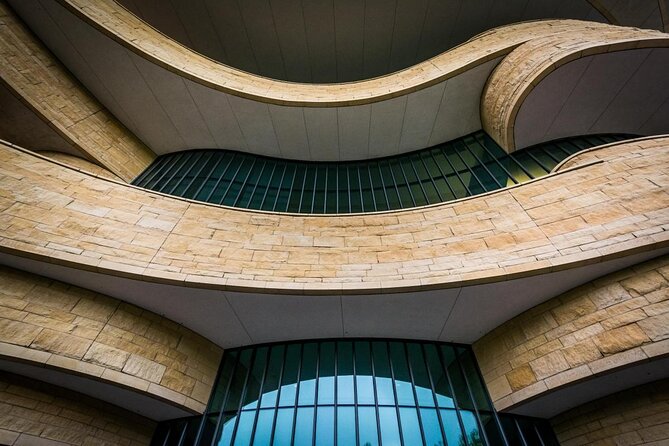
The tour begins outside the National Museum of the American Indian at 1 Bowling Green. The building is the former Alexander Hamilton Custom House, a Beaux-Arts structure completed in 1907.
You mainly use the exterior as a meeting point and opening setting, rather than touring the museum galleries. Your guide introduces the subject, explains the route, and places New York’s colonial development in context.
This is a useful start because the surrounding area was central to the city’s early trade. The tour does not treat slavery as an isolated topic. It shows how labor, shipping, commerce, government, and urban growth were connected.
Allow a little extra time to find the group. Bowling Green is in a busy part of Lower Manhattan, and the meeting point is near public transportation. The tour is conducted in English, with a mobile ticket, and the group can include up to 30 people.
Battery Park and the city’s arrival point
The first major walk takes you through Battery Park. The Battery is often treated as a pleasant waterfront park with views toward the harbor, but it also carries more than two centuries of New York history.
Before Ellis Island became the best-known entry point for newcomers, people arriving from Europe and elsewhere came through this part of Manhattan. Your guide uses the setting to discuss movement, arrival, freedom, and the different meanings those words had for different groups.
This stop is brief, around 10 minutes, so do not expect a long park tour. Its value comes from the larger story. New York was a meeting place for immigrants, merchants, enslaved people, free Black residents, abolitionists, and people seeking a way north.
The waterfront setting also helps you picture Manhattan as a working port rather than only a modern business district. Still, the stop is mostly about listening. You will not enter a major attraction here, and the tour does not include an admission ticket.
Fraunces Tavern and Revolutionary New York
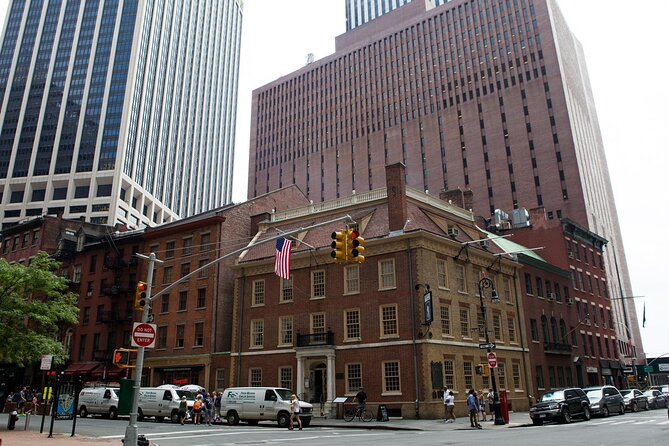
The route continues to Fraunces Tavern, visited from the exterior. The site played an important part before, during, and after the American Revolution.
This is one of the places where the tour broadens beyond the Underground Railroad. New York’s struggle for independence, its commercial life, and its treatment of enslaved and free Black people all overlap here.
You may want to return to Fraunces Tavern after the tour. The tour includes the site as part of the walking narrative, but not a museum admission. One useful option is to treat this stop as a pointer to a separate visit, especially if you enjoy Revolutionary-era history.
The guide’s explanation is what gives this place meaning. Without that context, it is easy to see only an old tavern building and move on. With the story, you begin to notice how many layers of American history sit within a few blocks.
More New York City Tours:
- NYC: SUMMIT One Vanderbilt Tickets
★ 4.7 · 51,195 reviews - NYC: Empire State Building Tickets – Observatory & Museum
★ 4.7 · 25,757 reviews - New York City: Statue of Liberty & Ellis Island with Ferry
★ 4.6 · 18,683 reviews - New York City: American Museum of Natural History Ticket
★ 4.5 · 15,447 reviews
Wall Street and the former slave market
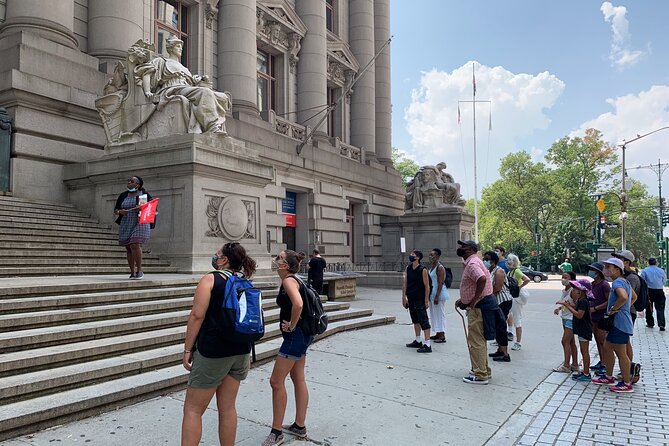
Wall Street is the tour’s most challenging stop for many people. The street is now associated with stock exchanges, banks, and global finance. Your guide explains that an actual wall once ran here from 1685 to 1699, and that enslaved people helped build it.
The tour also points to the former site of New York’s first slave market. This is an important correction to the usual tourist picture of Lower Manhattan. The district’s wealth and power were tied to systems that included forced labor and the buying and selling of human beings.
I find this section especially useful because the physical surroundings can seem so familiar. You may have walked Wall Street before and focused on architecture, finance, or famous photo spots. The tour adds a harder question: who built this city, who profited from it, and who was denied freedom?
The Wall Street portion lasts about 30 minutes, making it one of the longer stops. That gives the guide room to explain New York’s role rather than treating slavery as a quick side note. It can also mean a lot of stationary listening on a public sidewalk, so comfortable shoes and warm layers matter.
Foley Square and the human stories behind the history
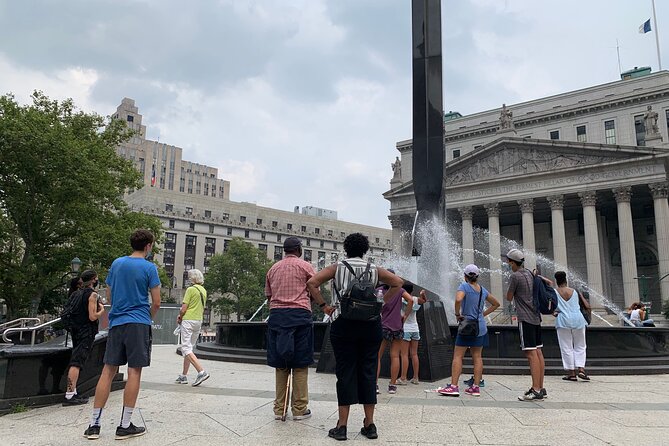
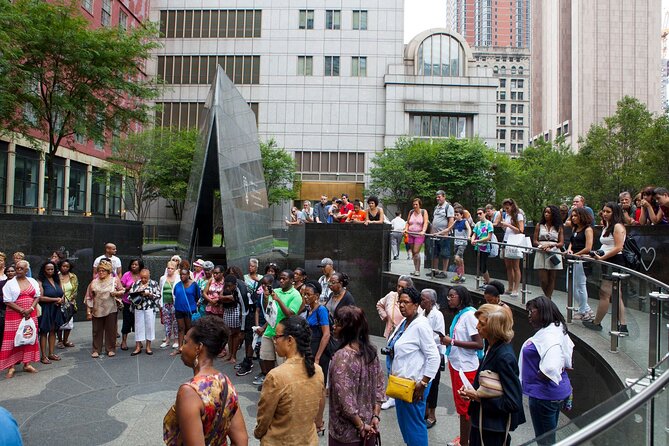
At Foley Square, the guide discusses Triumph of the Human Spirit, a sculpture honoring the presence of enslaved people in New York.
Public art can help give shape to a subject that otherwise remains abstract. Dates and laws matter, but the sculpture directs your attention back to human beings, their endurance, and the lasting effects of slavery.
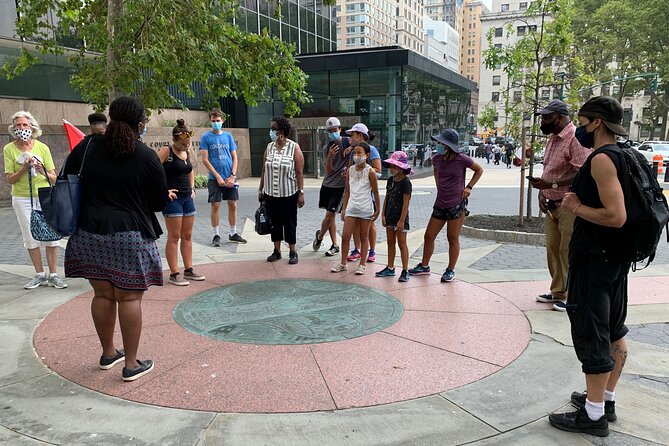
This is another short outdoor stop, about 15 minutes. Depending on conditions at the time of your visit, you might spend much of it listening near the street rather than examining a large collection of objects.
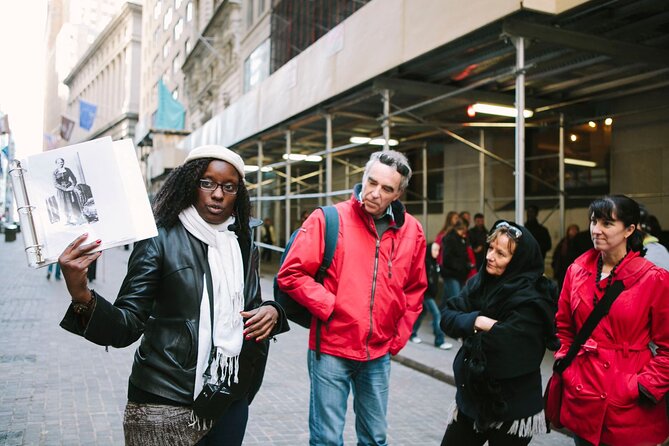
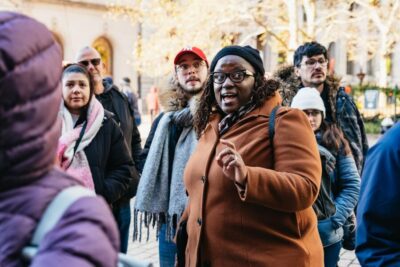
The guides are the heart of this part of the tour. Several have used photographs of historical figures and places to help explain who was involved. Guides named Ludie, Maia, and Sean have been singled out for bringing strong communication skills and a personal sense of purpose to the subject. Guide assignments can change, but the use of visual material has been a helpful feature.
African Burial Ground National Monument
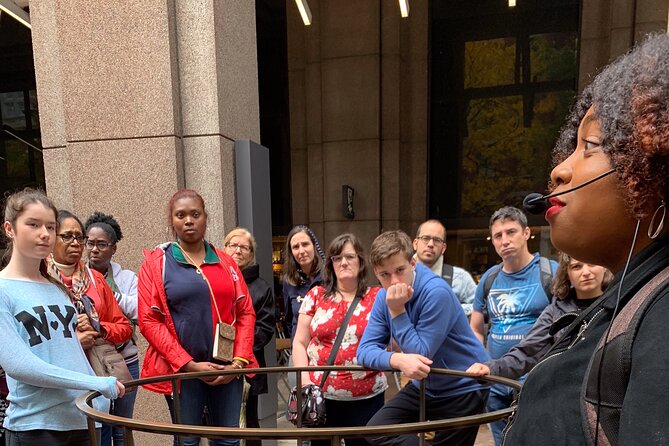
The tour finishes at African Burial Ground National Monument, at 290 Broadway. This is the oldest and largest known excavated burial ground in New York connected to enslaved Africans.
For many people, this is the most moving part of the route. The memorial gives you a quiet place to think about the people whose lives were often reduced to labor records, property documents, or brief mentions in official accounts.
The guide explains the site and the meaning of its memorial design. You may also learn how symbols carved into the monument relate to the people remembered there. The visit is included, and there is no admission charge.
The tour ends here, rather than returning you to Bowling Green. That is helpful if you plan to continue north through Lower Manhattan, but you should account for the one-way route when planning the rest of your day.
Construction or temporary closures can affect what you see at the memorial. On one recent occasion, parts of the outdoor area were blocked, with the indoor museum used instead. If the exterior is restricted during your visit, the experience can feel less complete, but the site still provides an important conclusion.
What the tour is really like on foot
This is a moderate walking experience, not a strenuous hike. The route covers several Lower Manhattan sites over 2.5 hours, and the tour stays near public transportation.
The bigger issue is not distance alone. It is the amount of standing while the guide speaks. One person found the long talks at street corners tiring, and another could not finish in cold, rainy, windy weather. That is useful advice, especially because the tour requires good weather and may pause outdoors rather than moving continuously.
Wear comfortable shoes. Bring water in warm weather and layers in cold weather. Rain or snow can make the experience less pleasant, and poor conditions may lead to cancellation.
Hearing clearly matters. A past participant had trouble following a guide without enough amplification, and the company indicated that a microphone would be provided for that guide. If the group is spread out or street noise is heavy, move closer to the guide early rather than missing the opening explanations.
Is $49 a fair price?
At $49 per person, this is a reasonable price for a focused two-and-a-half-hour guided walk in Manhattan. You are paying for interpretation, not admission to a chain of museums or buildings.
The value is strongest if you want to understand how the locations connect. Walking from Bowling Green to African Burial Ground with a guide gives you a framework that would be difficult to build from plaques alone. You also save time researching which sites relate to slavery and the Underground Railroad.
The value is weaker if you expect dramatic interiors, many artifacts, or constant movement. Several stops are exterior locations, and some historical sites are marked by a monument or a story rather than a preserved building.
At $49, I would book it for the guide’s context and the route. I would not book it expecting an attraction-heavy sightseeing tour.
Who should book this experience?
This tour is a strong choice for history-focused visitors, educators, students, and New Yorkers who want to see familiar streets differently. It also suits anyone reading about slavery, abolition, or the Underground Railroad and looking for a physical connection to the subject.
It can work well for families with older children, but the subject is serious and the walking format requires attention. Younger children may find the long talks and difficult material demanding.
The tour also makes sense for first-time visitors who have already seen the major Lower Manhattan sights. Instead of repeating the usual financial district story, it adds people and events that are often left out.
You should think twice if you dislike outdoor walking, cannot comfortably stand for long stretches, or want a tour built around indoor exhibits. The subject is valuable, but the format is not for everyone.
Booking, weather, and cancellation details
You receive confirmation when you book, and the experience is offered in English. Service animals are allowed, and the route is near public transportation.
Free cancellation is available up to 24 hours before the start time. Cancellations made less than 24 hours ahead are not refunded, and late changes are not accepted.
The tour requires suitable weather and a minimum number of participants. If the company cancels because of weather or insufficient bookings, you are offered another date or experience, or a full refund. A winter cancellation was attributed to a forecast snowstorm, so keep this possibility in mind when building a tightly scheduled sightseeing day.
Should you book the New York City Slavery and Underground Railroad Tour?
Book it if you want a serious, place-based history lesson that connects Wall Street, colonial Manhattan, abolition, and African Burial Ground. The guides are the main strength, with names such as Ludie, Maia, and Sean praised for strong storytelling, visual aids, and a direct approach.
Skip it if you want a fast-moving tour with lots of interiors and objects to see. You will spend plenty of time listening outdoors, and construction or weather can affect the route.
For the right audience, $49 buys more than a walk through Lower Manhattan. It gives you a clearer understanding of how New York’s wealth, streets, and public memory were shaped, and why the African Burial Ground deserves a place on your itinerary.
FAQ
Where does the tour begin?
The tour begins outside the National Museum of the American Indian, at 1 Bowling Green, New York, NY 10004.
Where does the tour end?
The tour ends at African Burial Ground National Monument, 290 Broadway, New York, NY 10007.
How long does the tour last?
The walking tour lasts approximately 2 hours and 30 minutes.
What places are included on the route?
The route includes the National Museum of the American Indian exterior, Battery Park, Fraunces Tavern exterior, Wall Street, Foley Square, and African Burial Ground National Monument. It also covers New York’s first slave market and the site of the city’s first African-American church.
Is admission included?
The tour includes a local guide and the historical interpretation. Admission to the National Museum of the American Indian and other paid attractions is not included. African Burial Ground National Monument and Foley Square are listed as free.
How large is the group?
The maximum group size is 30 participants.
What happens if the tour is canceled?
If poor weather or an insufficient number of participants causes cancellation, you are offered a different date or experience, or a full refund. You can cancel for a full refund up to 24 hours before the start time.
Recently added in New York City
- NYC: Midtown Hands-On Bagel Baking Class★ 5.0 · 12 reviews
- Personalize Sightseeing Tour★ 5.0 · 92 reviews
- Central Park Pedicab Tour with Guide★ 5.0 · 63 reviews
- Central Park Pedicab Guided Tour★ 5.0 · 17 reviews
- Photographer, Professional Photo shoot – New York★ 5.0 · 16 reviews
- Official Central Park Pedicab Ride ( UP TO 3 PERSONS )★ 5.0 · 4 reviews
- JFK or LGA package only (Round trip transfer plus VIP Contrasts)★ 5.0 · 3 reviews
- Official Central Park Pedicab Tours★ 5.0 · 35 reviews
NYC Subway and Underground Tours, compared.
History of Slavery & Underground Railroad Walking Tour
Read our review →

Underground Subway Guided Tour with Local New Yorker
Read our review →

New York 8 Hour Main Attractions Tour with City Bus/Subway
Read our review →

Browse the lists this tour appears in